


A jar of raw honey is more than a simple sweetener; it's a liquid map of a landscape captured in a single, fleeting moment of bloom. Much like a fine vintage wine, the most exquisite honeys of the world are defined by their terroir. This is the unique marriage of soil, climate, and floral source that creates a flavor profile found nowhere else on Earth. You might feel overwhelmed by the sheer variety of golden hues on the shelf. Perhaps you worry about the 4% adulteration rate recently reported in global honey supplies. It's natural to want absolute certainty when you're seeking something so pure and untouched.
We believe that your search for the perfect nectar is a journey of both health and heritage. Whether you're drawn to the ancient, medicinal potency of Yemeni Sidr or the delicate, floral elegance of White Mountain Honey, you deserve to feel confident in the authenticity of your purchase. This guide will demystify the nuances of global nectars and teach you how to identify truly raw, artisanal varieties. You'll learn how to select a signature honey that resonates with your palate and elevates your daily wellness rituals.
Key Takeaways
- Understand how terroir shapes the soul of every jar. You'll learn how geography and climate create the distinct flavor profiles found in remote regions.
- Master a connoisseur’s framework for selecting the finest honeys of the world. Find the perfect balance between light, floral varieties and dark, medicinal nectars.
- Protect your purchase by learning the hallmarks of authenticity. We'll show you how to identify raw, unfiltered honey and why natural crystallization is a mark of true quality.
- Elevate your daily rituals with expert pairing tips. Discover how to match rare global varieties with artisanal foods to transform a simple snack into a sensory journey.
What Defines 'Honeys of the World'? Understanding Global Terroir
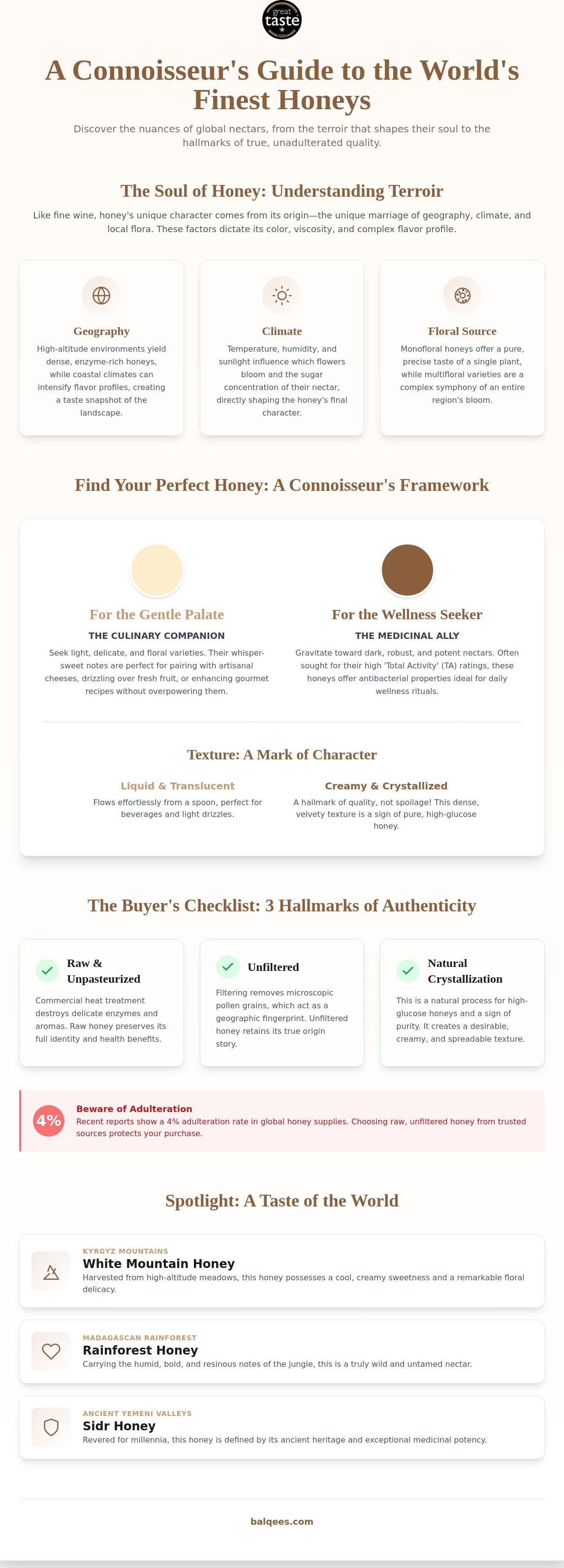
To the uninitiated, honey is a simple pantry staple. To the connoisseur, it's a sensory archive. The concept of terroir is often reserved for the world of viticulture, yet it's the silent architect behind every jar in the honeys of the world collection. Terroir is the unique marriage of geography, climate, and local flora. It's the reason why a harvest from one valley tastes fundamentally different from another just a few miles away. These environmental factors dictate the honey's color, viscosity, and chemical complexity.
Consider the vast differences in global environments. A honey harvested from the high-altitude meadows of the Kyrgyz mountains possesses a cool, creamy sweetness and a floral delicacy. In contrast, a Madagascan rainforest honey carries the humid, bold, and resinous notes of the jungle. While a comprehensive overview of honey provides the technical foundation of its production, it's the terroir that provides the soul. The distinction between monofloral and multifloral varieties also plays a vital role. Monofloral honeys are a masterclass in precision, where bees forage predominantly from a single plant species. Multifloral honeys are a complex symphony, capturing the diverse botanical spirit of an entire season in a specific region.
The Role of Floral Sources and Geography
Geography dictates the very texture and life of the nectar. High-altitude environments produce honeys with greater density and often higher enzyme content. The bees in these regions must adapt to thinner air and colder temperatures, which influences the nectar they collect. Coastal climates introduce subtle moisture variations that can intensify flavor profiles compared to their inland counterparts. Rare artisanal honey is, by its very nature, a limited-run product. It's a snapshot of a specific ecosystem that can never be perfectly replicated. When you taste a rare variety, you're tasting a moment in time that's been meticulously preserved by the hive.
Why 'Raw' is Non-Negotiable for Global Varieties
To experience these regional nuances, the honey must remain untouched. Commercial heat treatment, or pasteurization, is a form of sensory erasure. It destroys the delicate enzymes and volatile aromatic compounds that define a honey's origin. Filtering is equally damaging. It removes the microscopic pollen grains that act as a geographic fingerprint. Without these elements, the honey loses its identity and its health-giving properties. For a deeper look at these differences, explore our guide on Raw Honey vs Commercial Honey. Purity isn't just a preference; it's the only way to respect the craft of the hive and the integrity of the honeys of the world.
A Connoisseur’s Framework: How to Choose Your Global Honey
Selecting a rare nectar is an exercise in sensory awareness. It's a personal dialogue between your palate and the landscape that produced the harvest. When exploring the vast landscape of the honeys of the world, you must first decide whether you are seeking a culinary companion or a medicinal ally. This choice dictates the entire profile of your selection. A honey intended for a morning wellness ritual requires a different character than one destined to glaze a holiday roast.
Texture is often the first attribute you notice. Do you prefer a honey that is liquid and translucent, flowing effortlessly from a spoon? Or do you gravitate toward the velvet-like consistency of a creamy, crystallized variety? These textures are a natural result of the sugar composition and the specific flowers the bees visited. High-glucose honeys tend to crystallize more rapidly, creating a dense, spreadable texture. This is a hallmark of quality, not a sign of spoilage. It offers a structured mouthfeel that lingers longer on the tongue, allowing you to savor the complexity of the nectar.
If your goal is wellness, the flavor profile often shifts toward the dark and robust. These varieties are frequently sought for their 'Total Activity' (TA) ratings. This metric measures the combined peroxide and non-peroxide activity within the honey, indicating its antibacterial potency. A higher TA number signifies a more potent profile. If you are looking for specific health benefits, these markers are your most reliable guide to finding a truly functional nectar. If you are ready to begin your journey, you can explore our curated global collection to find a variety that resonates with your needs.
Light and Delicate: For the Gentle Palate
Light honeys are the whisper of the beehive. They are often pale straw or light golden in color, offering notes that are fruity, floral, and bright. These are the ideal choices for sweetening a delicate white tea or a morning bowl of yogurt without overpowering the other ingredients. A standout variety is Madagascar Lychee honey. It possesses a soft, rose-like aroma and a clean, citrusy finish that feels like a summer breeze in a jar. It is a perfect entry point for those new to artisanal honeys.
Bold and Robust: For the Adventurous Palate
On the opposite end of the spectrum lie the heavyweights. These honeys are earthy, woody, and occasionally carry a hint of smoke or bitterness. They are intended for those who appreciate a complex, lingering taste that demands attention. Madagascan Niaouli is a prime example, known for its intense, almost savory notes. Similarly, Raw Black Beech Honey Dew offers a rich, malt-like depth that is entirely unique. These robust nectars are best enjoyed alongside aged cheeses or as a deliberate, standalone spoonful to ground your morning routine. Understanding these distinctions is the first step in mastering the honeys of the world.
Spotlight on the 'Honeys of the World' Collection
Every jar in the Balqees collection is a vessel of history. We don't simply source honey; we seek out stories. Our honeys of the world collection is the result of years spent building relationships with artisanal beekeepers who work in some of the most remote corners of the globe. From the windswept slopes of the Mediterranean to the rainforests of Madagascar, these nectars represent a direct link to the earth. The price points reflect this arduous journey. Harvesting in these regions is often dangerous and always labor-intensive. It requires a deep respect for the rhythm of the seasons and the health of the hive. You aren't just buying a sweetener; you're supporting a lineage of craftsmanship.
Why settle for one origin? We often encourage connoisseurs to curate a 'Honey Flight.' By sampling several small jars from different regions, you can directly compare how the soil of Greece differs from the high-altitude flora of the Himalayas. It's the ultimate education in sensory terroir. It allows you to experience the full spectrum of the honeys of the world from the comfort of your home, turning a simple tasting into a global expedition.
The Alpine Purity of White Mountain Honey
This is honey in its most ethereal form. Sourced from the pristine, high-altitude meadows of the Tien Shan mountains, White Mountain Honey is celebrated for its startling, snow-white color. Its texture is exceptionally creamy, almost like a fine frosting, with delicate undertones of vanilla and wild herbs. Beyond its beauty, the White Mountain Honey benefits include a high concentration of antioxidants and enzymes, making it as functional as it is delicious. It's a testament to the purity of the alpine air.
The Mediterranean Excellence of Greek Sidr
While many associate the Sidr tree exclusively with the Arabian Peninsula, Greece offers a sophisticated European alternative. Greek Sidr honey has a thicker, more resinous consistency than its Yemeni counterpart. It carries a deep, malty flavor profile with hints of toasted nuts and dark caramel. It's a robust choice for those who want the legendary benefits of Sidr with a unique Mediterranean twist. It pairs beautifully with aged cheeses or thick, traditional yogurt.
Exotic Treasures: Madagascan and Himalayan Varieties
Our search for the exceptional often leads us to the most biodiverse regions on the planet. Madagascan Niaouli is a true medicinal powerhouse. It possesses a unique, slightly savory edge that sets it apart from traditional sweets. In the same region, we find Mokarana Raw Honey, a rare treasure for those seeking a floral signature that is both bright and complex. For the ultimate in wild purity, Himalayan Honey remains unsurpassed. Sourced from bees that forage in some of the world's last untouched wilderness, it offers a wild floral complexity that is impossible to replicate in a commercial setting.
A Buyer’s Checklist for Authenticity and Quality
A jar of honey should be a transparent window into a landscape. Unfortunately, the global market is often clouded by ambiguity. When browsing for the finest honeys of the world, your first line of defense is the label. Look for the words 'Raw' and 'Unfiltered.' Avoid anything simply labeled 'Pure.' While it sounds innocent, 'pure' often masks a product that has been pasteurized and stripped of its vital character. True quality reveals itself through texture. If a honey has turned solid or grainy, don't discard it. Natural crystallization is a biological proof of life. It shows the nectar hasn't been heat-treated into a sterile, sugary syrup.
Trust your nose. Real raw honey carries a distinct floral or earthy scent that mirrors its origin. If it smells only of generic sweetness, it likely lacks the botanical complexity of a true artisanal harvest. Specificity in origin is equally critical. A label claiming to be a 'Product of multiple countries' is a red flag for blending. Seek out jars that name a specific region, like the Tien Shan Mountains or the Do'an Valley. This level of detail ensures the honey's geographic fingerprint remains intact.
Sensory Indicators of Premium Honey
You can verify your purchase with a simple dissolve test at home. Real honey is dense. If you drop a spoonful into a glass of water, it should sink to the bottom and remain intact rather than dissolving instantly. You might also notice a fine layer of froth or tiny bubbles at the top of the jar. This isn't a defect; it's a sign of active, natural enzymes that are preserved only in raw varieties. While color varies, remember that darker hues often indicate a higher mineral content, though they aren't inherently 'better' than their lighter counterparts. It's simply a different expression of the earth's minerals.
Avoiding Common Global Sourcing Mistakes
The threat of 'honey laundering' is a significant concern for the modern connoisseur. In 2025, FDA sampling revealed a 4% adulteration rate in both domestic and imported honey supplies. This often involves blending high-quality nectar with cheap corn or rice syrups to increase volume. To avoid these traps, prioritize artisanal brands that maintain direct relationships with beekeepers. This transparency ensures that the story on the label matches the liquid in the jar. For more detailed steps on verifying your harvest, read our guide on How to Identify Pure Honey.
When you're ready to experience the difference that true transparency makes, shop our verified collection of raw nectars and find a variety that speaks to you.
How to Integrate Global Honeys into Your Lifestyle
Integrating the diversity of the honeys of the world into your home is more than a culinary choice. It's a commitment to a slower, more intentional way of living. We call this the 'Honey Ritual.' It begins by setting aside a moment each morning to savor a specific regional variety. This isn't just about sweetness. It's about grounding yourself. This appreciation for cultural heritage and authentic taste is similar to the experience of enjoying the Best Indian Food in Hayward, CA | Favorite Indian Restaurant | Indian Food near me, where traditional recipes are preserved. A single spoonful of Raw Yemeni Sidr Do'ani Honey acts as a potent wellness booster. It supports your immunity through a tradition that spans generations. By choosing a different origin each week, you keep your palate engaged and your body nourished by varying mineral profiles.
- Morning Vitality: A spoonful of Sidr or Raw Honey & Ginseng Fusion for sustained energy.
- Evening Calm: A drizzle of White Mountain Honey in warm chamomile tea.
- Culinary Flair: Pairing Yemeni Wild Flower Honey with sharp gorgonzola or aged cheddar.
Beyond the morning spoon, these nectars belong at the center of your table. Rare honeys are the secret language of a perfect host. They transform a standard charcuterie board into a narrative of global travel. Imagine the conversation that sparks when guests compare the malty depth of a Greek harvest against the resinous bite of a Madagascan rainforest honey. These pairings aren't accidental. They're a symphony of flavors that elevate artisanal ingredients to something extraordinary. You're not just serving food; you're sharing an ecosystem.
To complement these global nectars at your next event, consider the authentic, homemade Bengali catering from Ahare Bahare by Sumana, which brings a similar level of heritage and tradition to the table.
Pairing Guide: From Tea to Table
Precision is key when matching honey with your favorite infusions. Light, high-altitude nectars like Lychee honey are the perfect partners for delicate green teas. Their floral brightness won't overshadow the leaves. For food, pair these lighter varieties with soft, creamy cheeses like Brie or fresh goat cheese. Conversely, the dark, brooding notes of Niaouli or Black Beech Honey Dew require a partner with equal weight. Match them with robust black teas or aged, salty cheeses like Manchego. For a deeper look at these combinations, explore our Best Honey for Tea guide.
Gifting the World in a Jar
Sharing these nectars is an act of deep respect. Whether it's for Eid, a wedding, or a corporate milestone, gifting a honeys of the world set is a gesture that transcends the ordinary. It offers the recipient more than a product; it gives them an education in taste and heritage. You're inviting them to become a part of a global story of beekeeping and preservation. It's a gift that lingers long after the jar is empty. If you're ready to share this journey with someone special, you can browse the full Honeys of the World collection at Balqees to find the perfect selection.
Begin Your Global Sensory Journey
The world of artisanal nectar is a vast landscape of sensory discovery. By mastering the nuances of terroir and the hallmarks of raw, unfiltered purity, you've transitioned from a casual consumer to a true connoisseur. You now possess the framework to select the honeys of the world that align with your unique taste and wellness needs. Every jar we offer is a journey of heritage and health, sourced directly from artisanal beekeepers who respect the ancient rhythms of the hive. This commitment ensures that the liquid gold in your pantry remains as potent and pure as the day it was harvested.
Whether you are seeking a medicinal ally or a culinary masterpiece, the right nectar has the power to transform your daily rituals into moments of profound connection. We invite you to Explore the Honeys of the World Collection and begin your own odyssey. Your next favorite harvest is waiting to be found.
Frequently Asked Questions
What is the rarest honey in the world?
White Mountain Honey and Yemeni Sidr are widely considered the rarest nectars due to their limited harvest windows and remote origins. White Mountain is gathered from high-altitude alpine meadows during a fleeting summer bloom. Yemeni Sidr is harvested from ancient trees in secluded valleys. These varieties are the crown jewels of any collection, prized for their exceptional purity and the difficult, artisanal methods required to bring them to market.
Does honey from different countries really taste different?
Yes, the flavor of honey is a direct reflection of the local flora and specific soil chemistry of its region. Just as a fine wine possesses terroir, honey carries the unique botanical fingerprint of the blossoms the bees visited. This geographic diversity is what makes exploring honeys of the world such a rewarding sensory experience. A rainforest harvest from Madagascar will always taste fundamentally different from a Mediterranean meadow nectar.
Why is some honey white while others are black?
The color of honey is primarily determined by the mineral content of the soil and the specific nectar sources. Light, almost white honeys like our White Mountain variety come from specific high-altitude flowers and often have a creamy texture. Darker, near-black honeys typically possess a much higher mineral concentration and come from sources like forest honeydew. Color is a visual cue for the honey's flavor intensity and nutritional profile.
Is raw honey from other countries safe to eat?
Raw honey is safe and highly beneficial when it's sourced through artisanal beekeeping practices that prioritize purity and transparency. The key is knowing the exact origin of your jar. We work directly with beekeepers to ensure the honey remains untouched by industrial heat or filtration. This meticulous handling preserves the natural enzymes and pollen that make raw honey a functional wellness food, regardless of which corner of the globe it comes from.
How should I store my global honey collection?
Store your jars in a cool, dry place away from direct sunlight to preserve the delicate enzymes and complex flavor profiles. It's best not to refrigerate your honey, as cold temperatures can cause it to crystallize more quickly. Keep the lids tightly sealed to prevent the nectar from absorbing moisture or kitchen odors. When handled with care, your collection of honeys of the world will maintain its exceptional quality and character for years.
What is the best way to taste honey like a connoisseur?
Start by observing the color and clarity, then inhale the aroma to identify the primary floral or earthy notes. Take a small spoonful and let it dissolve slowly on your tongue without swallowing immediately. Notice the texture, the initial sweetness, and the lingering aftertaste. Cleanse your palate with a slice of green apple or a sip of sparkling water between different varieties to fully appreciate the unique nuances of each regional harvest.


