


That perfectly clear jar on the shelf isn't a sign of purity; it's often the mark of a honey that's been stripped of its soul. When exploring the landscape of filtered vs unfiltered honey UAE connoisseurs must look beyond the surface. True honey is a living, breathing tapestry of the landscape it was born from. By removing the tiny particles of pollen and propolis through heavy processing, industrial filtration sacrifices the medicinal potency that makes this ancient nectar so revered.
You've likely felt the confusion of "raw" versus "unfiltered" labels, fearing that your daily spoonful involves nothing more than a heat-treated syrup. We're here to change that. You'll discover the essential differences that define a truly potent honey, ensuring you source only the most nutrient-dense treasures found in the Emirates. We'll examine the restorative power of hive elements and provide a definitive framework for choosing authentic Yemeni Sidr honey with total confidence.
Key Takeaways
- Learn the fundamental distinction between filtered vs unfiltered honey UAE markets offer, and why minimal straining is the only way to preserve the nectar's living essence.
- Understand why preserving bee pollen and propolis is vital for maintaining the antimicrobial and antioxidant properties inherent in pure honey.
- Gain the sensory skills to identify authentic honey through visual cues like natural cloudiness and the complex, volatile aromas of wild blossoms.
- Discover why patient, artisanal gravity straining is superior to high-pressure industrial filtration for protecting the honey's delicate molecular structure.
- Establish a clear framework for sourcing the world’s most potent nectars, such as Raw Yemeni Sidr Do’ani Honey, without compromising on purity.
The Essence of Purity: Understanding Filtered vs Unfiltered Honey
Honey is far more than a simple sweetener; it's a complex biological archive of a specific time and place. When we discuss The Essence of Purity, we're looking at the degree to which human intervention has altered the bee's work. True unfiltered honey is only lightly strained. This gentle process removes large debris, like wax particles or a stray bee wing, without stripping away the microscopic treasures that give honey its medicinal soul. It remains a living food, teeming with the enzymes and delicate compounds that nature intended.
There's a common visual misconception that honey should be as clear as amber glass. In reality, that crystal-clear appearance is often a sign of heavy processing. Cloudy honey isn't "dirty" or "spoiled." That haze is actually a concentrated cloud of nutrition. It contains the very elements that make honey a functional powerhouse rather than just another sugar. When exploring filtered vs unfiltered honey UAE enthusiasts are discovering that the most potent jars are often the most visually complex.
What Exactly is Filtered Honey?
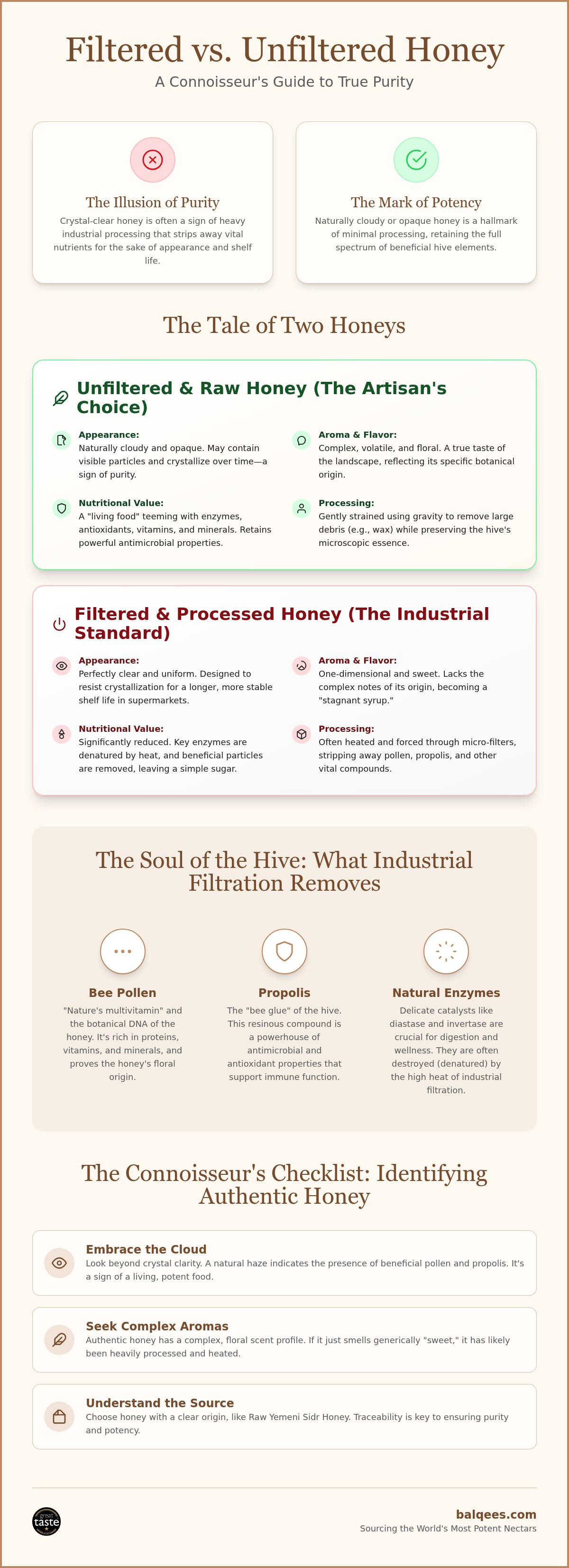
Industrial filtration is a high-pressure, high-temperature event. To achieve the uniform look required by global supermarkets, honey is often heated to high temperatures to make it more fluid. It's then forced through micro-filters, some smaller than 10 microns. This process effectively removes almost every trace of pollen. Why do producers do this? It's largely about shelf life. Clear honey doesn't crystallize as quickly, making it easier to manage in high-volume retail environments. However, this "perfection" comes at a heavy cost. By removing these particles, the honey loses its geographic identity and its status as a living food. The enzymes, like diastase, are often denatured by the heat, leaving behind a stagnant syrup that lacks the biological activity of the raw hive.
The Unfiltered Difference
At the other end of the spectrum lies the artisanal standard. Here, the focus is on preservation rather than presentation. Unfiltered honey is typically processed using gravity straining, a patient method that allows the honey to flow naturally while keeping the "hive’s fingerprint" intact. This includes:
- Bee Pollen: Tiny grains that act as nature's multivitamin.
- Propolis: A resinous "bee glue" with powerful antimicrobial properties.
- Natural Enzymes: Catalysts that support digestion and wellness.
The UAE market is increasingly demanding these unfiltered varieties because they offer a sensory experience that industrial honey can't match. When you taste an unfiltered nectar, you're tasting the volatile scents of the blossoms and the wild landscape. It's a connection to the earth that remains untouched and meticulously handled, ensuring that every spoonful delivers the full spectrum of the hive's benefits.
The Science of the Hive: What Filtration Removes and Why it Matters
The hive is a biochemical symphony. Every jar of honey should ideally reflect this complexity, yet the industrial drive for clarity often silences the most beneficial notes of this composition. When analyzing filtered vs unfiltered honey UAE standards, it's essential to understand that what is removed isn't "impurities," but rather the very bioactive compounds that define honey's value. Clarity in a jar is frequently a signal of a nutritional compromise.
Filtration typically relies on heat, which is the natural enemy of honey's enzymes. Diastase and invertase are delicate proteins that facilitate the unique health benefits of the nectar. According to The Science of Honey Processing, while some argue that basic processing preserves nutrients, the excessive heat and micro-filtration used to achieve commercial clarity can denature these enzymes. Without them, honey becomes little more than a shelf-stable sugar solution, lacking the "living" quality found in artisanal harvests. This enzymatic activity is what transforms a simple sweetener into a functional wellness tool.
Bee Pollen: The DNA of the Landscape
Pollen is more than just a byproduct; it's the botanical signature of the hive. It acts as nature's multivitamin, providing a concentrated source of protein, vitamins, and minerals that support immune function and reduce inflammation. Beyond nutrition, pollen serves as a forensic tool. It allows connoisseurs to trace the honey back to its specific floral origin. Filtered honey is often "anonymous" because the removal of pollen makes geographic tracing impossible. In contrast, our Raw Yemeni Sidr Do'ani Honey retains its natural pollen count, offering a direct link to the ancient, untouched landscapes of Yemen.
Propolis and Wax: The Protective Elements
Propolis, often called "bee glue," is a resinous substance bees use to seal and protect the hive. It's a powerhouse of antimicrobial and antioxidant activity. When honey is micro-filtered, these resinous particles are lost. This is a significant nutritional cost, as propolis is renowned for supporting respiratory health and strengthening the body's natural defenses. Similarly, microscopic wax particles contribute to the unique, velvety texture of unfiltered varieties. These elements work in synergy. They aren't flaws in the honey; they are the protective essence of the hive itself, meticulously preserved to ensure that every spoonful remains as potent as the day it was gathered.
The Connoisseur’s Evaluation: Identifying Real Honey in the UAE
Distinguishing between filtered vs unfiltered honey UAE varieties requires engaging all the senses. It isn't just about reading a label; it's about understanding the language of the hive. While industrial honey is engineered for visual perfection, artisanal honey is a reflection of the wild. To the untrained eye, a cloudy jar might seem imperfect. To the connoisseur, that haze is a hallmark of integrity, indicating the presence of suspended pollen and propolis.
One of the most persistent myths in the Emirates is that solid or grainy honey has "gone bad." This couldn't be further from the truth. Crystallization is a natural sign of life. It occurs when the glucose in the nectar separates from the water, often binding to the tiny particles of pollen found in unfiltered varieties. If your honey never sets, it's likely been overheated or micro-filtered to the point of biological stillness. Real honey is dynamic. It changes texture with the seasons, moving from a liquid gold to a thick, creamy butter without losing its nutritional value.
A Sensory Guide to Unfiltered Nectar
Sight is your first diagnostic tool. Hold the jar to the light. Unfiltered honey lacks a "glassy" or translucent appearance. You should see a gentle opacity and perhaps tiny specks of "honey dust" on the surface. These are the particles of wax and pollen that provide the honey's structural depth. Smell is equally revealing. When you open a jar of pure nectar, the aroma should be deep and complex. You're looking for the volatile scents of the blossoms, which can range from earthy and musky to bright and floral. If it smells only of simple sugar, the soul of the plant has likely been lost to processing.
The taste of unfiltered honey is a journey. It starts with a nuanced sweetness but ends with a lingering aftertaste. This "finish" is often where you'll detect the resinous notes of propolis or the slight bitterness of specific pollens. It's a full-bodied experience that coats the palate differently than a thin, filtered syrup.
Simple At-Home Purity Tests
If you're uncertain about a purchase, there are several ways to verify the quality. The Water Test is particularly effective. Drop a teaspoon of honey into a glass of water. Adulterated or heavily filtered syrups will begin to dissolve almost immediately. Pure, unfiltered honey is dense and cohesive; it will sink to the bottom and remain intact as a solid mass. You can also try the Thumb Test. Place a small drop on your thumbnail. Pure honey stays put, maintaining a rounded shape, while thinned or treated versions will spread or run off the edge.
Learning how to identify pure honey is an essential skill for anyone sourcing wellness products in the Emirates. These simple sensory checks bridge the gap between confusion and confidence, ensuring that your investment supports both your health and ancient beekeeping traditions.
Beyond the Label: Why Artisanal Gravity Straining Surpasses Industrial Processing
In the fast-paced world of global trade, time is often treated as an enemy. For the industrial honey producer, the goal is efficiency: moving thousands of liters from hive to bottle as quickly as possible. This industrial mindset stands in stark contrast to the "slow food" movement that defines artisanal apiculture. When we look at the debate of filtered vs unfiltered honey UAE consumers often find that the difference lies in the patience of the producer. Gravity straining isn't just a technique; it's a philosophy of respect for the honey’s natural structure.
Patience is the defining ingredient of purity. While industrial methods prioritize a clear, shelf-stable look, the artisanal path preserves the biological complexity that makes honey a medicinal marvel. By avoiding the aggressive interventions of mass production, we ensure that the nectar remains as the bees intended: a living, breathing reflection of the wild landscape.
The Industrial Filtration Process
To keep up with supermarket demand, industrial honey is often heated to temperatures as high as 70°C. This intense heat makes the nectar thin and watery, allowing it to pass through micro-filters at high speeds. While this facilitates rapid bottling, it triggers the formation of Hydroxymethylfurfural (HMF). This chemical compound is a primary indicator of heat damage and aging. UAE regulations are strict regarding HMF levels, as excessive heat effectively kills the honey’s soul. High-pressure pumps further shear the honey’s delicate molecules, resulting in a product that lacks the "terroir" or unique character of its origin. It becomes a generic sweetener rather than a biological treasure.
The Artisanal Path
Artisanal beekeepers choose a more difficult road. Instead of high-pressure pumps, they rely on gravity. This cold-pressed approach involves letting the honey flow naturally through a coarse mesh. It's a slow, rhythmic process that preserves the complex flavor profiles of rare honeys. This method ensures that the volatile aromatics of the blossoms remain trapped within the jar. Central to this path is the practice of sustainable beekeeping honey, where the health of the colony and the integrity of the environment take precedence over mass production.
Because this process respects the natural cycles of the bees, artisanal honey is a limited, seasonal luxury. It isn't something that can be infinitely scaled without losing its essence. Every batch is unique, reflecting the specific rainfall and floral bloom of that year. This commitment to minimal intervention is why we offer only the most pristine harvests. Experience the difference of a truly untouched nectar with our Raw Yemeni Sidr Do'ani Honey, harvested with the same reverence for tradition that has existed for centuries.
The Balqees Standard: Sourcing the World’s Most Potent Unfiltered Nectars
At Balqees, we view honey as a sacred gift from the natural world. Our philosophy is simple: zero compromise. We don't believe in stripping away the very essence that makes honey a healing force. When navigating the choice of filtered vs unfiltered honey UAE, our standard is the absolute preservation of the "living" element. We act as a bridge between ancient harvesting traditions and your modern lifestyle, ensuring that every jar remains untouched and meticulously handled. This commitment to purity isn't just about taste; it's about honoring the integrity of the hive.
The Rare Power of Yemeni Sidr
Known as "liquid gold," our Raw Yemeni Sidr Do'ani Honey is the jewel of our collection. In the UAE, Sidr honey is prized for its legendary medicinal properties and deep, mono-floral heritage. However, these benefits are only fully realized when the honey is kept in its unfiltered state. By retaining the natural pollen and propolis, we ensure the honey’s enzymatic activity remains at its peak. For those seeking to understand the deep history and science behind this nectar, we recommend exploring The Ultimate Guide to Raw Yemeni Sidr Do’ani Honey.
Beyond the Sidr trees, we also source the ethereal White Mountain Honey. This creamy, pale nectar is harvested from high-altitude blossoms and offers a completely different sensory profile. It's a vital addition to any connoisseur’s collection, providing a mild, floral sweetness while adhering to our strict standards of minimal intervention and zero heat-treatment.
Functional Blends and Unfiltered Purity
Purity provides the essential foundation for our functional wellness range. We use our raw, unfiltered base to create potent fusions like our Black Seed Fusion and Raw Honey & Ginseng Fusion. There's a powerful synergy between raw honey and these functional herbs. When the honey is unfiltered, it acts as a more effective carrier for the bioactive compounds in the black seed or ginseng, facilitating better absorption and efficacy. Choosing the right jar depends on your specific health goals, whether you're seeking immune support or a natural vitality boost.
Integrating these nectars into your daily wellness ritual is a simple yet profound act. A spoonful in the morning on an empty stomach allows the enzymes and antioxidants to work their best. It's about creating a moment of connection with the earth. We always advise our community to avoid adding unfiltered honey to boiling liquids. High heat will destroy the very nutrients we've worked so hard to preserve. Instead, enjoy it straight from the spoon or stirred into lukewarm infusions to maintain the full, potent spectrum of the hive's benefits.
Embracing the Hive’s Living Legacy
Choosing between filtered vs unfiltered honey UAE markets provide is a decision that impacts both your palate and your wellness. We've explored how industrial filtration often sacrifices the "hive's fingerprint" for the sake of supermarket clarity. By opting for unfiltered varieties, you preserve the vital bee pollen, propolis, and enzymes that define honey as a living food. True purity isn't found in a crystal-clear jar; it resides in the cloudy, textured depth of a nectar handled with reverence and patience.
At Balqees, we remain the guardians of these ancient traditions. Our commitment to artisanal beekeeper sourcing ensures that every batch of our heritage-rich Yemeni Sidr honey is treated with the respect it deserves. To guarantee the highest standards, every harvest is independent lab tested for purity, ensuring you receive only the most potent treasures of the hive. It's time to reclaim the authentic sensory experience of the wild.
Explore our collection of pure, unfiltered raw honey today.
Frequently Asked Questions
Is unfiltered honey safe to eat?
Unfiltered honey is perfectly safe and highly beneficial for healthy adults and children over the age of one. It remains a living food, teeming with the same natural enzymes and compounds found within the hive. Because it hasn't been subjected to industrial heat or chemical treatments, it retains its biological integrity. We ensure every jar meets rigorous purity standards, providing a safe way to enjoy nature's most potent nutrients.
Does unfiltered honey expire or go bad?
Pure honey doesn't expire and can remain edible for decades if stored in a sealed container. Its unique chemistry, characterized by a low moisture content and a naturally acidic pH, creates an environment where bacteria cannot survive. While unfiltered varieties may crystallize or change texture over time, this is a physical shift rather than a sign of spoilage. Simply warm the jar gently to return it to a liquid state.
Why does unfiltered honey look cloudy compared to supermarket honey?
The cloudiness you see is a visual testament to the honey’s nutritional density. This haze consists of microscopic particles of bee pollen, propolis, and wax that haven't been stripped away by micro-filters. In the debate of filtered vs unfiltered honey UAE consumers often find that the clearest jars are the most processed. This suspended "honey dust" is exactly what provides the complex flavor and medicinal benefits that industrial syrups lack.
Can I give unfiltered honey to children?
You can safely introduce unfiltered honey to children once they have reached 12 months of age. Before this milestone, infants shouldn't consume any form of honey due to the risk of botulism spores, which their developing digestive systems cannot yet handle. For older children, the natural pollen and antioxidants found in our raw harvests can be a wonderful, nutrient-dense addition to a balanced and healthy diet.
How should I store unfiltered honey in the UAE climate?
Proper storage in the Emirates involves keeping your honey in a cool, dry place away from direct sunlight. While you don't need to refrigerate it, you should avoid leaving jars in areas prone to extreme heat, such as near a window or stove. Heat can denature the delicate enzymes and diminish the honey's medicinal potency. A kitchen cupboard at room temperature is generally the ideal environment for maintaining its quality.
What is the difference between raw honey and unfiltered honey?
Raw honey refers to nectar that hasn't been heated beyond the temperature of the hive, preserving its enzymatic activity. Unfiltered honey specifically means the pollen and propolis haven't been removed through fine mesh or high-pressure systems. While the terms are often used together, they describe different aspects of processing. At Balqees, we prioritize both, ensuring our harvests are neither overheated nor stripped of their essential, hive-born particles.
Does filtering honey remove the pollen benefits?
Yes, industrial micro-filtration is specifically designed to remove pollen grains to achieve a clear, liquid appearance. This process strips the honey of its botanical DNA and its anti-inflammatory properties. When pollen is removed, the honey also loses its geographic traceability. By choosing unfiltered varieties, you ensure that these nutrient-dense grains remain in every spoonful, allowing you to benefit from the full medicinal spectrum of the local flora.
Why is unfiltered honey more expensive than filtered honey?
The higher cost reflects the patient, labor-intensive nature of artisanal beekeeping. Unlike industrial producers who use high-pressure pumps and heat to speed up bottling, we rely on slow methods like gravity straining. This "slow food" approach respects the natural cycles of the bees and the integrity of the environment. You aren't just paying for a sweetener; you're investing in a rare, seasonal luxury that prioritizes purity over mass production.


