


If liquid gold had a flavor, it would be the deep, caramel-rich essence of the Wadi Do’an. You've likely heard the whispers of its legendary status, yet the reality of the modern market is often less than golden. It's frustrating to seek out the world's finest nectar only to be met with vague labels, pasteurized blends, or sugary syrups masquerading as medicine. You deserve the clarity that comes with true connoisseurship. This guide will help you master the nuances of Raw Yemeni Sidr Do'ani Honey, transforming your search for purity into a journey of confidence.
We'll peel back the layers of tradition that define this rare harvest from the Hadramaut mountains. You'll learn why the Do’ani variety is the crown jewel of the Sidr family and how to spot the sensory markers of a truly raw, artisanal jar. From understanding its potent medicinal profile to navigating the complexities of sourcing in the UAE, we're here to act as your knowledgeable friend. By the end, you'll possess the expertise to choose honey that isn't just a sweetener, but a profound connection to heritage and health.
Key Takeaways
- Understand why the Hadhramaut region produces the world's most rare monofloral nectar and the ancient heritage behind the Sidr tree.
- Discover the biological difference between "living" honey and commercial alternatives. You'll see why Raw Yemeni Sidr Do'ani Honey must be cold-pressed to preserve its vital enzymes.
- Master the connoisseur’s checklist to identify authentic jars through sight and scent, focusing on the signature deep amber hue and medicinal herbal aroma.
- Explore practical ways to integrate this potent nectar into your daily routine, from morning gut health rituals to natural, low-glycemic energy boosts.
What Makes Raw Yemeni Sidr Do'ani Honey the 'Liquid Gold' of the Middle East?
It isn't just honey. It's a biological masterpiece. Raw Yemeni Sidr Do'ani Honey is a monofloral nectar harvested from the remote Hadhramaut region of Yemen. For centuries, it's been revered as "Liquid Gold." This isn't just about the shimmering amber color. It's about the labor, the heritage, and the sheer rarity of the harvest. To call it "raw" is to respect its living state. It's untouched, unheated, and unfiltered. This ensures that every enzyme and pollen grain remains intact, exactly as the bees intended. When you taste a spoonful, you're experiencing the desert's pure essence. Amidst a market of mass production, this honey stands apart. The bees only have a short forty-day window when the trees bloom in winter. This scarcity, combined with the difficult terrain of Yemen, creates a value that transcends typical grocery store finds. It's a rare gift from a landscape that demands resilience.
The Sacred Origin: The Sidr Tree (Ziziphus spina-christi)
The Sidr tree (Ziziphus spina-christi) is a resilient marvel. It thrives in the desert's harsh, arid soil, standing strong against the sun. Because few other plants flower during its bloom, the bees focus exclusively on its nectar. This creates a concentrated, medicinal profile found nowhere else. Ancient texts and religious traditions have praised this tree for millennia. It's more than a plant; it's a symbol of life and healing that's supported communities for generations. The bees' dedication to this single source is what gives the honey its monofloral purity. It's a connection to an ancient world that still exists today.
Understanding the 'Do'ani' Distinction
Not all Sidr honey is created equal. The "Do'ani" label refers specifically to Wadi Do'an, a valley in the Hadhramaut region. This valley has a unique micro-climate. The specific soil minerals and humidity levels here influence the honey's specific enzymes and deep, complex flavor. It's a geographical mark of excellence. You can compare it to a stamp of authenticity that guarantees a certain standard. While other regional Sidr honeys exist, the Do'ani variety is often considered the pinnacle. It's the result of a perfect harmony between the bees, the tree, and the unique earth of the valley. This specific terroir is what connoisseurs in the UAE look for when they seek the very best for their wellness rituals.
The Science of Raw Purity: Why Unprocessed Honey Matters
Raw honey is a living, breathing entity. When we speak of Raw Yemeni Sidr Do'ani Honey, we are describing a nectar that has never seen the inside of a pasteurization tank. Most commercial honeys found on supermarket shelves in the UAE are "dead" products. They've been heated to high temperatures to ensure they remain clear and liquid for months. This process, while convenient for mass retail, destroys the very essence of what makes honey a therapeutic powerhouse. In contrast, raw honey remains exactly as it was inside the hive, brimming with bioactive compounds that support your well-being. It is a snapshot of a moment in nature, preserved without interference.
The preservation of enzymes like diastase and invertase is only possible through cold-pressing. These delicate proteins are the catalysts for honey's antibacterial properties. When honey is unfiltered, it also retains micro-particles of propolis and bee pollen. These aren't impurities. They are the fingerprints of the Wadi Do'an landscape, providing a complex nutritional profile that processed alternatives simply cannot match. You might notice your honey becoming thick or grainy over time. This crystallization is often misunderstood as spoilage. It is, in fact, a hallmark of purity. It proves the honey hasn't been over-processed or diluted with syrups. It's nature's way of showing you that the honey is authentic and raw.
Enzyme Bioactivity and Medicinal Potency
Heat is the enemy of healing. Pasteurization strips away the high antioxidant levels that make Sidr Do'ani so legendary. By keeping the honey raw, we protect its bioactivity. Bioactivity is the honey's ability to interact with human health systems. This interaction is rooted in the traditional uses of the Sidr tree, which has been valued for its medicinal bark and leaves for centuries. The honey carries this botanical legacy directly to your spoon, offering a level of wellness support that processed sugars can't replicate.
The Artisanal Beekeeping Process
Authentic Yemeni honey depends on the integrity of the beekeeper. In the rugged mountains of Hadhramaut, beekeepers still use traditional, non-industrial methods that have remained unchanged for generations. They avoid the use of chemicals and antibiotics, ensuring the hive remains a pristine environment. The beekeeper acts as a guardian, moving the hives by hand to follow the blossoming Sidr trees. This slow, methodical approach is what maintains the "Raw" status of every jar. If you are looking to experience this untouched quality, you can explore our range of artisanal honeys to find the perfect jar for your home.
Raw Sidr Do'ani vs. Commercial Honey: A Practical Comparison
The price tag on a jar of supermarket honey in the UAE can be tempting. Yet, when you look closer, the true cost of "cheap" honey becomes clear. Most mass-market brands rely on industrial blending. They combine honeys from various regions and often dilute the final product with refined sugar syrups. This process creates a uniform, clear liquid that lacks character and life. In contrast, Raw Yemeni Sidr Do'ani Honey represents a commitment to purity. It's never stretched, never diluted, and never blended with inferior grades. You're paying for a concentrated dose of nature's best work, harvested under conditions that respect the hive. One is a processed commodity; the other is a medicinal heritage treasure.
In the UAE, where the market is flooded with options, discernment is your greatest asset. Authenticity isn't just a label. It's a measurable reality. By choosing a trusted artisanal source, you bypass the uncertainty of "honey laundering" and adulteration. This honey is a finite resource. The bees only produce a limited amount each season, making every jar a portion of a very small, precious harvest. When you hold a jar of authentic Sidr honey, you're holding the result of thousands of hours of flight and a culture of beekeeping that spans centuries.
Nutritional Density and Health Impact
The impact on your body is the most significant differentiator. Commercial honeys, often high in fructose and added syrups, can lead to sharp glycemic spikes. Raw Sidr honey offers a more balanced interaction with your system. It's naturally rich in minerals like iron, magnesium, and potassium, which are often absent in processed versions. The sensory experience is equally profound. While a blended honey offers a flat, sugary sweetness, the Do'ani variety presents a complex profile. You'll notice multi-layered notes of resin, wood, and a deep, herbal undertone that lingers on the palate. It's the difference between a synthetic fragrance and a garden in bloom.
The 'Real Price' of Authenticity
We often hear questions about why the price in AED is higher for Yemeni honey. To understand it, one must look at the journey from the valley to your home. Sourcing from the remote Wadi Do'an involves navigating rugged terrain and supporting traditional beekeeping families. It's a slow, labor-intensive process that can't be rushed or automated. Ensuring that every jar meets the highest standards also requires sophisticated laboratory testing. These tests confirm the absence of pesticides and verify the honey's unique chemical fingerprint. When you see the value, remember it reflects a chain of integrity. You aren't just buying a sweetener. You're investing in a wellness tool that's been protected at every step of its journey.
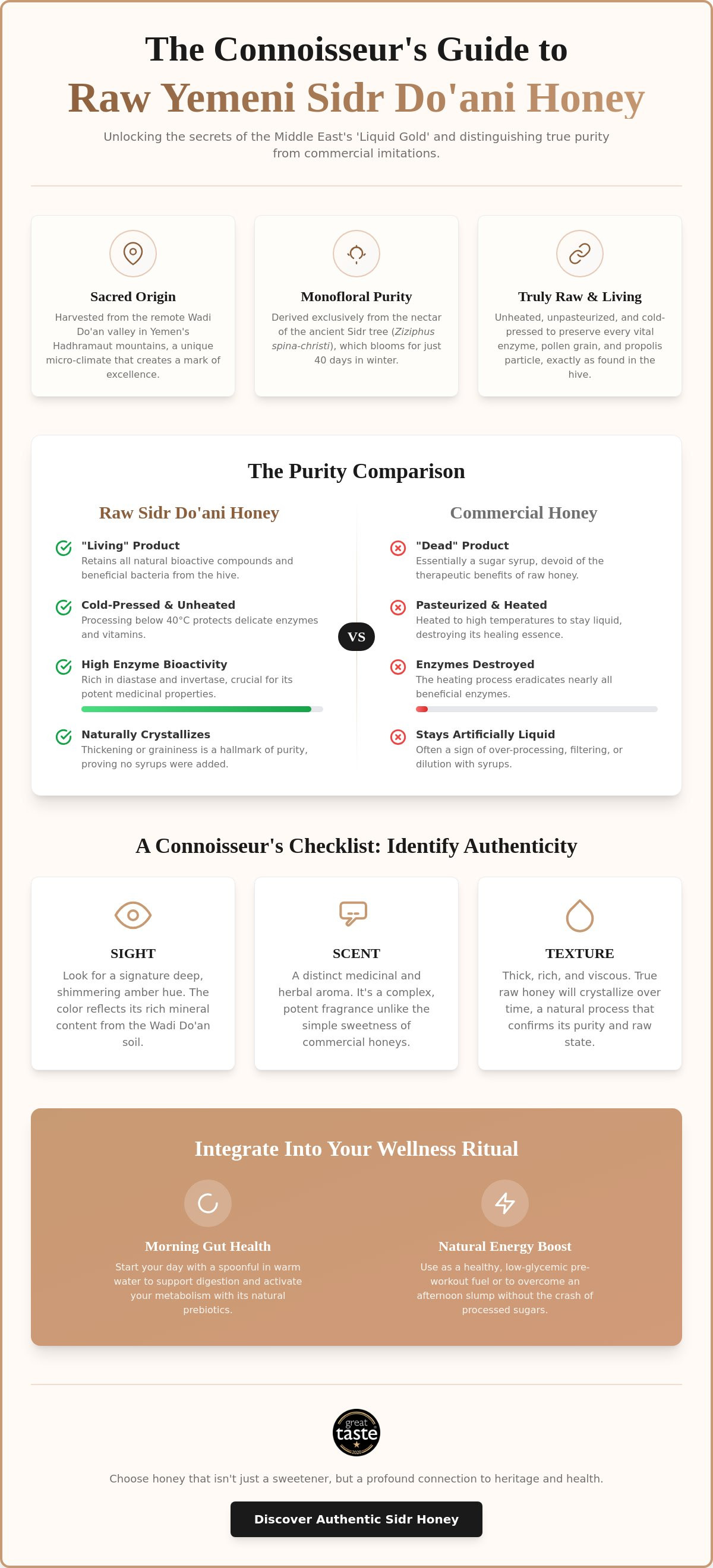
A Connoisseur’s Checklist: How to Identify Authentic Sidr Honey
How can you be certain the jar in your hand is the genuine article? In a market as vibrant as the UAE, the presence of various grades can make selection feel like a daunting task. Identifying Raw Yemeni Sidr Do'ani Honey is a visceral experience that engages every sense. You aren't just looking for a sweetener; you're looking for a biological fingerprint. Authenticity leaves clues in the color, the weight, and the way the nectar behaves when it leaves the spoon. By following a simple checklist, you can move from uncertainty to expertise, ensuring your investment in wellness is well-placed.
- The Sight Test: Hold the jar to the light. You should see a deep, glowing amber hue. The viscosity is key; it's a thick, heavy liquid that resists movement. When you tilt the jar, the honey should roll slowly, like molten lava.
- The Scent Test: Open the lid and inhale. Real Sidr honey doesn't smell like a field of flowers. It has a distinct, herbal, and slightly medicinal aroma. It's a scent that reminds you of the earth and sun-scorched wood.
- The Taste Test: The first note is buttery and rich. As it dissolves, look for a complex depth that ends with a subtle, peppery finish at the back of the throat. It shouldn't be a one-dimensional sugar hit.
- The Water Test: Drop a spoonful into a glass of cold water. Raw, pure honey is dense and won't dissolve instantly. It should sink to the bottom and remain intact as a solid lump until you stir it vigorously.
Sensory Profile of a Premium Jar
A true Wadi Do'an harvest carries a beguiling aroma that is almost impossible to replicate. The texture is exceptionally smooth, moving across the palate with a luxurious weight. While many honeys crystallize within weeks, authentic Sidr honey is famous for its stability. Because of its unique chemical composition and low moisture content, it remains liquid for much longer than other varieties. If your honey stays fluid and clear for months in the UAE heat, it's often a sign of its high-grade origin and raw state.
What to Avoid: Red Flags in Honey Shopping
Be wary of products labeled as "Sidr-flavored" or those that lack specific geographical data. Transparency is the hallmark of a trusted source. If a seller cannot provide laboratory certification or clear details about the harvest date, it's a significant red flag. Buying unverified honey from untrusted sources risks exposure to "honey laundering," where inferior syrups are passed off as premium nectar. To ensure you are receiving the highest quality, you can shop our certified Sidr collection and experience the difference that laboratory-verified purity makes.
Integrating Sidr Do'ani Honey into Your Daily Wellness Ritual
Owning a jar of this nectar is only the beginning. The true value of Raw Yemeni Sidr Do'ani Honey reveals itself through consistent, intentional use. It isn't a product to be hidden away for special occasions; it's a foundational element of a balanced lifestyle. By weaving this "living" food into your daily rhythm, you allow its bioactive properties to work in harmony with your body's natural cycles. Whether you're seeking a morning boost or an evening sanctuary, there's a ritual that honors the honey's potent heritage. Every drop of Raw Yemeni Sidr Do'ani Honey carries the energy of the sun and the resilience of the desert.
Many connoisseurs begin their day with a "Morning Ritual." Consuming a spoonful on an empty stomach, perhaps dissolved in a glass of room-temperature water, is a centuries-old practice for supporting gut health and digestion. For the active individual, it serves as an exceptional "Athletic Fuel." Unlike refined sugars that cause energy crashes, this honey provides a steady, low-glycemic source of vitality for your workouts. When the sun sets, an "Evening Calm" ritual can be found by pairing a small amount with a warm herbal infusion. It aids in recovery and signals to the body that it's time for restorative sleep.
Beyond personal use, there is the "Art of Gifting." In the UAE, sharing honey is a deeply respected tradition. A premium honey set isn't just a gesture of hospitality. It's a profound statement of care for the recipient's health. It's a gift that speaks of history, resilience, and the untouched beauty of the Yemeni landscape. It's a wish for longevity delivered in a jar.
Culinary Pairings for the Connoisseur
To truly appreciate the depth of Do'ani honey, try pairing it with artisanal cheeses like a sharp Manchego or a creamy Gorgonzola. The contrast between the savory fat and the medicinal sweetness is exquisite. You can also drizzle it over raw walnuts or use it as a refined glaze for fruit-based desserts. There is one non-negotiable rule: never heat raw honey above 40°C. High temperatures destroy the delicate enzymes and antioxidants that define its raw status. If you're adding it to tea, wait until the liquid is at a drinkable temperature to ensure the honey remains "alive."
The Balqees Commitment to Purity
Our journey at Balqees is rooted in a deep respect for the artisanal beekeepers of Hadhramaut. We act as a bridge, bringing you honey that is sourced directly from the source with total transparency. We don't believe in industrial processing. We believe in "living" honey and fusions that maintain their natural integrity. Every jar we offer is a testament to this commitment. We invite you to explore the Balqees collection to find your first jar and begin your own journey into the world of authentic Yemeni nectar.
Elevate Your Wellness with the Gold of Wadi Do'an
Choosing a jar of honey is an act of stewardship for your health and a nod to a thousand-year-old tradition. You now possess the tools to look beyond the label. You understand that true quality is found in the raw, cold-pressed state of the nectar and the specific micro-climate of the Yemeni valleys. By prioritizing laboratory-verified purity and artisanal methods, you ensure that every spoonful delivers the bioactive benefits your body deserves. It's a journey from the rugged Hadhramaut mountains directly to your home in the UAE.
We invite you to step into this world of liquid heritage. At Balqees, we remain dedicated to the slow, careful process of bringing you honey that is sourced directly from Wadi Do'an. Each jar is artisanal, cold-pressed, and strictly unpasteurised to preserve its living essence. When you choose our laboratory-tested collections, you're choosing 100% purity without compromise. There is no substitute for the integrity of a harvest handled with such reverence.
Experience the Purity of Authentic Raw Yemeni Sidr Do'ani Honey and transform your daily rituals into a celebration of nature's finest craft. Your path to authentic wellness starts with a single, golden drop.
Frequently Asked Questions
Is Raw Yemeni Sidr Do'ani Honey safe for diabetics?
Yes, Raw Yemeni Sidr Do'ani Honey is often considered a better alternative for diabetics due to its lower glycemic index compared to refined sugars. However, it's a concentrated source of natural carbohydrates. You should always consult your healthcare provider to see how it fits into your specific dietary plan. Its high mineral content and enzymatic activity provide a more balanced metabolic response than processed sweeteners.
Why is Yemeni Sidr honey more expensive than other varieties?
The price reflects the extreme scarcity and the perilous journey required to harvest it. The Sidr trees in Wadi Do'an bloom for only about forty days each year. Beekeepers must transport hives into remote, rugged valleys without industrial roads. When you factor in the low yield and the intensive laboratory testing required to verify purity, the cost in AED represents a fair value for a rare, medicinal resource.
How should I store my raw honey to keep it fresh?
Store your honey in a cool, dry place away from direct sunlight. A kitchen cupboard is usually perfect. Always keep the lid tightly sealed to prevent the honey from absorbing moisture from the air. You don't need to refrigerate raw honey. In fact, cold temperatures can cause it to thicken or crystallize prematurely, which might alter the smooth texture you enjoy.
Does Yemeni Sidr honey ever expire?
Pure honey doesn't have a true expiration date. Its unique chemical composition, low moisture, and acidic pH create an environment where bacteria cannot survive. Archaeologists have even found edible honey in ancient Egyptian tombs. While the flavor and aroma might subtly evolve over several years, the honey remains safe to consume as long as it's been stored correctly in a sealed glass jar.
Can children consume raw Sidr honey?
Children over the age of one can safely enjoy Sidr honey. However, you must never give honey of any kind to infants under twelve months old. This is due to the risk of infant botulism, as their digestive systems aren't yet mature enough to handle natural spores found in raw products. For older children, a small spoonful can be a wonderful, natural energy source for their active days.
How can I tell if my Sidr honey is fake or diluted?
Authenticity is found in the details of the sensory profile. Fake or diluted honey often lacks the characteristic medicinal aroma and the slightly peppery finish of Raw Yemeni Sidr Do'ani Honey. If the honey dissolves instantly in water or feels thin and watery, it's likely been adulterated. Always look for a trusted source that provides transparent laboratory results to confirm the honey hasn't been stretched with sugar syrups.
What is the best time of day to eat Sidr honey for health benefits?
The most beneficial time is early in the morning on an empty stomach. This allows your body to absorb the enzymes and minerals without competition from other foods. Many people in the UAE follow this tradition to support gut health and kickstart their metabolism. If you prefer, a second spoonful in the evening can help soothe the system before sleep, though the morning ritual remains the gold standard.
Is all Yemeni honey 'Sidr' honey?
No, Yemen produces a diverse range of exquisite honeys beyond the Sidr variety. While Sidr is the most famous, you'll also find Yemeni Wild Flower Honey and White Mountain Honey. Each type has a distinct flavor profile and medicinal focus based on the specific flora the bees visit. Sidr honey is unique because it comes specifically from the Ziziphus spina-christi tree during its winter bloom.


