


Could the world’s most famous medicinal honey actually be outmatched by an ancient desert rival? When exploring the nuances of Yemeni Sidr honey vs Manuka honey, you aren't just choosing a sweetener. You're selecting a potent botanical legacy. It's natural to feel overwhelmed by the technical jargon of MGO ratings, UMF certifications, and Total Activity levels. You want the purest support for your well-being, yet the rising tide of counterfeit jars makes every purchase feel like a gamble.
We understand that a true connoisseur seeks more than just a label; you seek a connection to the earth and a guarantee of potency. This guide will help you discover the precise scientific and sensory differences between these two prestigious elixirs. You'll gain the clarity needed to choose the right remedy for your specific wellness goals, whether you require a surgical specialist for recovery or a holistic powerhouse for systemic health. We'll provide a clear framework to distinguish their unique benefits and show you exactly how to verify the authenticity of your liquid gold.
Key Takeaways
- Understand how the extreme environments of the Yemeni desert and New Zealand islands forge distinct medicinal profiles in these rare, botanical honeys.
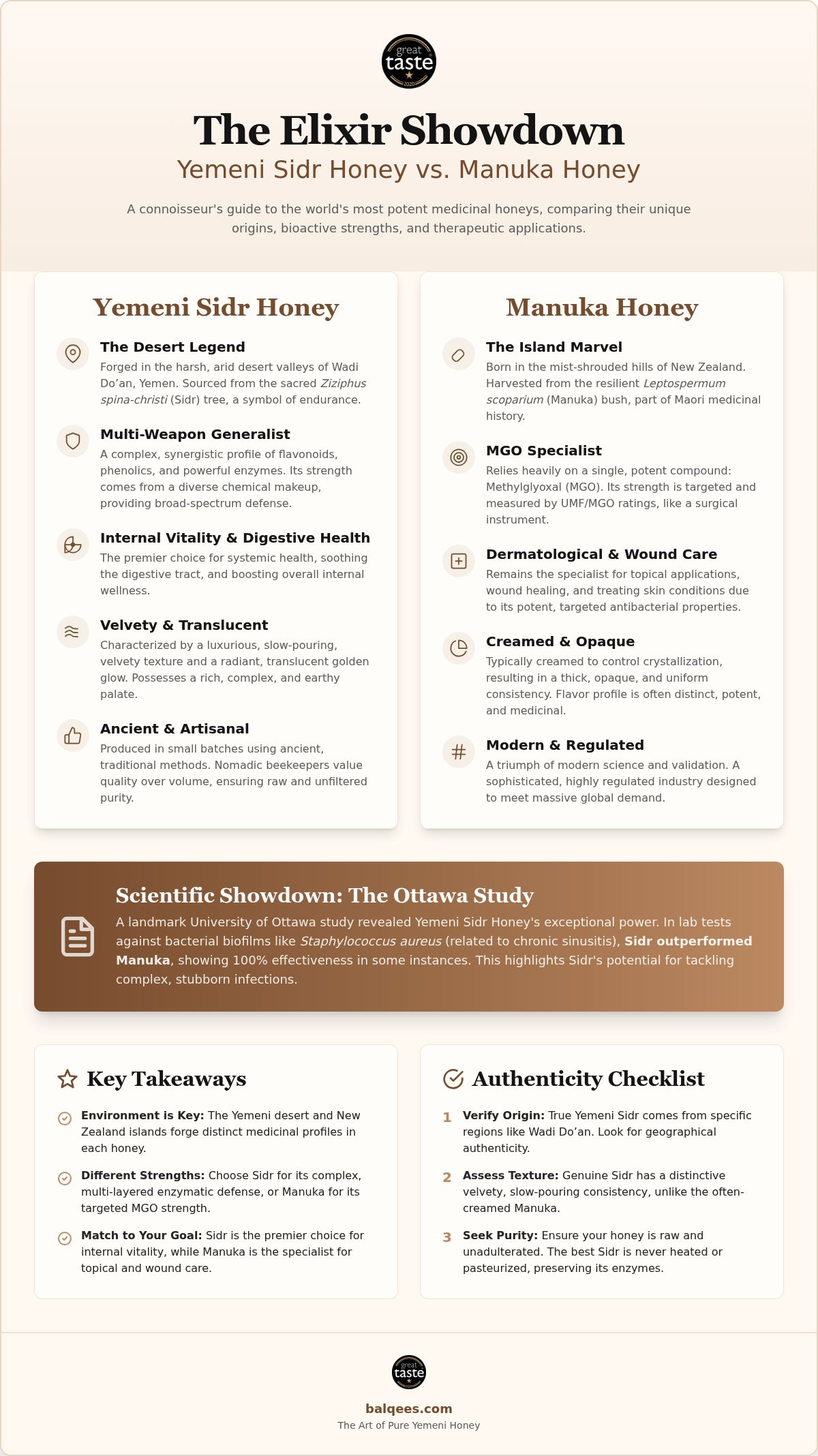
- Navigate the comparison of Yemeni Sidr honey vs Manuka honey by contrasting Manuka’s targeted MGO strength with Sidr’s complex, multi-layered enzymatic defense.
- Discover why Sidr is the premier choice for internal vitality and digestive health, while Manuka remains the specialist for dermatological and wound care.
- Elevate your palate by learning the sensory markers of authenticity, such as the velvety, slow-pouring texture of genuine Wadi Do’an honey.
- Master a practical checklist to verify geographical origin and physical characteristics, ensuring you receive the pure, unadulterated elixir you deserve.
Origins of Excellence: The Desert Legend vs. The Island Marvel
The story of these two legendary nectars begins with the soil and the sky. While both are celebrated for their medicinal prowess, the comparison of Yemeni Sidr honey vs Manuka honey is essentially a study of two extremes. One is forged in the furnace of the Arabian desert. The other is born in the mist-shrouded hills of New Zealand. These environments don't just provide a backdrop; they dictate the very chemistry of the honey. Within these landscapes, the bees act as alchemists, transforming the nectar of resilient plants into liquid gold.
The Sacred Sidr Tree of Yemen
In the remote valleys of the Hadramaut region, the Ziziphus spina-christi, or Sidr tree, thrives where little else can survive. This tree is more than just a plant. It's a cultural icon mentioned in sacred texts as a symbol of endurance and divinity. The harsh, arid climate of the desert forces the tree to concentrate its nutrients, resulting in a nectar of unparalleled density and mineral content. Local beekeepers in regions like Wadi Do’an still follow methods passed down through centuries, eschewing modern machinery for the rhythms of the earth. You can explore the depth of this heritage in our guide to The Sidr Tree: The Sacred Origin of the World’s Rarest Honey. This artisanal approach ensures that the honey remains raw, unfiltered, and deeply connected to its desert terroir. It's a labor-intensive tradition that values quality over industrial volume.
The Resilient Manuka Bush of New Zealand
Contrast this with the Leptospermum scoparium, the botanical source of Mānuka honey. Indigenous to New Zealand, this hardy shrub has its own history of Maori medicinal use, where the bark and leaves were used for healing long before the honey became a global phenomenon. The challenge for Manuka producers lies in the timing. The bush flowers for only a few weeks each year, creating a frantic, high-pressure window for bees to gather nectar. While the Yemeni Sidr honey vs Manuka honey debate often focuses on bioactive strength, it's the production scale that differs most significantly. New Zealand has developed a sophisticated, highly regulated industry to meet massive global demand. This contrasts with the small-batch, nomadic beekeeping found in the Yemeni mountains. The result is an "Island" profile that is typically creamed and opaque, a sharp departure from the translucent, velvety glow of its desert counterpart.
These origins shape everything from the enzyme count to the price. Yemeni Sidr is a product of scarcity and ancient tradition, while Manuka is a triumph of modern scientific validation and island resilience. Both represent the pinnacle of their respective worlds, offering a choice between the spirit of the desert and the soul of the forest.
The Bioactive Battle: MGO Specialist vs. Multi-Weapon Generalist
When we look beyond the golden hues and velvety textures, the true distinction in the Yemeni Sidr honey vs Manuka honey debate lies in their molecular architecture. Manuka is often viewed as a surgical specialist. It relies heavily on a single, potent compound called Methylglyoxal (MGO). Sidr, by contrast, behaves like a multi-weapon generalist. Its strength doesn't come from one source but from a complex, synergistic profile of flavonoids, phenolic compounds, and powerful enzymes. This difference in "weaponry" determines how each honey interacts with your body and where its healing potential is most effective.
Scientific research has begun to quantify what traditional healers have known for centuries. A landmark study at the University of Ottawa revealed that Yemeni Sidr honey was remarkably effective against certain bacterial biofilms, including Staphylococcus aureus and those related to chronic sinusitis. In these specific laboratory tests, the Sidr honey actually outperformed Manuka honey, showing a 100% effectiveness rate in killing the bacteria in some instances. This suggests that while Manuka is a formidable antibacterial agent, Sidr’s diverse chemical makeup may provide a broader reach against stubborn, complex infections.
Another critical factor for the connoisseur is stability. Many honeys lose their medicinal value when exposed to light or heat because they rely on hydrogen peroxide activity. Both Sidr and Manuka possess "non-peroxide activity," meaning their potency remains intact even under environmental stress. If you are looking to experience this resilient vitality, our Raw Yemeni Sidr Do'ani Honey provides a pure, unadulterated example of these bioactive properties.
Manuka’s Targeted Potency
The Manuka industry has perfected the art of measurement through the Unique Manuka Factor (UMF) rating. These numbers represent the concentration of MGO, the heat-resistant sniper that targets bacteria with precision. When you see a UMF rating of 15+ or 20+, you are looking at a guaranteed level of this specific antibacterial specialist. It's a reliable, standardized choice for focused recovery, particularly for external dermatological issues.
Sidr’s Holistic Bioactivity
Sidr honey doesn't rely on a single rating system because its power is holistic. It contains significantly higher levels of antioxidants than most global honeys, which work to neutralize oxidative stress within the body. This makes it an ideal elixir for systemic support and internal wellness. To understand why these diverse compounds earn it the title of "Liquid Gold," explore our detailed breakdown of Authentic Sidr Honey Benefits: Why It Is Liquid Gold. This complexity is what allows Sidr to support the immune system and digestive health with such refined elegance.
A Sensory Evaluation: Comparing the Palate of the Desert and the Island
While the laboratory can measure bioactive markers, your senses provide the most immediate testimony to quality. To truly appreciate the nuances of Yemeni Sidr honey vs Manuka honey, you must look beyond the label. You must observe how the honey catches the light and how it behaves on the palate. One is a radiant reflection of the sun-drenched Arabian Peninsula. The other is a dense, earthy expression of the New Zealand wilderness. These sensory cues are not merely about preference. They are the fingerprints of authenticity that help a connoisseur distinguish a true medicinal elixir from a commercial imitation.
The visual contrast is striking. Authentic Sidr honey possesses a deep, golden-amber glow. It is translucent and clear; it looks like liquid sunlight captured in a jar. Manuka honey is typically creamed during processing to ensure a smooth consistency, resulting in an opaque, tan, or light brown appearance. The aroma profiles are equally distinct. Sidr carries a sophisticated scent of desert herbs and a faint, ghostly hint of woodsmoke. Manuka, by comparison, smells of damp earth and crushed medicinal leaves. It is a heavier, more herbaceous fragrance that prepares the palate for its intense character.
The Palate of Yemeni Sidr
The first encounter with Sidr honey is often a revelation. It possesses a rich, lavish sweetness that lacks the sharp, acidic bite found in common varieties. The texture is famously buttery and velvety; it coats the tongue with a weight that feels substantial yet smooth. Because of its unique mineral composition and low moisture content, Sidr does not granulate or crystallize as easily as other honeys. A single spoonful takes you on a journey. It starts with a floral brightness, moves into a deep caramel body, and finishes with subtle, spiced notes that linger long after the honey has dissolved. It is a sensory masterpiece of the desert.
The Earthy Profile of Manuka
Manuka honey offers a more rugged experience. High-MGO varieties often have a slightly bitter, medicinal aftertaste that can be surprising to the uninitiated. It is thixotropic, meaning it is naturally gel-like and thick but becomes more fluid when stirred or agitated. This creates a dense, almost chewy mouthfeel that contrasts sharply with the consistent, silken flow of Raw Yemeni Sidr Do'ani Honey. While Manuka is bold and functional, Sidr remains the choice for those who seek a balance between potent bioactivity and a refined, artisanal flavor profile. In the contest of Yemeni Sidr honey vs Manuka honey, the desert variety often wins the heart of the culinary enthusiast.
Therapeutic Selection: Matching the Elixir to Your Wellness Goals
Choosing between Yemeni Sidr honey vs Manuka honey is rarely a matter of deciding which is objectively superior. Instead, it is a choice of matching a specific medicinal profile to your body's immediate needs. While we have explored their chemical differences, their practical application in a modern wellness routine is where the connoisseur finds the most value. One acts as a broad-spectrum guardian for your internal systems. The other serves as a targeted specialist for external recovery. Understanding this distinction allows you to use these elixirs with intention and precision.
The Internal Powerhouse: Sidr
Sidr honey functions as a systemic tonic. Its complex enzymatic structure and high antioxidant content make it the premier choice for internal vitality. It serves as a potent prebiotic, fostering a healthy gut environment and supporting smooth digestion. In traditional practices across the Middle East, it is also a revered ally for respiratory health, often taken to soothe the throat or support the body during seasonal changes. For those focused on longevity and stamina, the traditional use of Sidr as a natural energy booster is a cornerstone of its legacy. You can explore these specific benefits further in our guide on Sidr Honey for Men’s Health: An Ancient Secret for Modern Vitality. It is a holistic remedy designed to fortify the body from the inside out.
The Topical Specialist: Manuka
Daily Rituals for Holistic Health
Integrating these honeys into your life should be a mindful practice rather than a chore. Consider these rituals to maximize their benefits:
- The Morning Vitality Ritual: Dissolve a teaspoon of Sidr honey into a glass of warm water. Drink this on an empty stomach to prime your digestive system and provide a sustained, natural energy lift for the day ahead.
- The Evening Skin Ritual: Apply a thin layer of high-UMF Manuka honey as a spot treatment or a calming face mask. Its thick texture allows it to sit on the skin, drawing out impurities while providing deep hydration.
- The Pre-Activity Boost: Take a single spoonful of raw Sidr honey thirty minutes before a workout or a demanding mental task. The unique sugars provide a refined fuel source that avoids the sharp spikes and crashes of processed alternatives.
If you are ready to experience the profound internal benefits of the desert's most prized elixir, discover our Raw Yemeni Sidr Do'ani Honey and begin your own wellness ritual today.
The Authenticity Checklist: How to Source True Liquid Gold
The high market value of these elixirs has, unfortunately, invited a shadow industry of imitation. In the ongoing dialogue of Yemeni Sidr honey vs Manuka honey, the most critical factor isn't just the species of bee or the type of flower. It's the integrity of the supply chain. Because these honeys are among the most expensive in the world, they are frequent targets for "honey laundering" and adulteration. A 2026 study revealed that 42% of honey samples in certain regional markets failed to meet international quality standards, often due to high HMF levels. This chemical marker indicates that the honey was either overheated or is simply too old to retain its medicinal life force. To ensure you are investing in a true botanical treasure, you must become a discerning judge of provenance.
Use this checklist to evaluate your next jar with the eye of a connoisseur:
- Demand Geographic Specificity: Authentic Sidr honey must have a clear origin. Look for labels that specify the region, such as Wadi Do’an in the Hadramaut mountains. General "Yemen" labels are often used for lower-grade blends.
- The Viscosity Test: Real Sidr is exceptionally thick. At room temperature, it should pour with a slow, heavy deliberation. If it runs quickly like a commercial syrup, it has likely been diluted or harvested too early.
- The Aroma of the Wild: Artisanal honey should never smell merely of sugar. When you open the jar, you should be met with a complex, floral scent that carries hints of the desert. Manuka should smell earthy and medicinal; Sidr should smell of sun-warmed herbs and ancient earth.
- Check for "Raw and Unfiltered": Ensure the honey has not been pasteurized or micro-filtered. These industrial processes strip away the pollen and enzymes that define the Yemeni Sidr honey vs Manuka honey medicinal comparison.
Red Flags in the Honey Market
Beware of "Yemeni-style" honeys. This is a common marketing tactic used to sell blends from other regions that have been flavored or colored to mimic the desert legend. True Sidr is a product of its terroir; it cannot be replicated in a laboratory or a different climate. Another significant red flag is ultra-filtration. This process removes all traces of pollen, making it impossible to verify the honey's botanical origin. If a label doesn't proudly state its raw status and specific harvest region, it's likely a product of convenience rather than craftsmanship. Specialist retailers like Balqees maintain a direct-from-beekeeper chain to bypass these common market pitfalls.
The Connoisseur’s Seal of Approval
Transparency is the only true guarantee of quality. A reputable provider should be able to discuss the harvest season, the nomadic beekeeping traditions, and the specific valleys where the nectar was gathered. Choosing a rare honey is about more than a purchase. It's an act of preservation for an ancient craft. For those navigating the complexities of the digital marketplace, our guide on how to Buy Raw Honey Online in the UAE: A Connoisseur’s Guide to Purity and Heritage offers deeper insights into verifying your source. Always choose quality over convenience. Your wellness deserves nothing less than the pure, unadulterated spirit of the desert.
Selecting the Right Elixir for Your Wellness Journey
Your exploration into the world of Yemeni Sidr honey vs Manuka honey brings a clear realization: both are masters of their craft. While Manuka excels as a targeted specialist for external recovery, Sidr stands as a holistic powerhouse for internal vitality and systemic health. Choosing between them is a matter of matching their unique botanical signatures to your personal wellness goals. True quality isn't found in a mass-produced jar; it's found in the preservation of ancient, artisanal methods.
Since 2013, Balqees has acted as a guardian of these traditions. We source our honey directly from the remote, sun-drenched valleys of Yemen. Our focus remains on providing unfiltered, raw, and cold-pressed varieties that retain their full enzymatic life force. This direct-from-beekeeper chain ensures that the liquid gold you enjoy is as pure as the day it was harvested. You're not just buying honey; you're participating in a legacy of purity.
Experience the Purity of Raw Yemeni Sidr Do’ani Honey and discover the profound difference that heritage and integrity can make to your daily health. Let the spirit of the desert fortify your path to well-being.
Frequently Asked Questions
Is Yemeni Sidr honey more effective than Manuka honey?
Effectiveness depends entirely on your specific wellness goals. In the comparison of Yemeni Sidr honey vs Manuka honey, research such as the University of Ottawa study indicates that Sidr is exceptionally powerful against bacterial biofilms and internal systemic issues. Manuka remains the clinical leader for topical wound healing and dermatological care. One provides a broad, holistic defense for the body, while the other acts as a targeted specialist for external recovery.
Why is Yemeni Sidr honey so expensive compared to other types?
The price reflects extreme scarcity and the labor-intensive nature of nomadic beekeeping in Yemen’s rugged terrain. Sidr trees bloom for only a few weeks each year, and the honey is often harvested just twice in remote valleys like Wadi Do’an. This artisanal process, combined with the logistical challenges of sourcing from high-altitude desert regions, makes every jar a rare botanical treasure that cannot be mass-produced.
Can I use Sidr honey on my face like Manuka honey?
You can certainly use Sidr honey for facial treatments, although its texture differs from the creamed consistency of Manuka. Sidr is rich in antioxidants and provides a deep, velvety hydration that can soothe sensitive or aging skin. While Manuka is often chosen for active acne due to its stable MGO, Sidr serves as a lavish, nutrient-dense mask for overall skin radiance and vitality.
How can I tell if my Sidr honey is authentic and raw?
Authentic Sidr honey is characterized by its thick, slow-pouring consistency and a complex aroma of desert herbs and woodsmoke. It rarely crystallizes at room temperature because of its unique sugar profile and low moisture content. Always verify that the label specifies a precise Yemeni region and confirms the honey is raw, unfiltered, and cold-pressed to ensure the medicinal enzymes remain intact and active.
Does Sidr honey have an MGO rating like Manuka?
Sidr honey does not use the MGO or UMF rating system; these were developed specifically for the New Zealand Manuka industry. Instead, the potency of Yemeni Sidr honey vs Manuka honey is often measured by Total Activity (TA) or its concentration of flavonoids and phenolic compounds. Sidr’s strength comes from a diverse chemical synergy rather than a single, dominant antibacterial marker like methylglyoxal.
What is the best way to consume Sidr honey for health benefits?
To maximize the health benefits, consume a teaspoon of raw Sidr honey on an empty stomach every morning. You can enjoy it directly from the spoon or dissolve it in a glass of warm water. It's vital to avoid using boiling water. Excessive heat can destroy the delicate enzymes and heat-sensitive antioxidants that give this desert elixir its renowned medicinal value.
Which honey is better for cough and sore throat relief?
Both honeys are excellent for soothing the throat, but Sidr honey is often preferred for its velvety texture that coats the respiratory tract more effectively. Its high antioxidant levels and natural anti-inflammatory properties provide a gentle, lingering relief from irritation. While Manuka offers targeted antibacterial support, the smooth, buttery finish of Sidr makes it a more comforting ritual for persistent coughs.
Does Sidr honey expire or lose its medicinal properties over time?
Pure honey does not expire if stored in a sealed container, though its medicinal properties can subtly shift over many years. Fortunately, the "non-peroxide activity" in both Sidr and Manuka makes them remarkably stable compared to standard commercial honeys. To preserve the enzymatic life force for as long as possible, store your jar in a cool, dark place away from direct sunlight and moisture.


