


The amber jar on your shelf might look like honey, but if it's been touched by industrial heat, its medicinal soul has already departed. You've likely felt the frustration of standing in a local market, staring at labels like "raw" and "unfiltered" while wondering if the premium price truly matches the liquid inside. In the search for authentic cold pressed honey UAE connoisseurs often find themselves caught between marketing jargon and the fear of buying heat-damaged imitations. It's a valid concern. The delicate enzymes and floral notes that define a true Sidr honey are fragile; once they're lost to high temperatures, they can't be recovered.
We believe that choosing a jar of honey is an investment in your well-being and a connection to an ancient craft. This guide reveals why cold pressing is the essential standard for preserving the living integrity and rich heritage of premium honey. You'll learn the nutritional secrets of the cold-pressed method, how to distinguish artisanal excellence from mass-produced blends, and the best ways to safeguard your honey's potency in the unique UAE climate. Let's explore the sensory secrets of honey as nature intended it.
Key Takeaways
- Understand that true cold pressing honors the hive's natural temperature, never exceeding 35°C to ensure the nectar remains a living, bioactive treasure.
- Learn to identify authentic cold pressed honey UAE through its unique sensory markers, from its textured, cloudy appearance to its complex flavor notes.
- Explore the science of heat damage and why preserving enzymes like Diastase is vital for the medicinal potency of every spoonful.
- Master practical storage techniques to protect your honey from the UAE's humidity, including why you should always reach for a wooden spoon over metal.
- Discover how traditional extraction methods safeguard the prestigious heritage of rare varieties like Raw Yemeni Sidr Do'ani Honey.
What is Cold Pressed Honey and Why Does it Matter in the UAE?
Honey is more than a simple sweetener; it's a complex biological miracle. To understand What is Honey? in its most potent form, we must look at how it's handled after the bees have finished their work. In the vast markets of the Middle East, the term cold pressed honey UAE has become a beacon for those seeking more than just sugar. It represents a commitment to the "living" state of the nectar, ensuring that the bottle you hold contains the same vitality as the comb it came from.
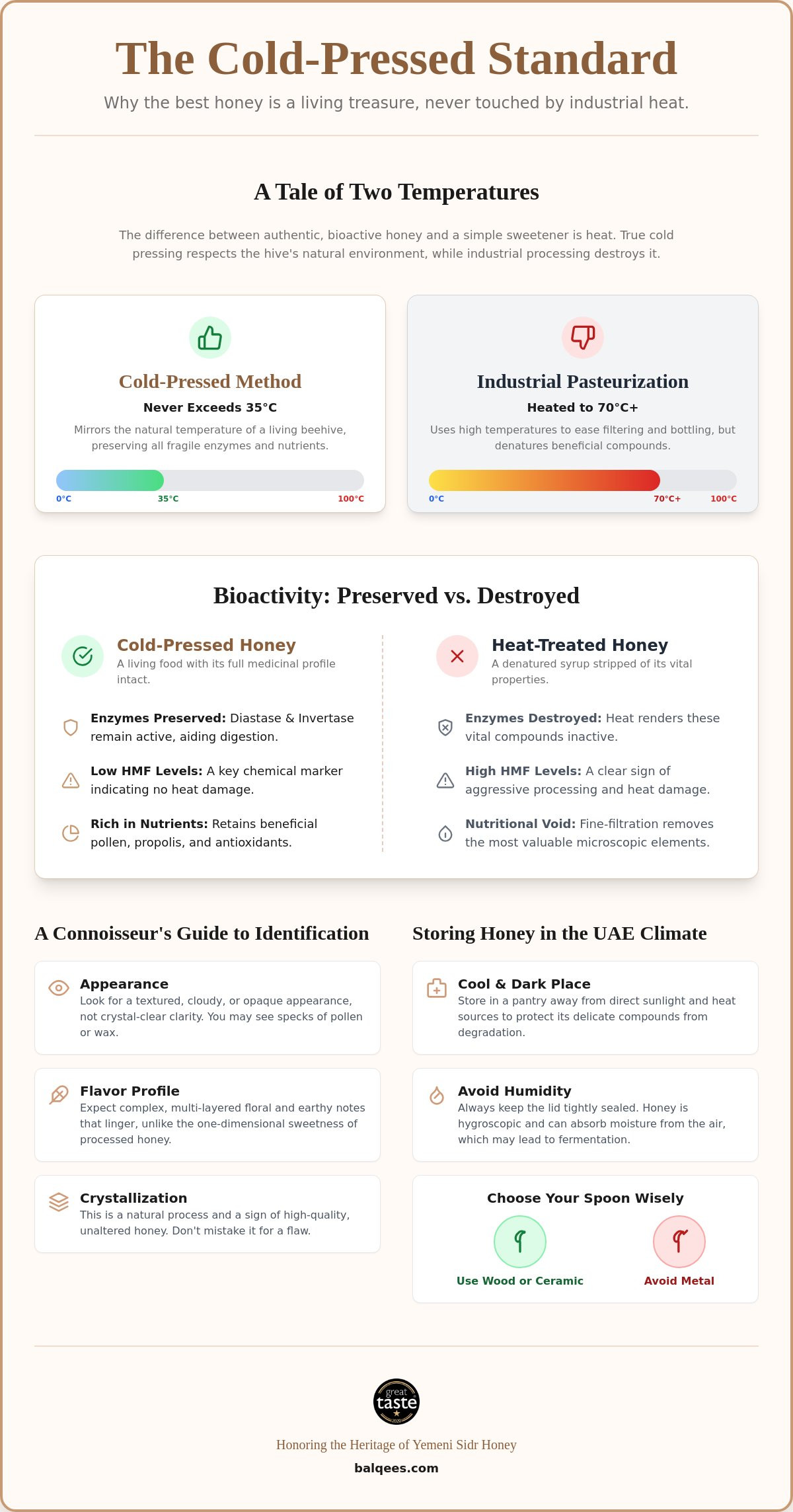
While many commercial brands use high heat to speed up bottling and prevent crystallization, cold pressing takes a slower, more respectful path. This method ensures the honey is never heated above 35°C, which is the natural temperature found within a thriving beehive. While "raw" labels often focus on the absence of fine filtration, the cold-pressed standard specifically guards against the thermal damage that robs honey of its soul. By mirroring the environment of the hive, we protect the fragile enzymes and delicate aromatic compounds that give each jar its unique character.
The Definition of the Cold Pressed Standard
True cold pressing is a labor of patience. Unlike industrial methods that rely on flash-heating to force honey through fine filters, this process uses gravity straining or low-speed centrifugal force to separate the nectar from the wax. This distinction is critical. When honey is pushed past 35-40°C, it reaches a point of no return where its biological integrity begins to fail. Essential enzymes, which contribute to the honey's medicinal profile, are denatured by heat. Cold pressing is the preservation of the honey’s biological fingerprint, ensuring that what reaches your table is exactly what the bees intended.
The UAE’s Growing Demand for Artisanal Purity
We've seen a profound shift in the local market. Consumers are moving away from mass-produced pantry staples in favor of foods that tell a story of origin and integrity. In a region where honey has always been a cornerstone of wellness and hospitality, the demand for cold pressed honey UAE reflects a deeper desire for transparency. This evolution is part of a larger trend where artisanal honey brands UAE are gaining prominence by prioritizing quality over volume.
As more entrepreneurs enter this specialized market, navigating the regulatory environment becomes essential; if you're planning a similar venture, you can discover Goodhand for professional guidance on UAE business setup and offshore solutions.
For the health-conscious resident, a jar of cold-pressed nectar isn't just food; it's a functional ritual rooted in heritage. It offers a sensory promise of deeper aromas and multi-layered flavors that heat-treated alternatives simply cannot replicate. When you taste honey that has been handled with such reverence, you aren't just tasting sweetness; you're tasting the sun, the soil, and the ancient landscapes of the region.
The Science of Heat: Why Cold Pressing Preserves Bioactivity
To the casual observer, honey is simply a golden liquid. To the scientist and the seeker of wellness, it's a complex matrix of enzymes, minerals, and bioactive compounds. The secret to its potency lies in its stability. When we discuss cold pressed honey UAE standards, we're talking about protecting a delicate biological balance. Heat is a thief. It steals the very elements that transform honey from a sweetener into a medicine.
At the heart of this story are enzymes like Diastase and Invertase. These are the "living" workers within the nectar. They aid digestion and support the Nutritional and Anti-inflammatory Effects of Honey that have been celebrated for centuries. When honey is subjected to industrial heat, these enzymes are denatured. They simply stop working. High heat also triggers the formation of Hydroxymethylfurfural (HMF). This compound serves as a chemical marker of heat damage. A high HMF level is a clear sign that the honey’s integrity has been compromised by aggressive processing.
Heat vs. Healing: The Enzyme Story
Industrial pasteurization often involves heating honey to 70°C or higher. This makes the honey easy to pump and filter, but it leaves a nutritional void. It's an act of destruction. This intense heat kills the beneficial yeast and destroys the microscopic traces of pollen and propolis that provide honey its character. By choosing cold pressed honey UAE, you ensure these elements remain intact. Without them, you're left with little more than a "supermarket" syrup devoid of the antimicrobial strength found in legendary varieties like Sidr.
Antioxidants and the Cold Press Advantage
The true magic of unheated nectar lies in its antioxidant profile. Compounds such as phenolics and flavonoids are the guardians of our health. Cold pressing ensures these fragile molecules aren't shattered by thermal stress. These are exactly the treasures that define the white mountain honey benefits that our community values so highly. Research shows that cold pressed varieties maintain a significantly higher antioxidant capacity than their commercial counterparts. If you're looking to experience this purity for yourself, you might explore our collection of living nectars to see the difference that careful handling makes.
Cold Pressed vs. Commercial Honey: A Connoisseur’s Comparison
Walk down any supermarket aisle in Dubai or Abu Dhabi and you'll see rows of identical, crystal-clear golden jars. It's a visual perfection that's actually a warning sign. Real cold pressed honey UAE enthusiasts know that nature is rarely so uniform. While commercial honey is processed to stay liquid and clear indefinitely, it sacrifices its soul for shelf appeal. In contrast, artisanal nectar is often cloudy, textured, and unapologetically bold. This visual difference is the first clue to the honey's history.
Commercial honey often tastes like a one-note sweetness, a flat sugary profile that lacks depth. This is the result of blending different harvests and using high heat to create a consistent product. Artisanal, cold-pressed honey offers a multi-layered experience. You might taste the earthy musk of the Sidr tree, a hint of wild herbs, or the delicate floral finish of a mountain harvest. Every jar is a unique vintage. While the price of artisanal honey is higher, it reflects the slow, low-yield extraction and the meticulous labor required to protect these nuances.
The Sensory Test: Texture, Color, and Aroma
The "cloudiness" you see in a premium jar is something to celebrate. It's caused by the presence of beneficial pollen, propolis, and tiny wax particles that have been preserved through gravity straining. These aren't impurities; they're the building blocks of flavor and health. The Science of Cold Pressed Honey shows that these elements are often stripped away by industrial micro-filtration. When you open a jar of unheated honey, the aroma should be immediate and evocative. If it smells like nothing, it's likely been heat-damaged.
Purity Markers: Beyond the Label
There are simple ways to test the density of your honey at home. Pure, cold-pressed nectar has a low water content, usually below 18%. If you place a drop on your thumb, it should stay in a cohesive bead rather than running off. In the "water test," a spoonful of high-quality honey will sink to the bottom of a glass and stay intact rather than dissolving instantly. These markers of density are your best defense against adulterated products. Because of the complexity of the market, we always encourage seekers of quality to buy raw honey online UAE only from sources that offer full transparency about their harvest and handling methods.
Don't be alarmed if your honey begins to crystallize or "set." This isn't a sign of spoilage. It's actually a hallmark of purity. Only honey that has been over-heated or ultra-filtered remains liquid forever. Embracing the natural evolution of the jar is part of the journey of becoming a true honey connoisseur.
Practical Guidance: Using and Storing Cold Pressed Honey in the UAE
The desert sun is a powerful force. While it nourishes the resilient Sidr trees, it can be the undoing of your honey once it's bottled. To maintain the integrity of cold pressed honey UAE residents must treat their jars with the same care a curator gives to a rare manuscript. This isn't just a pantry staple; it's a living biological product that reacts to its environment. If the temperature or light isn't managed, the very bioactivity that makes the honey medicinal will begin to fade.
One of the most common mistakes in our region is leaving honey in areas exposed to fluctuating temperatures. Ideally, keep your honey between 18°C and 24°C. While the fridge might seem like a safe haven from the summer heat, it actually accelerates crystallization, turning a smooth nectar into a solid block. Instead, choose a low, dark cupboard away from the stove or sunny windows. Humidity is another silent thief. Honey is hygroscopic, meaning it draws moisture from the air. In the humid coastal air of the Emirates, an improperly sealed lid can lead to unwanted fermentation, spoiling the delicate flavor profile.
When you reach for a serving, the tool you use matters more than you might think. We always advise against using metal spoons. Honey is naturally acidic, and contact with metal can trigger a subtle ion exchange that may diminish its enzymatic potency. A simple wooden dipper or a glass spoon is the connoisseur’s choice for preserving every drop of vitality.
Preserving Potency in a Desert Climate
Protecting your investment means paying attention to the vessel and the light. UV rays can degrade the delicate compounds within the nectar, particularly the glucose oxidase that provides antimicrobial benefits.
- Choose Glass: Always prioritize honey stored in glass jars. Unlike plastic, glass is inert and won't leach chemicals into the honey if the ambient temperature rises.
- Seal the Integrity: Ensure the rim is clean before closing. A tight seal is your primary defense against the UAE's intense humidity.
- Avoid Direct Light: Dark glass or a dark cupboard helps preserve the enzymes responsible for the honey's health properties.
Rituals for Health: Morning and Evening Usage
Incorporating honey into your daily life should be a mindful ritual. For those using functional blends like our Black Seed Fusion, a spoonful on an empty stomach in the morning offers a potent start to the day. In the evening, a lighter nectar can provide a soothing transition to rest. If you enjoy honey with your brew, patience is essential. Adding cold-pressed nectar to boiling water will instantly kill the enzymes. Wait until your drink has cooled to a sippable temperature to enjoy the best honey for tea pairings without sacrificing the nutritional benefits.
If your honey has set into crystals, don't worry. Simply place the jar in a bowl of warm water, ensuring it does not exceed 35°C, to gently return it to a liquid state. Ready to elevate your wellness routine? Browse our selection of raw, cold-pressed fusions to find your perfect match.
Balqees: Honoring the Heritage of Cold Pressed Nectar
At Balqees, we don't view honey as a simple commodity to be traded. It's a sacred link between the natural world and our collective well-being. Our philosophy is rooted in a deep, artisanal reverence for the bees and the ancient landscapes they inhabit. We act as guardians of tradition, ensuring that every jar of cold pressed honey UAE families bring into their homes carries the same vitality it possessed in the hive. This commitment isn't just about quality control; it's about honoring the biological soul of the nectar.
Our role is that of a dedicated mentor, bridging the gap between ancestral wisdom and the modern UAE lifestyle. We understand that in a fast-paced world, the purity of what we consume becomes a grounding force. By insisting on unheated and unfiltered processing, we protect the complex aromatic profiles and medicinal integrity of our offerings. We don't just sell honey. We share a legacy of health that has been whispered through the valleys of the Middle East for centuries.
The Yemeni Connection: Ancient Methods, Modern Purity
The heart of our collection lies in the remote, sun-drenched valleys of Yemen. Here, beekeeping is not an industry but a heritage passed down through generations. The methods used in these regions naturally align with the highest modern standards for cold pressing. Because the beekeepers in Wadi Do'an work in harmony with the seasons, the extraction of our Raw Yemeni Sidr Do'ani Honey is a slow, patient process. There are no industrial heaters in these mountains. The honey is harvested and handled with a gentleness that preserves the unique potency of the Sidr tree, often referred to as the "Lote tree" in sacred texts.
Our Artisanal Promise to the UAE
Integrity is the foundation of the Balqees supply chain. We maintain a direct-to-apiary connection, ensuring that the cold pressed honey UAE connoisseurs receive is never compromised by third-party blending or aggressive processing. We invite you to step beyond the one-note sweetness of commercial varieties and explore a sensory world of functional fusions and rare mountain nectars. Whether it's the deep, earthy notes of a desert harvest or the bright, floral finish of a wildflower blend, each jar is a testament to transparency.
Choosing cold pressed honey is more than a nutritional decision. It's a commitment to a lifestyle that values heritage, respects the earth, and prioritizes the "living" nature of our food. As you incorporate these nectars into your daily rituals, you aren't just consuming a product; you're participating in a story of purity that began long before the jar reached your shelf. This dedication to authentic, fresh sourcing is mirrored by services like shift2fresh.com, which specialize in importing high-quality fruits and vegetables to the UAE.
Elevate Your Daily Ritual with Living Nectar
Choosing the right honey is a decision that impacts your well-being and honors a timeless craft. We have explored how maintaining the hive's natural temperature protects the fragile enzymes and antioxidants that make nectar truly medicinal. By recognizing the sensory markers of purity and mastering the art of storage in our desert climate, you become more than a consumer; you become a connoisseur. It's a journey of rediscovering what food can be when it's handled with reverence and patience.
When you seek the authentic cold pressed honey UAE standards demand, look to the source. Our collection is sourced from the most remote, pristine apiaries in Yemen, where tradition dictates every step. These nectars are never heated and never filtered, ensuring they arrive at your table always bioactive and rich with heritage. From rare single-origin harvests to sophisticated functional blends for targeted wellness, each jar is a testament to integrity and the living energy of the hive.
Experience the purity of artisanal cold pressed honey at Balqees. Let the authentic taste of the wild transform your daily wellness routine into a meaningful connection with the natural world.
Frequently Asked Questions
Is cold pressed honey the same as raw honey?
Cold pressed honey is a specific, higher standard of raw honey that focuses on strict temperature control. While "raw" typically means the honey is unfiltered, "cold pressed" ensures it was never heated above 35°C. This distinction is vital for those seeking cold pressed honey UAE residents can trust for its biological vitality. It ensures that the living enzymes and delicate nutrients remain exactly as they were in the hive.
Does heating honey to 40 degrees destroy its benefits?
Yes, 40°C is the critical threshold where honey begins to lose its bioactive potency. While this temperature doesn't destroy everything instantly, it starts the process of denaturing fragile enzymes like Diastase. Maintaining temperatures below 35°C is the only way to safeguard the honey's biological fingerprint. Anything higher begins to transform a medicinal treasure into a simple sweetener.
Why is cold pressed honey more expensive in the UAE?
The price reflects the slow, artisanal nature of the extraction process. Industrial producers heat honey so it flows rapidly through pipes and filters, maximizing volume. Cold pressing relies on patience and low-yield gravity straining, which requires significantly more time and care. You're investing in the integrity of the harvest and the preservation of its medicinal soul.
How can I tell if my honey has been heat-treated?
You can identify heat-treated honey by its unnatural clarity and lack of aroma. If a jar is perfectly transparent and stays liquid for years, it has likely been over-processed. Authentic cold pressed honey UAE connoisseurs look for is often cloudy and textured. It should have a rich, evocative scent that reminds you of the blossoms and trees from which it was gathered.
Should I store my cold pressed honey in the fridge?
We don't recommend storing your honey in the refrigerator. Cold temperatures cause the natural sugars to bind with pollen particles, which accelerates the crystallization process. This makes the honey hard and difficult to spread. Instead, find a cool, dark cupboard away from the stove. Keeping it between 18°C and 24°C is ideal for maintaining its smooth, pourable texture.
Can I put cold pressed honey in hot tea?
You can enjoy honey in tea, but only after the water has cooled to a drinkable temperature. Adding cold-pressed nectar to boiling water will immediately neutralize the very enzymes you're seeking. Let your brew sit for a few minutes before stirring in a spoonful. This simple act of patience ensures you receive the full spectrum of health benefits without compromise.
What are the benefits of cold pressed Sidr honey?
Cold pressing preserves the rare antimicrobial and anti-inflammatory compounds unique to the Sidr tree. In varieties like our Raw Yemeni Sidr Do'ani Honey, these benefits are easily lost to heat. By using cold extraction, we ensure the volatile aromatic compounds and antioxidants remain intact. This results in a more potent nectar that offers superior support for the immune system and general wellness.
Why does cold pressed honey crystallize faster?
Crystallization is a sign of purity and the presence of natural pollen. Because cold-pressed honey isn't ultra-filtered or flash-heated, it contains microscopic particles of wax and pollen. These particles act as "seeds" around which crystals form. While commercial brands remove these to keep honey liquid on the shelf, their absence means the honey has been stripped of its nutritional value.


