


For decades, the global wellness community has looked to New Zealand as the undisputed pinnacle of medicinal honey, yet an ancient, sun-drenched treasure from the remote valleys of Yemen quietly challenges that throne. You've likely felt the weight of confusion when weighing the merits of Sidr honey vs Manuka honey, wondering if a high UMF rating truly outweighs the storied heritage of a raw, wild-harvested nectar. It is natural to feel overwhelmed by technical jargon like MGO or NMR, especially when you're searching for a genuine tool for healing rather than a clever marketing story. You deserve to know exactly what you're inviting into your home.
This guide settles the comparison by stripping away the noise to reveal the clinical reality and artisanal soul of both elixirs. We'll explore their distinct biochemical profiles, from Manuka’s targeted non-peroxide activity to the broad-spectrum antibacterial potency of Yemeni Sidr. By the end, you'll understand the specific bioactivity of each and gain the confidence to identify authentic provenance. Whether you seek a specialized clinical aid or a versatile daily tonic, we invite you to discover which of these prestigious gifts from the hive best aligns with your personal pursuit of health.
Key Takeaways
- Explore how the ancient landscapes of Yemen and New Zealand define the unique therapeutic heritage of the world’s most prestigious honeys.
- Understand the biochemical nuances of Sidr honey vs Manuka honey, contrasting targeted MGO activity with the diverse antioxidant profile of raw, unfiltered nectar.
- Refine your palate by learning to distinguish between the earthy, gel-like consistency of Manuka and the smooth, malty richness of authentic Sidr.
- Determine the best application for your wellness goals, choosing between specialized topical care and comprehensive internal immune support.
- Protect your investment by learning to verify authenticity through NMR lab testing and direct provenance, ensuring you never settle for an adulterated product.
The Tale of Two Terroirs: Understanding Sidr and Manuka Origins
The landscape writes the story of the honey. To understand the nuances of Sidr honey vs Manuka honey, you must first look at the earth where these elixirs begin. One thrives in the mist-shrouded, temperate hills of New Zealand, while the other emerges from the ancient, sun-scorched valleys of Yemen. These aren't just different flavors. They represent two entirely different relationships with the natural world. One is a product of modern agricultural precision; the other is a gift of wild, untamed heritage.
The Sidr tree, known botanically as Ziziphus spina-christi, is a resilient giant of the desert. It's a sacred tree, mentioned in holy texts and revered for millennia across the Arabian Peninsula for its medicinal bark, leaves, and fruit. In contrast, the Manuka bush, or Leptospermum scoparium, is a hardy, fast-growing shrub. While Manuka production has scaled into a sophisticated global industry, Raw Yemeni Sidr Do'ani Honey remains an artisanal rarity. It's wild-harvested by nomadic beekeepers who follow the brief flowering cycles of trees that have stood for centuries. The harsh, arid climate of Yemen forces the Sidr tree to concentrate its nutrients, resulting in a honey that is exceptionally dense in bioactive compounds.
The Heritage of the Sidr Tree
The cultural footprint of the Sidr tree spans thousands of years. It isn't merely a source of nectar; it's a pillar of traditional life. Within the Hadramaut region, the Wadi Do’an is celebrated as the "Grand Cru" of honey production. Here, the specific soil composition and the isolation of the valley create a purity that is impossible to replicate in cultivated settings. This deep-rooted history is visible in all traditional Yemeni honey products, where the focus remains on raw, unfiltered extraction. It's a slow, deliberate process. It respects the rhythm of the seasons rather than the demands of a factory line.
The Rise of Manuka
Manuka’s journey is quite different. Once considered a nuisance by farmers, this shrub became a global phenomenon after researchers identified its unique antibacterial properties. Today, New Zealand has transformed this humble plant into a highly regulated, industrial success story. To achieve medical-grade status, Manuka must meet strict "monofloral" requirements, ensuring the bees have feasted almost exclusively on the Manuka flower. While this ensures consistency, it often lacks the wild, poly-floral complexity found in the untamed landscapes where Sidr honey vs Manuka honey comparisons often begin.
The Biochemical Battle: MGO vs. Non-Peroxide Activity
When you look at the science of Sidr honey vs Manuka honey, you're observing two different philosophies of natural defense. Manuka is a specialist. It targets bacteria with surgical precision through its high concentration of methylglyoxal (MGO). This compound provides "non-peroxide activity," a stable form of antibacterial power that remains effective even when exposed to light or heat. It's a reliable, measurable force that has made Manuka a staple in clinical settings. However, focusing solely on MGO overlooks the complex "multi-weapon" arsenal found in Yemeni Sidr.
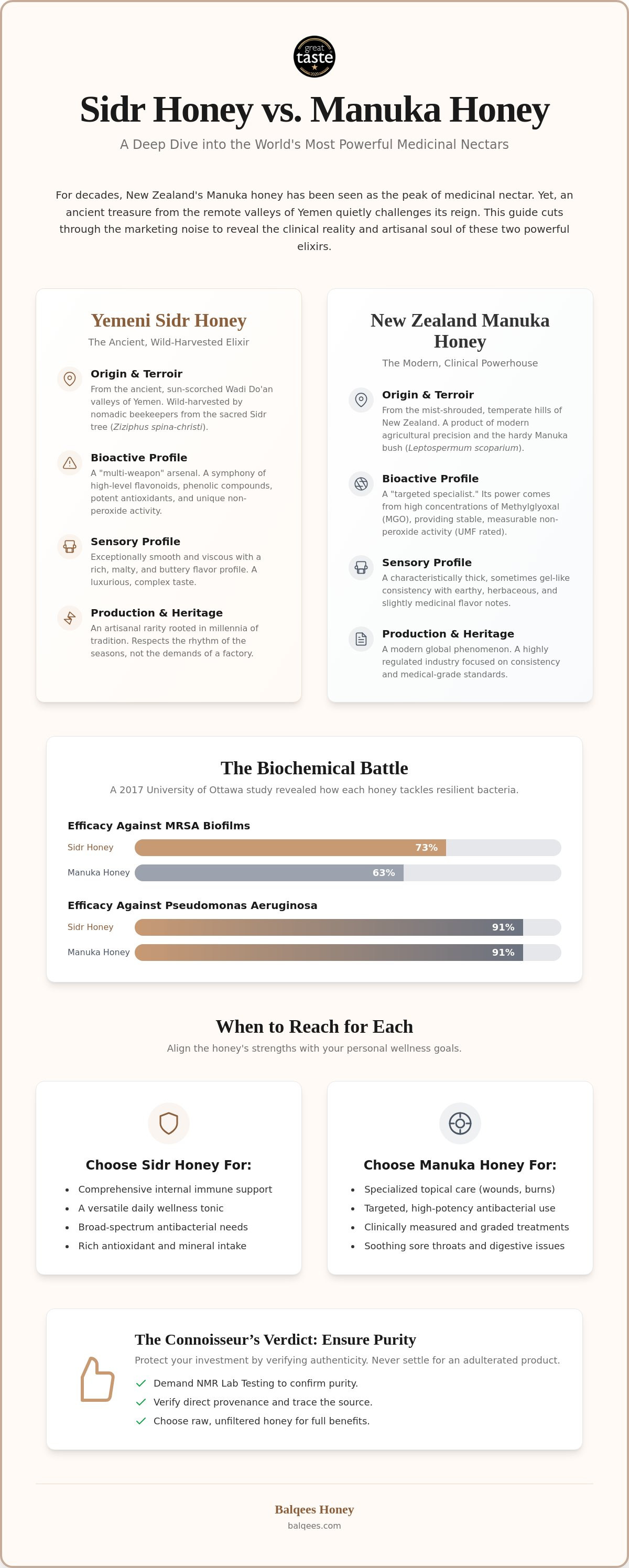
Sidr honey doesn't rely on a single star performer. Instead, it utilizes a symphony of high-level flavonoids, phenolic compounds, and potent non-peroxide activity. A study conducted at the University of Ottawa revealed the strength of this diverse profile. Researchers found that Sidr honey achieved a 73% kill rate against MRSA biofilms, while Manuka achieved 63%. Both honeys were exceptionally effective at 91% against Pseudomonas aeruginosa. This research, which directly compares Sidr and Manuka honey, suggests that Sidr's complex chemical makeup is uniquely equipped to dismantle the protective layers of resilient bacteria. Sidr’s naturally low pH and exceptionally high mineral content create an environment that inhibits microbial growth while preserving its delicate enzyme-rich profile for years.
Understanding the Manuka Grading Systems
The numbers on a Manuka jar, whether MGO or UMF (Unique Manuka Factor), indicate the concentration of methylglyoxal. UMF is the more comprehensive scale; it verifies MGO levels along with markers like leptosperin to ensure authenticity. While a high rating is vital for treating a wound, it isn't always better for daily wellness. Some producers use heat-treating processes to artificially accelerate the maturation of MGO, which can degrade the honey's natural enzymes. For daily immune support, a moderate, raw, and unheated grade is often more beneficial than an industrial-strength clinical batch.
The "Total Activity" of Sidr Honey
Sidr honey exists outside the UMF scale. Instead, connoisseurs look for Total Activity (TA) and NMR (Nuclear Magnetic Resonance) testing. These tests verify the honey's botanical origin and its overall antioxidant capacity. The deep, dark hue of authentic Sidr is a visual cue of its mineral density and polyphenol content. This richness is why Sidr is increasingly favored for internal health, particularly for gut resilience and soothing chronic sinus issues. If you wish to explore these ancient benefits, our Raw Yemeni Sidr Do'ani Honey provides a pure, laboratory-verified example of this biochemical potency.
Sensory Profiles: A Comparative Study of Taste and Texture
Experience is everything. While laboratory data provides a foundation, the true soul of a honey is found on the tongue. In the nuanced debate of Sidr honey vs Manuka honey, the sensory profiles are worlds apart. One is a rugged, medicinal specialist from the southern hemisphere; the other is a decadent, liquid treasure born from the Arabian desert. They speak different languages of flavor, texture, and aroma.
Manuka presents a profile that is unapologetically bold. It smells of damp earth and crushed herbs. Its flavor is complex, often carrying a slightly bitter, medicinal finish that lingers. The texture is thixotropic. This means it is gel-like while at rest but becomes liquid when stirred. It is a honey that feels functional, even in its physical form. Visually, it sits in the range of deep gold to warm amber, appearing opaque and dense.
Yemeni Sidr offers a contrast of pure indulgence. Imagine a flavor that is rich, buttery, and deeply malty. Its aroma is a sophisticated blend of floral notes and spicy woodland scents. Visually, Sidr is striking. It ranges from a warm amber to a dark, obsidian-like glow as it ages. Unlike most honeys, pure Sidr is famous for its stability. It rarely crystallizes. It remains smooth and viscous for years, a testament to its unique mineral composition and the low moisture content of the Yemeni desert air.
The Palate of a Connoisseur
Because of its balanced sweetness, Sidr is the preferred choice for luxury gifting and culinary pairings. It doesn't overwhelm a dish with medicinal notes. Instead, it enhances flavors. High-MGO Manuka often has a sharp aftertaste that can be polarizing for those used to traditional nectars. If you are curious about how these profiles compare to other global treasures, you can explore our guide to rare honey varieties. It's a journey through the world's most coveted nectars.
Texture and Stability
Sidr's texture is its calling card. It possesses a "stretchy" quality. When you lift a spoon, the honey should form a continuous, unbreakable thread. This is a hallmark of purity. While Manuka is thick and almost creamy, Sidr is silky and heavy. It glides. This stability means you won't find the gritty sugar crystals common in processed or lower-quality honeys. It stays exactly as nature intended, from the hive to your home.
Clinical Applications: When to Reach for Each
Choosing between Sidr honey vs Manuka honey often depends on where the healing needs to happen. Is the challenge internal or external? While both offer profound antimicrobial benefits, their historical and clinical applications have carved out distinct niches in the apothecary of nature. One is a surgical specialist. The other is a broad-spectrum guardian of vitality. Knowing when to reach for each ensures you maximize the therapeutic potential of these liquid elixirs.
Wound Healing and Skincare
Manuka remains the undisputed king of the clinic. Because of its stable MGO levels, medical-grade Manuka is a staple in hospitals worldwide for treating MRSA, pressure ulcers, and surgical wounds. It creates an acidic, low-moisture environment that inhibits bacterial growth while promoting tissue regeneration. It's a targeted, functional tool for acute recovery. Research data consolidated in 2026 confirms that honey-based topical treatments provide a superior barrier against persistent inflammation by neutralizing reactive oxygen species at the site of an injury.
Sidr honey takes a more artisanal approach to skin health. While it possesses significant antibacterial power, it's often prized as a luxury face mask for anti-aging and deep hydration. Its high concentration of antioxidants and live enzymes helps to soothe redness and promote a radiant, youthful glow. It doesn't just treat; it nourishes. This makes it the preferred choice for those seeking a natural, non-clinical way to maintain a healthy complexion.
Immunity and Vitality
When evaluating Sidr honey vs Manuka honey for internal use, Sidr often takes the lead. In traditional Middle Eastern medicine, Sidr has been the primary remedy for "stomach ailments" for generations. It acts as a potent prebiotic. It feeds the beneficial bacteria in your microbiome, supporting gut resilience and digestive comfort. If you're struggling with seasonal allergies or a persistent sore throat, the high mineral density of Sidr provides a coating, soothing effect that Manuka’s more herbaceous profile sometimes lacks.
There is also the "Vitality" factor to consider. Historically, Sidr is used to boost energy levels and support reproductive health. This is likely due to its impressive Oxygen Radical Absorbance Capacity (ORAC). Darker honeys like Sidr typically possess a higher antioxidant capacity than lighter varieties, allowing them to combat oxidative stress more effectively across the entire body. It is a holistic tonic for the modern lifestyle. To experience this ancient strength for yourself, we recommend starting with a daily spoonful of our Raw Yemeni Sidr Do'ani Honey to anchor your wellness routine.
The Connoisseur’s Verdict: How to Source Authentic Honey
Standing before two jars, the choice of Sidr honey vs Manuka honey isn't just about flavor profiles. It's about trust. Because these are among the most expensive foods in the world, they're also among the most frequently adulterated. Protecting the integrity of your purchase requires more than just reading a label. It requires an understanding of the science and the soul behind the harvest. While Manuka production has scaled into a massive industrial success, Yemeni Sidr remains a rare, artisanal treasure. This scarcity makes it a primary target for counterfeiters who often blend high-quality nectar with cheap syrups or lower-grade honeys.
At Balqees Honey, we bridge the gap between ancient tradition and modern safety. We utilize Nuclear Magnetic Resonance (NMR) testing for our batches. This sophisticated laboratory analysis provides a molecular "fingerprint" of the honey. It confirms the botanical origin and ensures the nectar hasn't been heat-treated or diluted. For a connoisseur, this transparency is the only way to guarantee that the living enzymes and bioactive compounds remain intact. Authentic Sidr should be raw and unfiltered. It must come directly from the source to retain its status as a true elixir of the desert.
Spotting a Fake: A 5-Point Checklist
Verifying authenticity in the UAE market requires a discerning eye. Don't rely on the price tag alone. Follow these five essential checks:
- Origin Scrutiny: A label saying "Product of Yemen" is the start, not the end. Demand to know the specific valley, such as Wadi Do’an.
- The Thread Test: Pure Sidr honey is viscous. It should pour in a continuous, unbreakable thread rather than dripping in droplets.
- The Water Test: Drop a spoonful into a glass of water. Real raw honey will sink to the bottom as a solid lump; it won't dissolve instantly.
- Aroma Complexity: Authentic honey smells like the landscape. If it lacks a floral or woody scent, it may have been over-processed.
- Raw Certification: Ensure the honey is cold-pressed. Heat-treating honey to speed up bottling kills the very enzymes you're paying for.
Creating a Daily Ritual
Once you have secured a genuine jar, the way you consume it matters. A single "morning spoonful" on an empty stomach is the gold standard for absorption. It allows the enzymes to interact directly with your system before the day's meals. We often suggest pairing our honey with functional herbs to target specific needs. This philosophy led to our Black Seed and Ginseng fusions, which combine the broad-spectrum power of Sidr with traditional vitality boosters. If you're ready to begin your journey, you can buy raw honey online UAE through our curated collection. Remember to store your honey in a cool, dark place and always use a dry, wooden spoon to preserve its delicate chemistry.
Embrace the Ancient Power of the Sidr Harvest
The choice between Sidr honey vs Manuka honey is ultimately about matching nature's gifts to your specific wellness journey. While one excels as a targeted clinical tool, the other thrives as a broad-spectrum daily tonic for vitality and resilience. We have explored how the unique, arid landscape of the Do'an valley creates a nectar that is as stable as it is potent, offering a complexity that modern science is only beginning to fully quantify. Purity is the only path to experiencing these benefits in their true form.
At Balqees Honey, we take our role as guardians of this heritage seriously. For over a decade, we have been trusted by connoisseurs across the UAE to deliver honey that is lab-tested for purity and enzymatic integrity. Every jar of our Raw Yemeni Sidr Do’ani Honey is a bridge to an ancient world of healing, sourced directly from artisanal beekeepers who respect the rhythm of the desert. Experience the sacred purity of our Raw Yemeni Sidr Do’ani Honey at Balqees Honey and discover why true quality never needs to be rushed. Your path to a more vibrant life is just a spoonful away.
Frequently Asked Questions
Is Sidr honey more medicinal than Manuka honey?
Sidr honey offers a broader spectrum of antioxidant and phenolic compounds, while Manuka is highly specialized for specific bacterial targets. In clinical comparisons of Sidr honey vs Manuka honey, Sidr has shown a superior ability to dismantle certain persistent bacterial biofilms in laboratory settings. One acts as a surgical specialist; the other serves as a holistic, broad-spectrum guardian of internal wellness and vitality.
Why is Yemeni Sidr honey so expensive compared to Manuka?
Scarcity and the challenging nature of the harvest drive the value of Yemeni Sidr. Unlike the industrial scale of New Zealand’s honey production, Yemeni Sidr is wild-harvested by nomadic beekeepers in remote valleys like Wadi Do’an during a very brief flowering window. This artisanal process, combined with the extreme desert climate, ensures a concentration of nutrients that's impossible to replicate in cultivated settings.
Can I use Sidr honey for wound healing like Manuka?
You can use Sidr honey for its natural antibacterial benefits, though Manuka remains the recognized clinical standard for medical-grade dressings. Sidr is exceptionally effective for nourishing the skin and is often used in luxury anti-aging treatments. Its high mineral content and enzymatic activity help soothe inflammation while promoting a hydrated, radiant complexion without the harshness of clinical chemicals.
What is the best way to consume Sidr honey for health?
Take a single spoonful on an empty stomach every morning to maximize the absorption of its living enzymes. It's best to avoid adding it to boiling liquids, as high temperatures can destroy the delicate bioactive compounds. Always use a dry, wooden spoon to preserve the honey's natural chemistry and prevent any oxidation that might occur with metal utensils.
Does Sidr honey have an MGO rating?
No, Sidr honey doesn't use the MGO (Methylglyoxal) scale, which is specific to the chemistry of the Manuka plant. Instead, the quality and potency of Sidr are measured through Total Activity (TA) and NMR testing. These sophisticated methods verify the honey's botanical origin and its overall antioxidant capacity, ensuring you receive the full therapeutic profile of the sacred Sidr tree.
How can I tell if my Sidr honey is authentic Yemeni?
Authenticity is confirmed through laboratory NMR testing and verifiable provenance from specific regions like the Hadramaut. Pure Yemeni Sidr possesses a distinct, stretchy texture and a rich, malty aroma that lingers. It's famous for its stability and rarely crystallizes, remaining liquid for years. Always source from a trusted guardian of tradition who provides transparency regarding the harvest location.
Is it safe to give medicinal honey to children?
It's safe for children over the age of one, but you should never give raw honey to infants under 12 months. This is due to the risk of botulism, as an infant's digestive system isn't yet mature enough to handle natural spores. For older children, a small daily dose of Sidr honey vs Manuka honey can be a wonderful, natural way to support their developing immune systems.
Which honey tastes better, Sidr or Manuka?
Taste is subjective, but most connoisseurs prefer the buttery, malty sweetness of Sidr for culinary enjoyment. Manuka often carries an earthy, herbaceous, and slightly bitter aftertaste that can feel quite medicinal on the palate. Because Sidr lacks this bitterness, it's the more versatile choice for luxury gifting and pairing with fine foods or morning teas.


