


What if the secret to the world's most potent wellness elixir wasn't found in a laboratory, but at three thousand meters above sea level where the air is thin and the flora is ancient? Altitude acts as nature's ultimate filter. The higher the beehive, the more concentrated and enzymatically active the nectar becomes. You've likely felt the frustration of standing before a crowded shelf in the Emirates, wondering if that golden jar is truly pure or just another mass-produced syrup. It's a common dilemma for any connoisseur seeking genuine quality and transparency.
Choosing between Yemeni Sidr vs Wildflower honey involves more than just a preference for taste; it's an exploration of terroir and ancient tradition. We'll show you how to distinguish these rare mountain nectars and why they remain the pinnacle of wellness in 2026. You'll discover the scientific secrets of the Yemeni highlands, learn to identify authentic White Mountain honey, and master the art of preserving these liquid treasures at home. Let's begin this journey into the heart of the mountains to uncover the true essence of purity.
Key Takeaways
- Discover how elevations above 1,500 metres produce honey with unique enzyme density and rare floral notes that can't be found in lowland varieties.
- Understand the critical differences between Yemeni Sidr vs Wildflower honey by comparing the buttery caramel of Wadi Do'an with the light, bright notes of mountain meadows.
- Learn to identify raw, high-altitude honey using sensory cues like natural honey foam and complex, lingering aromas that signify true purity.
- Master the artisanal secrets of storing rare mountain elixirs to preserve their delicate medicinal properties and prevent unwanted fermentation.
- Explore the deep heritage of Yemeni beekeeping and how traditional methods ensure these mountain treasures reach your table in their most potent form.
What Defines High Altitude Honey in the UAE?
High-altitude honey isn't just about height; it's about the struggle for survival in a rarefied environment. In the context of the UAE and the wider region, we define high-altitude honey as nectar harvested from hives perched at elevations above 1,500 metres. At these heights, the air is crisp and the atmosphere is thin. Bees must work harder, foraging on resilient wildflowers that have adapted to intense UV rays and rocky soils. While lowland hives might produce honey in abundance, mountain hives yield a much lower volume. This scarcity is exactly what makes the nectar so precious. It's more concentrated, carrying a depth of character that mass-produced varieties simply can't match. When you look at Yemeni Sidr vs Wildflower honey, you're seeing the result of two distinct mountain environments.
The Concept of Mountain Terroir
Flavor begins with the earth. Mountain terroir refers to the unique combination of mineral-rich soil, extreme weather patterns, and specific altitudes that shape a honey's profile. Cooler temperatures at these heights slow down the bees' foraging cycles, allowing the nectar to mature within the hive for longer periods. This results in what many call the "grand cru" of the honey world. The UAE’s own mountainous landscapes provide a home for the Sidr tree (Ziziphus spina-christi), which thrives in these rugged environments. This connection between the local terrain and the regional honey trade has existed for centuries, positioning the UAE as a vital hub for connoisseurs seeking the purest mountain harvests.
Rare Varieties Found in High-Altitude Regions
When exploring the debate of Yemeni Sidr vs Wildflower honey, altitude is the deciding factor in quality. The highlands of Yemen produce the legendary Raw Yemeni Sidr Do'ani Honey, a nectar so thick and potent it's often compared to liquid gold. Moving even higher into alpine peaks, we encounter White Mountain Honey. This variety is prized for its creamy texture and delicate, almost vanilla-like finish. For those who enjoy a more complex profile, Yemeni Wildflower honey offers a symphony of high-altitude blossoms, capturing the essence of an entire mountain range in a single spoonful. These varieties represent the pinnacle of artisanal honey, untouched by industrial processes and rich in heritage. They aren't just food; they're a sensory journey through the clouds.
The Alchemy of Altitude: Why Mountain Honey is Healthier
Nature has a way of concentrating its best work where the air is thinnest. At high elevations, the environmental pressures of cold nights and intense UV exposure force mountain flora to produce higher levels of protective compounds. These polyphenols and antioxidants are then transferred directly into the nectar. When we analyze Yemeni Sidr vs Wildflower honey, the health benefits often boil down to these specific enzymatic markers. High-altitude honey isn't just a sweetener; it's a living substance. The slow maturation process in the hive allows bees to infuse the honey with significant concentrations of diastase and invertase, enzymes that support everything from digestion to cellular repair.
The rugged Sidr trees found in these highlands produce nectar with potent antimicrobial properties that are often compared to clinical-grade honey. These benefits are amplified by several factors unique to the mountain environment:
- Intense UV Protection: High-altitude plants develop more flavonoids to survive solar radiation, increasing the honey's antioxidant capacity.
- Enzymatic Density: Cooler temperatures mean the honey remains in the honeycomb longer, allowing for a more thorough enzymatic infusion by the bees.
- Purity of Source: These hives are located far from industrial centers, ensuring the honey is free from modern pollutants and pesticides.
The Science of Low Moisture and Purity
Thin mountain air acts as a natural dehydrator. This process reduces the moisture content of the honey far below the levels found in lowland varieties. Lower moisture isn't just about a thicker, more luxurious texture that clings to the spoon; it's a vital preservative. It prevents natural fermentation and ensures the honey remains stable for years. This inherent stability is a hallmark of quality that connoisseurs look for when sourcing premium elixirs. Because these regions are so remote, the honey remains untouched by the chemical runoff common in commercial agriculture. It's as close to the source as one can possibly get. If you're looking to experience this purity firsthand, you might consider exploring our collection of raw mountain honeys.
Therapeutic Uses of High-Altitude Nectar
In the UAE, where the transition between desert heat and air-conditioned interiors can be taxing, high-altitude honey offers a natural shield. It's frequently used to soothe respiratory discomfort and bolster the immune system during seasonal changes. The diastase number serves as a critical laboratory metric that measures the enzymatic activity and heat-exposure history of high-altitude honey. Beyond respiratory support, these honeys are prized for their prebiotic effects, helping to maintain a healthy balance in the gut microbiome. Whether it's the deep, earthy Sidr or a bright Wildflower variety, these mountain nectars bring the resilience of the highlands into your daily wellness ritual.
Comparing the Giants: Sidr Do'ani vs. Wildflower Honey
Choosing between Yemeni Sidr vs Wildflower honey is like selecting between a vintage reserve and a vibrant field blend. Both are masterpieces of high-altitude beekeeping, yet they speak different sensory languages. While Sidr honey is often revered for its singular, potent focus, wildflower varieties offer a panoramic view of the mountain's botanical diversity. To the untrained palate, honey is simply sweet. To the connoisseur, these two elixirs represent the polar opposites of the mountain's character, defined by their unique origins and the specific foraging habits of the bees that create them.
The Legend of Yemeni Sidr Do'ani
Wadi Do'an is more than just a location; it's a sanctuary for the world's most prestigious honey. The soil here is mineral-dense and untouched by modern agriculture, creating a foundation that beekeepers consider sacred. Because the Sidr tree only blossoms for a brief period each year, this honey is harvested in strictly limited quantities. It possesses a thick, liquid gold viscosity that resists crystallization for years. When you taste authentic Sidr Do'ani, look for the deep, buttery caramel notes followed by a subtle, lingering herbal aftertaste. This complexity is a hallmark of its purity, making it the preferred choice for those seeking a dedicated medicinal ritual in their daily wellness routine.
The Complexity of Yemeni Wildflower Honey
If Sidr is a solo performance, Yemeni Wildflower honey is a full orchestral symphony. Nomadic bees traverse diverse high-altitude meadows, foraging on a shifting tapestry of seasonal blooms. This multi-floral approach provides a broader spectrum of botanical nutrients, contributing to the honey's noted antioxidative and anti-inflammatory effects. Its flavour is light and bright, often carrying whispers of citrus or wild herbs depending on the specific harvest. This makes it an exceptional partner for culinary pursuits or pairing with delicate teas, where it enhances rather than overpowers the palate. For those eager to explore the world's most coveted nectars, understanding these rare honey varieties is the first step toward becoming a true mentor of the craft.
At a Glance: The Connoisseur’s Comparison
- Sidr Do'ani: Monofloral, buttery caramel, thick viscosity, best for medicinal use.
- Wildflower: Polyfloral, bright and floral, seasonal consistency, best for culinary pairings.
Whether you prefer the bold authority of Sidr or the playful complexity of a wildflower blend, both represent a commitment to preserving ancient traditions. These honeys don't just provide sustenance; they offer a direct connection to the rugged landscapes of the Yemeni highlands, delivered with the integrity that only raw, high-altitude harvesting can provide. Just as we value the integrity of our source, those seeking a premium lifestyle in Dubai can check out TAG Property to discover community-focused real estate in the Tilal Al Ghaf area.
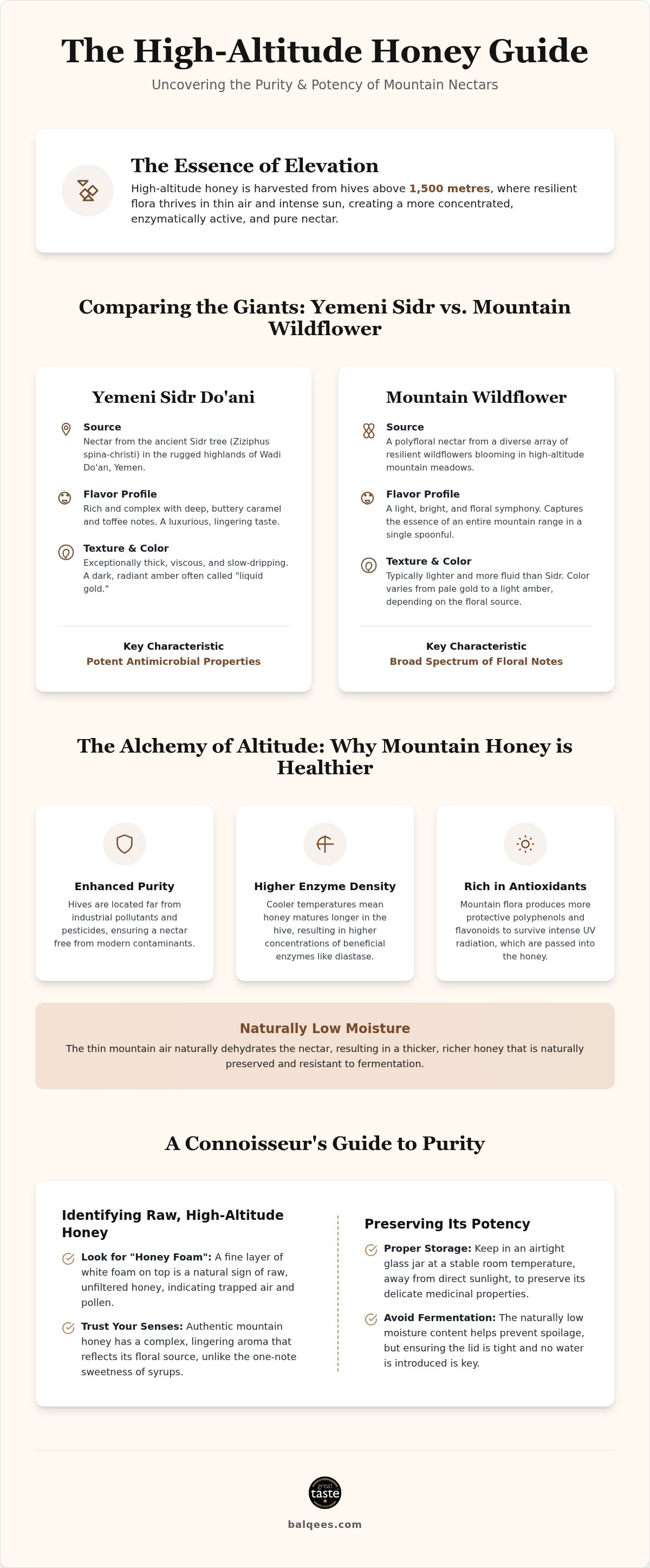
A Connoisseur’s Guide to Identifying and Storing Rare Honey
Identifying a true mountain elixir requires an intimate engagement with the senses. It's not enough to simply trust a label. You must look for the subtle signatures of raw life. One of the most telling visual cues is a fine layer of white foam on the surface. This isn't a defect; it's a sign of active enzymes and trapped air from the bottling process. Cloudiness is another indicator of a raw, unfiltered state, suggesting the presence of beneficial pollen and propolis. When evaluating Yemeni Sidr vs Wildflower honey, these visual markers are your first line of defense against mass-produced alternatives. Sidr often presents a dense, opaque amber, while Wildflower varieties may shimmer with a more translucent, golden hue. Breathe it in deeply. Mountain honey carries a complex bouquet that lingers long after the jar is opened. If it smells only of generic sweetness, it likely lacks the botanical depth of a high-altitude harvest.
The Sensory Experience of Raw Honey
To truly appreciate these nectars, conduct a tasting at home. Use a dry, clean spoon and let a small amount rest on your tongue. Notice the mouthfeel. High-viscosity mountain honey, like the Sidr Do'ani, should feel rich and heavy, coating the palate with a buttery texture. In contrast, wildflower varieties often have a more fluid, syrupy consistency that feels light and refreshing. Natural crystallization is a definitive mark of purity and high glucose content, proving the honey has not been ultra-filtered or pasteurized. These textures are the physical manifestation of the mountain's terroir, capturing the essence of the flowers and the bees' tireless work.
Preservation Tips for the UAE Climate
The UAE’s intense heat demands a disciplined storage ritual. Glass jars are far superior to plastic, as glass is non-porous and won't leach chemicals or alter the honey's delicate flavour profile. To prevent enzyme degradation, keep your honey in a cool, dark cupboard where temperatures stay between 18 and 24 degrees Celsius. Never expose the jar to direct sunlight or high humidity. One common mistake is using a metal spoon, which can cause minor oxidation; use wood, glass, or ceramic instead. If you want to ensure your collection maintains its therapeutic potency, explore our range of artisanal mountain honeys and treat each jar with the reverence it deserves. Avoiding heat is paramount. Cold-pressed honey must never be microwaved or added to boiling water, as this destroys the very enzymes that make it a pinnacle of wellness.
The Balqees Commitment: Sourcing the World’s Finest Altitudes
Our journey is one of relentless pursuit. At Balqees Honey, we don't just sell honey; we act as a bridge between the ancient wisdom of the Yemeni highlands and your modern lifestyle in the UAE. This commitment starts with an artisanal reverence for the natural world. We believe that absolute purity is not a luxury but a standard. By working directly with traditional beekeepers who have spent generations mastering the rugged terrain of Wadi Do'an and the surrounding peaks, we ensure that every jar tells a story of heritage. Whether you are weighing the merits of Yemeni Sidr vs Wildflower honey, our role is to ensure you receive the most authentic expression of these mountain elixirs.
The journey from a mountain hive to your home is a delicate process that requires patience and precision. We maintain a strict "raw and unfiltered" policy to preserve the living enzymes and delicate aromas that define high-altitude nectar. Each batch is meticulously handled to ensure it arrives in the UAE with its therapeutic potency fully intact. We don't believe in industrial shortcuts or high-heat processing. Instead, we embrace the slow, methodical pace of nature, respecting the bees' seasonal cycles and the beekeepers' ancestral techniques. This transparency is the foundation of the trust we build with our community of connoisseurs.
Artisanal Sourcing and Heritage
Preserving the environment is as vital as preserving the tradition itself. We prioritize sustainable beekeeping honey practices because we understand that the health of the mountain flora is inextricably linked to the quality of the nectar. Our partnerships are built on mutual respect and fair trade, ensuring that the ancient traditions of Yemeni honey harvesting continue to thrive. We believe that you deserve to know exactly where your honey comes from, which is why transparency in our supply chain remains our core value. It is this dedication to the source that allows us to bring you the world's most coveted mountain treasures.
Begin Your Wellness Ritual
Your journey into the world of high-altitude honey is deeply personal. Beyond our single-origin treasures, we have curated a selection of functional fusions designed to elevate your health. Whether it is the infusion of ginseng for energy or black seed for immunity, these blends are crafted with the same artisanal reverence as our pure honeys. Choosing between Yemeni Sidr vs Wildflower honey is just the beginning of your exploration. Incorporating honey for daily wellness can transform a simple habit into a revitalizing ritual that supports long-term vitality. We invite you to discover the difference that altitude, integrity, and passion can make.
Explore our collection of high-altitude honey and find the perfect mountain elixir for your table.
Elevate Your Daily Wellness Ritual
Nature’s most potent secrets are often found where the air is thinnest. You now understand how altitude acts as a master filter, concentrating enzymes and minerals into a substance that is far more than just a sweetener. Whether your journey has led you to favor the bold, medicinal authority of Sidr or the bright, symphonic complexity of a mountain meadow, the choice between Yemeni Sidr vs Wildflower honey is ultimately a reflection of your own sensory path. It's a decision rooted in terroir and tradition.
At Balqees, we remain dedicated guardians of this artisanal Yemeni heritage. We ensure that every jar reaches your home in its raw and unfiltered state, preserving the ancient life force found only in high-altitude nectars. With premium delivery across the UAE, the world's most rare mountain elixirs are now within your reach. Don't settle for the ordinary when the extraordinary is harvested from the clouds.
Discover the Purity of High Altitude Honey and bring the resilience of the highlands into your home today. We're honored to be your guide on this journey toward absolute purity.
Frequently Asked Questions
Is high altitude honey in the UAE different from local desert honey?
Yes, high altitude honey differs significantly from local desert varieties like Samar or Ghaf. While desert honey thrives in intense heat, mountain nectar is harvested from elevations above 1,500 metres where the air is crisp. This environment forces plants to produce more protective antioxidants. The resulting honey has a much higher enzyme density and lower moisture content, offering a more concentrated flavour and a thicker, more luxurious texture than its lowland counterparts.
Why is Yemeni Sidr Do'ani honey considered the most expensive in the world?
This focus on quality and verified origins is a hallmark of the UAE's marketplace across all industries, from artisanal foods to industrial manufacturing. For those interested in exploring the broader network of reliable business and industrial providers in the region, you can find out more.
The prestige of Yemeni Sidr Do'ani stems from its extreme rarity and the sacred soil of Wadi Do'an. Sidr trees only blossom for a short period each year, meaning the harvest is strictly limited. Beekeepers use ancient, artisanal methods without any modern machinery, preserving the honey's raw integrity. Because it is highly sought after for its medicinal potency and complex buttery caramel notes, the demand consistently outpaces the small annual yield.
Can I use high-altitude mountain honey for cough and sore throat relief?
High-altitude honey is an exceptional natural remedy for respiratory discomfort. Its thick, viscous texture provides a protective coating for the throat, while its natural antimicrobial properties work to soothe inflammation. When comparing Yemeni Sidr vs Wildflower honey for this purpose, Sidr is often favoured for its potent antibacterial markers. Simply taking a spoonful or mixing it into warm water can offer immediate relief and support your body's immune response during seasonal changes.
How do I know if the honey I bought online in the UAE is truly raw?
Identifying truly raw honey online requires looking for specific sensory signatures. Authentic raw nectar often has a fine layer of white foam on top and a slightly cloudy appearance, indicating it hasn't been ultra-filtered. It should have a complex, lingering aroma rather than just a simple sugary scent. Always check for a high diastase number on lab reports, which confirms the enzymes are alive and the honey hasn't been heated during bottling.
Does mountain honey expire if stored correctly in the UAE?
Pure mountain honey doesn't expire if it's stored correctly in a cool, dark place. Its naturally low moisture content and acidic pH create an environment where bacteria cannot survive. While the texture may change over time through crystallization, this is a sign of purity rather than spoilage. To maintain its medicinal properties in the UAE heat, keep the glass jar tightly sealed and away from direct sunlight or high humidity levels.
Why is some high-altitude honey white and creamy while others are dark gold?
The colour and texture are determined entirely by the floral source and the altitude of the hive. When looking at Yemeni Sidr vs Wildflower honey, the visual differences are striking. White Mountain Honey often comes from high alpine flora, producing a creamy, pale nectar with delicate vanilla notes. In contrast, Sidr honey is typically a rich, dark amber because of the specific tannins in the blossoms. Both are high-altitude treasures reflecting unique botanical diversity.
What is the best way to consume mountain honey for maximum health benefits?
For maximum health benefits, consume mountain honey raw and on an empty stomach. Taking a spoonful first thing in the morning allows the enzymes to be absorbed more efficiently. If you prefer it in a drink, ensure the water is warm rather than boiling to avoid destroying the heat-sensitive nutrients. Using a wooden or ceramic spoon is also recommended to prevent any minor oxidation that might occur with metal utensils over time.
Is it safe to give raw high-altitude honey to children?
It's not safe to give any raw honey, including high-altitude varieties, to infants under twelve months old. This is due to the risk of infant botulism, as their digestive systems aren't yet mature enough to handle natural spores. For children older than one year, raw honey is a wonderful addition to their diet. It provides a natural energy boost and supports their developing immune systems with a wealth of antioxidants and enzymes.


