


While the world often looks to the singular nectar of the Sidr tree, have you considered that the true soul of a landscape is found in its diversity? Yemeni wild flower honey is a liquid tapestry of a thousand different blossoms, each contributing its own unique essence to a final, golden masterpiece. You likely appreciate the legendary status of Yemeni apiculture, yet it's common to feel a sense of confusion when distinguishing between these wilder, multi-floral varieties. You want more than just sweetness; you seek the assurance of purity and a clear path toward better health.
This guide will help you master the nuances of Yemeni wild flower honey benefits, moving beyond simple taste to explore its complex therapeutic profile. We'll reveal why this seasonal nectar is becoming a cornerstone of national medicine in Yemen, as documented in the landmark 2026 scientific conference. You'll learn exactly how to integrate this artisanal treasure into your daily wellness ritual and, most importantly, how to identify genuine, raw honey in a market where authenticity is everything. Let's begin a journey into the heart of Yemen's most biodiverse mountains.
Key Takeaways
- Experience the seasonal soul of the Yemeni landscape by understanding how nomadic beekeeping captures a diverse floral tapestry in every jar.
- Uncover the broad therapeutic profile of Yemeni wild flower honey benefits, focusing on the high enzyme levels and antioxidants that set this polyfloral variety apart.
- Learn to distinguish authentic wild flower honey through its sensory profile, noting the difference between its sun-drenched amber color and the earthier tones of Sidr.
- Discover practical rituals for incorporating this raw nectar into your lifestyle, helping to enhance your morning metabolism and support clean energy recovery.
- Gain the confidence to verify your source by identifying the non-negotiable standards of raw, cold-pressed, and unfiltered honey production.
The Essence of Yemeni Wild Flower Honey: A Seasonal Polyfloral Masterpiece
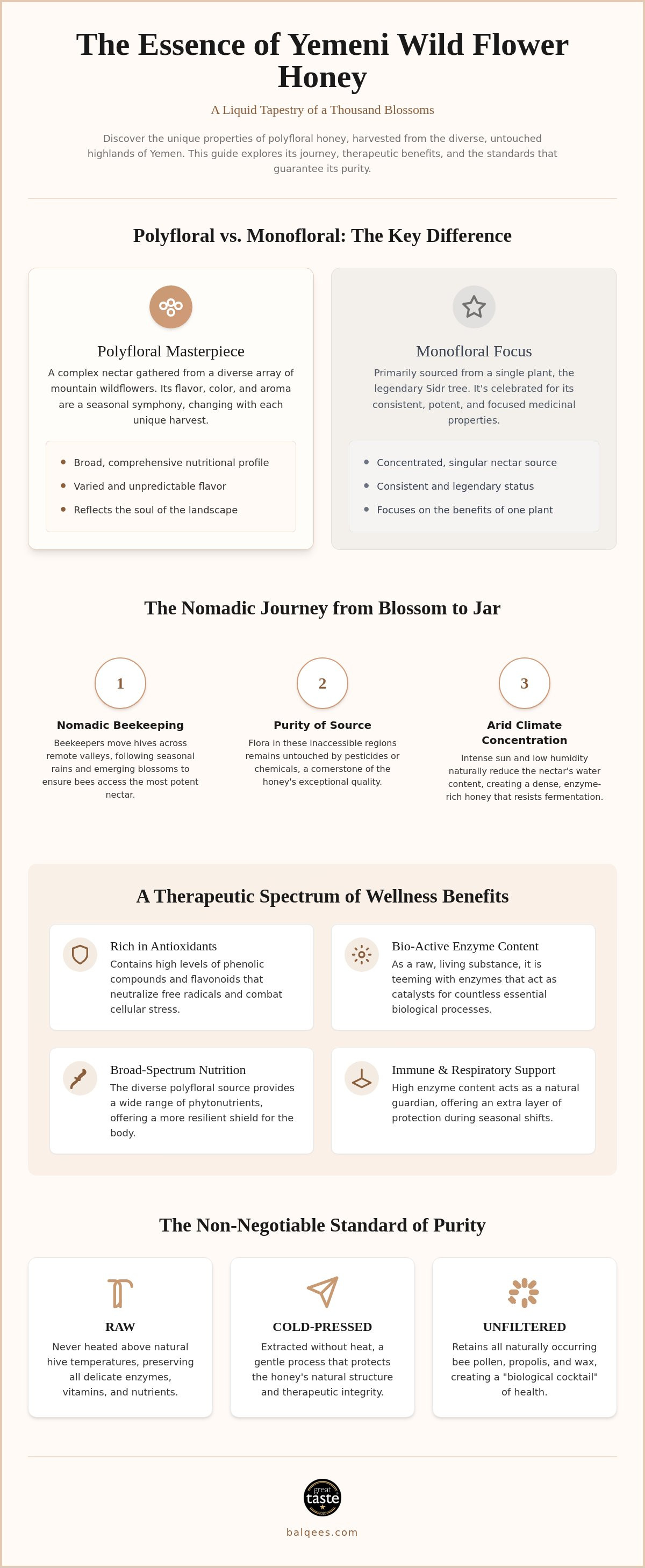
Nature doesn't adhere to a rigid schedule. It breathes, shifts, and blooms in a rhythm that is entirely its own. Yemeni Wild Flower Honey is a liquid record of this breath. While the legendary Sidr honey is celebrated for its monofloral focus on a single tree, our wild flower variety is a polyfloral masterpiece. It's a complex nectar gathered from a dizzying array of mountain flora. This isn't just honey; it's a seasonal symphony. During the summer months, the Yemeni highlands transform into a vibrant tapestry of wildflowers, each contributing its own unique essence to the final harvest. This diversity creates a flavor profile that is far more varied and unpredictable than its monofloral cousins.
The deep reverence for honey in Yemeni cuisine reflects its status as more than just a sweetener. It's a sacred gift of the earth. In the wild flower variety, you taste the collective soul of the landscape. Because the bees visit hundreds of different plant species, the resulting honey carries a broader, more intricate character. It's a reflection of a specific time and a specific place, captured in a jar before the season turns.
The Nomadic Harvesting Process
The journey of this honey begins with the ancient tradition of nomadic beekeeping. Beekeepers move their hives across untouched valleys and rugged highlands, following the trail of seasonal rains and emerging blossoms. This movement is vital. It ensures the bees always have access to the most potent, nutrient-dense nectar available. Because these regions are remote and largely inaccessible to modern industry, the flora remains untouched by pesticides or chemicals. This purity is a cornerstone of the honey's quality. The arid Yemeni climate also plays a crucial role. The intense sun and low humidity naturally reduce the water content of the nectar, resulting in a dense, thick honey that resists fermentation and concentrates its natural enzymes.
Why Single-Origin Polyfloral Honey Matters
Diversity is the greatest strength of this nectar. When bees forage from a wide spectrum of plants, they create a "biological cocktail" of health. One of the primary Yemeni wild flower honey benefits is this expansive range of phytonutrients. Each flower species adds its own specific compounds to the mix, offering a more comprehensive nutritional profile than honey derived from a single source. You'll notice that the color and texture of this honey can shift with every harvest. One year it may be a bright, sun-drenched amber; the next, it might lean toward a deeper, darker hue. These variations aren't flaws. They are the honest signatures of a changing environment, proving that the honey is raw, natural, and entirely dictated by the whims of the mountain summer.
The Therapeutic Spectrum: Yemeni Wild Flower Honey Benefits for Wellness
To understand the potency of this nectar, one must view it as a living substance. It isn't merely a collection of sugars. It's a bio-active concentrate. Raw, unfiltered Yemeni honey is teeming with life in the form of enzymes. These proteins act as catalysts for countless biological processes. Among the most significant Yemeni wild flower honey benefits is its remarkable concentration of phenolic compounds and flavonoids. These are the plant's own defense mechanisms, passed from the blossom to the bee, and finally to you. They act as scavengers, neutralizing free radicals that contribute to cellular stress. This isn't just traditional wisdom. Modern clinical research on honey's health benefits confirms that these antioxidants provide a robust foundation for long-term wellness.
Because the bees forage from a diverse polyfloral source, the resulting honey offers a comprehensive nutritional profile. Each flower contributes a different set of phytonutrients. This creates a more resilient shield for the body compared to monofloral varieties. It's a broad-spectrum approach to health, gifted by the mountains themselves. The synergy of these different nectars produces a final product that is far greater than the sum of its parts.
Immune Resilience and Respiratory Support
As the seasons shift, the body often requires an extra layer of protection. This honey acts as a natural guardian. Its high enzyme content, particularly glucose oxidase, produces low levels of hydrogen peroxide. This creates an environment where harmful bacteria struggle to thrive. It's a gentle yet effective way to support the respiratory tract. For generations, it's been a primary remedy for soothing the raw discomfort of a sore throat. The honey coats the membranes, providing immediate relief while its antibacterial properties go to work. You can find more detailed ways to use honey for immune support in our dedicated guide to resilience rituals. It's about building a daily practice that honors the body's needs.
Digestive Wellness and Prebiotic Power
Health often begins in the gut. Raw honey serves as a potent prebiotic. It doesn't just feed you; it feeds the beneficial bacteria that reside in your digestive system. These "good" microbes are essential for everything from nutrient absorption to immune regulation. The Yemeni wild flower honey benefits for the digestive system are rooted in enzymes like amylase, which assist in breaking down complex starches, making the digestive process smoother and more efficient. The honey's texture also plays a role. It provides a gentle, soothing coating for the stomach lining, which can be particularly helpful for those dealing with occasional acidity or irritation. It's a testament to the intelligence of nature that something so delicious can also be so deeply restorative. If you're looking to elevate your wellness routine, exploring the range at Balqees Honey is a wonderful place to start.
Sensory Analysis: Taste, Texture, and Terroir
To truly appreciate this honey, you must first look at its color. Hold a jar against the light. You'll see a luminous amber hue that seems to have captured the very essence of the summer sun. This isn't a static shade. It's a living reflection of the season's specific blooms. In the world of fine honey, we speak of "terroir," a term borrowed from the vineyards of France. It represents the taste of the land itself. When you sample this nectar, you aren't just tasting sugar; you're tasting the soil, the altitude, and the wild air of the Yemeni highlands. Beyond the palate, understanding Yemeni wild flower honey benefits begins with a sensory appreciation of its origin.
The texture is equally remarkable. It's thick, velvety, and slow to pour. This density is a hallmark of authentic Yemeni harvests. Because the region is so arid, the bees produce a honey with exceptionally low moisture content. This natural concentration creates a luxurious mouthfeel that lingers, allowing the complex floral notes to unfold slowly across your tongue. It's a deliberate, methodical experience that demands your full attention.
The Seasonal Flavor Profile
Nature doesn't repeat itself. One harvest might lean toward bright, citrusy notes if the orange blossoms were particularly vibrant. Another might offer a deeper, herbal complexity reminiscent of wild thyme or lavender. This variability is the soul of a polyfloral nectar. The concentration of the nectar is dictated by subtle shifts in rainfall and temperature, ensuring that no two years are ever exactly the same. For the discerning enthusiast, we've prepared a brief tasting guide:
- Aroma: Expect a bouquet of sun-drenched wildflowers, often with a hint of warm earth and dried herbs.
- Initial Palate: A bright, floral sweetness that feels fresh rather than heavy.
- Finish: A clean, slightly spicy or peppery lingering note that speaks to its high enzyme content.
Wild Flower vs. Sidr: Choosing Your Nectar
A common question among connoisseurs is whether to choose the legendary Sidr or the vibrant Wild Flower. The answer depends on your intention. Sidr is famous for its bold, medicinal intensity and earthy depth. It's a powerhouse for targeted healing. In contrast, Wild Flower is bright, spirited, and incredibly versatile. While it shares many therapeutic properties, its lighter profile makes it superior for culinary use, where it can enhance without overpowering. While we celebrate the taste, we don't overlook the science. Peer-reviewed research on Yemeni honey's anti-cancer properties highlights how these complex floral compounds provide more than just flavor. If you're curious about how this compares to other global treasures, exploring our guide to rare honey varieties will broaden your perspective. For daily metabolic support and a more delicate sensory experience, the wild flower variety is often the preferred choice.
Connoisseur Rituals: Incorporating Wild Flower Honey into Your Daily Life
A ritual is a promise you make to yourself. It's that quiet, intentional moment before the world demands your attention, where a single spoonful of nectar grounds you in the present. Exploring Yemeni wild flower honey benefits reveals that its utility extends far beyond the kitchen; it's a tool for holistic living. Start your morning with a simple metabolic activation. Dissolve a generous teaspoon of honey into a glass of lukewarm water. It's vital to avoid boiling water, as high heat destroys the living enzymes that make this honey so restorative. This ritual gently awakens the digestive tract and provides a steady, lucid clarity to begin your day.
As the sun sets, honey can also be your path to nighttime serenity. A small spoonful before bed helps regulate glycogen levels in the liver. This prevents the brain from triggering a stress response that can lead to wakefulness in the middle of the night. Whether you're drizzling it over a bowl of overnight oats or stirring it into a cup of artisanal chamomile tea, this honey adapts to your needs, bringing the vibrant energy of the Yemeni highlands into your home.
Natural Energy for Active Lifestyles
For those who move with purpose, raw honey is the ultimate clean fuel. Unlike processed sugars that cause a sharp insulin spike followed by a draining crash, the complex sugars in polyfloral nectar provide a sustained release of energy. This makes it an exceptional companion for endurance and recovery. You can dive deeper into the performance data by reading our guide on raw honey for athletes. To create your own pre-workout "shot," simply mix one tablespoon of Yemeni Wild Flower Honey with a squeeze of fresh lemon and a tiny pinch of sea salt. It's a natural electrolyte boost that honors your body's biology.
Skincare and Topical Applications
The beauty of this honey isn't just skin deep, but it certainly benefits the surface. As a natural humectant, it draws moisture into the skin, making it a powerful ally for hydration. Its antibacterial properties also help soothe blemish-prone areas without the harshness of synthetic chemicals. For a simple, two-ingredient mask that delivers a natural glow, mix equal parts honey and plain organic yogurt. Apply it to clean skin for fifteen minutes before rinsing with cool water. You'll feel the immediate softening effects of the mountain flora. Ready to elevate your wellness routine? Experience the purity of Yemeni Wild Flower Honey and transform your daily rituals today.
The Balqees Standard: Sourcing Authentic Yemeni Wild Flower Honey
Authenticity is the silent guardian of quality. In a market where labels can be misleading, understanding the technical journey from the hive to your table is essential for any true connoisseur. At Balqees, we view honey as a living substance. This means that "raw" and "unfiltered" aren't just marketing terms; they're a commitment to biological integrity. To truly capture the Yemeni wild flower honey benefits we have explored, the nectar must remain untouched by industrial heat. We rely exclusively on cold-pressing. Why is this non-negotiable? High temperatures destroy the delicate floral enzymes and volatile compounds that give this honey its medicinal soul. If honey is heated to speed up the bottling process, it becomes little more than a dead syrup. We choose the slower, more respectful path.
Storing your honey correctly is the final step in preserving this mountain treasure. Keep your jar in a cool, dark place away from direct sunlight. There's no need for refrigeration. In fact, cold temperatures can accelerate crystallization. When stored properly in glass, raw honey can maintain its potency and flavor for years. It's a testament to the natural preservatives found within the nectar itself. Always use a clean, dry wooden or glass dipper. Moisture is the only real threat to the stability of your honey.
Identifying Purity in the UAE
How can you tell if your honey is truly raw? Look for the signs of life. Crystallization is one of the most reliable indicators of purity. If your honey becomes cloudy or solidifies over time, don't be alarmed. This is a natural process where the glucose separates from the water, proving that the honey hasn't been ultra-filtered or heat-treated. Industrial supermarket "syrups" often remain unnaturally clear and liquid forever because their vital pollen and enzymes have been stripped away. Our commitment to zero additives ensures that every jar of Balqees honey retains its original, complex character.
Sustainable Heritage and Ethical Beekeeping
Choosing authentic honey is an act of preservation. The honey industry in Yemen is valued at an estimated $500 million annually, providing a vital livelihood for approximately 100,000 beekeeper households. By sourcing from these traditional cooperatives, we help sustain ancient nomadic practices that are currently under pressure from environmental and regional challenges. These bees do more than just produce nectar; they're the primary pollinators for the diverse flora of the Yemeni highlands, maintaining the biodiversity of the entire landscape. This ethical cycle ensures that the Yemeni wild flower honey benefits both the consumer and the earth. Every spoonful supports a heritage that dates back millennia. Are you ready to taste the true soul of the mountains? Explore our Yemeni Wild Flower Honey and experience the Balqees standard for yourself.
Embrace the Living Heritage of the Yemeni Highlands
The journey through the Yemeni highlands reveals a nectar that is as diverse as the landscape itself. You've discovered how the nomadic tradition captures a seasonal symphony of blossoms, creating a honey that is far more than a simple sweetener. By choosing these polyfloral varieties, you access a broader therapeutic spectrum, ensuring that the Yemeni wild flower honey benefits extend from metabolic support to deep immune resilience. The true power of this liquid gold lies in its untouched state. Preserving the delicate enzymes and complex phytonutrients requires an absolute commitment to raw, cold-pressed standards that honor both the work of the bees and the ancient heritage of the beekeepers.
At Balqees, we act as guardians of this specialized craft. Our honey is sourced from pesticide-free nomadic hives and remains 100% raw and unfiltered, a standard trusted by honey connoisseurs across the UAE. It's time to bring the vibrant, untamed soul of the mountains into your own daily rituals. Experience the Floral Symphony of Raw Yemeni Wild Flower Honey and let each spoonful be a reminder of nature's quiet wisdom and the enduring strength of artisanal tradition.
Frequently Asked Questions
Is Yemeni Wild Flower honey as beneficial as Sidr honey?
Yemeni Wild Flower honey is equally beneficial but offers a different therapeutic profile compared to the legendary Sidr. While Sidr is famous for its specific medicinal intensity, the polyfloral nature of wild flower honey provides a more diverse antioxidant profile. It's an excellent choice for daily wellness and metabolic support. Both varieties are premium; however, they serve different roles in a holistic health routine by offering different sets of phytonutrients.
Why does the color of my Wild Flower honey change between orders?
The color shifts because this is a seasonal, polyfloral product dictated by the specific summer blooms available to the bees. Factors like rainfall and temperature in the Yemeni highlands change the nectar concentration and floral availability from year to year. These variations are a hallmark of authentic, raw honey. They prove that your honey is a natural product of the land, untouched by the standardization of industrial processing.
Can I use Yemeni Wild Flower honey for a sore throat?
Yes, this honey is highly effective for soothing a sore throat due to its natural antibacterial properties and high enzyme content. The thick, velvety texture coats the membranes, providing immediate relief from irritation while its bio-active compounds work to calm inflammation. For the best results, take a small spoonful directly or mix it into lukewarm water. Don't use boiling water, as it can compromise the honey's restorative properties.
What is the best way to consume honey for maximum health benefits?
Consume your honey raw and avoid exposing it to high heat to maintain the maximum Yemeni wild flower honey benefits. High temperatures destroy the delicate enzymes and volatile compounds that provide its health value. Many connoisseurs prefer a morning ritual of dissolving a spoonful in lukewarm water or drizzling it over breakfast. This ensures you receive the full range of its living, bio-active compounds in their most potent form.
Does raw Yemeni honey expire or go bad?
Properly stored raw honey does not expire and can remain safe for consumption indefinitely. It contains natural preservatives and exceptionally low moisture levels that prevent the growth of bacteria. While it might crystallize or change texture over time, this is a sign of purity rather than spoilage. Simply keep your jar in a cool, dark place to maintain its medicinal potency and flavor for many years.
Is this honey suitable for children?
This honey is safe and beneficial for children over the age of one year. It's a clean energy source that supports their growing immune systems and provides a natural alternative to processed sugars. However, you must never give honey to infants under twelve months old. This is due to the risk of botulism spores, which a developing digestive system is not yet equipped to handle safely.
How can I tell if my Yemeni honey is authentic?
You can verify authenticity by looking for natural crystallization and ensuring the honey is labeled as raw, cold-pressed, and unfiltered. Authentic Yemeni honey should have a thick, slow pour and a complex floral aroma. We work directly with nomadic cooperatives to ensure a transparent supply chain. If the honey is unnaturally clear or lacks a deep, multi-layered flavor, it has likely been heat-treated or adulterated with syrups.
Why is Yemeni honey more expensive than commercial honey?
The premium price reflects the labor-intensive nomadic harvesting methods and the ethical support of traditional Yemeni beekeeping communities. This industry is valued at an estimated $500 million annually and provides a vital livelihood for approximately 100,000 beekeeper households. When you purchase this honey, you're paying for purity and the preservation of a heritage. Modern industrial methods cannot replicate the quality found in these remote, pesticide-free highlands.


