


What if the golden liquid in your pantry was actually a living biological record of a distant forest, rather than just another sweetener? While many see only sugar, the connoisseur recognizes a living nectar teeming with vitality. You have likely stood in a grocery aisle feeling skeptical of superfood claims or frustrated by the lack of raw honey nutrition facts on a standard label. It's difficult to distinguish between a mass-produced syrup and a genuine artisanal treasure, especially since federal regulations in 2026 still lack an official definition for the term raw honey.
We understand that you want more than just sweetness; you want the integrity of the hive. Purity matters. Quality is rarely accidental. This guide explores the complex biological blueprint that validates your choice to seek out nature's living nectar. We'll break down the specific enzymes, minerals, and antioxidants that industrial heat destroys, providing a clear breakdown of why raw honey remains a superior choice. You will learn how to read artisanal labels with confidence and discover practical ways to use these living nutrients for your daily wellness.
Key Takeaways
- Understand the delicate balance of fructose and glucose that makes honey a more complex energy source than refined sugars.
- Explore the raw honey nutrition facts that reveal a wealth of B-vitamins and essential minerals like potassium and magnesium found only in unfiltered varieties.
- Learn why maintaining temperatures below 40°C is vital for protecting the living enzymes that define true raw honey.
- Discover the functional benefits of a lower glycemic index and the prebiotic power that supports a flourishing gut microbiome.
- Gain insight into the "Hive-to-Jar" philosophy and why remote origins like Wadi Do’an ensure your honey is free from industrial pollutants.
The Macronutrient Profile: Understanding the Sugars in Raw Honey
To understand the essence of the hive, one must look beyond the surface sweetness. Raw honey is a complex, supersaturated sugar solution. It is a biological masterpiece crafted by bees through a process of enzymatic transformation and moisture reduction. Most people assume honey is just another form of sugar. However, the raw honey nutrition facts tell a different story. While refined sugar is a simple, industrial product, the chemical composition of Honey reflects the specific flora from which it was gathered. This makes every jar a unique liquid map of its origin.
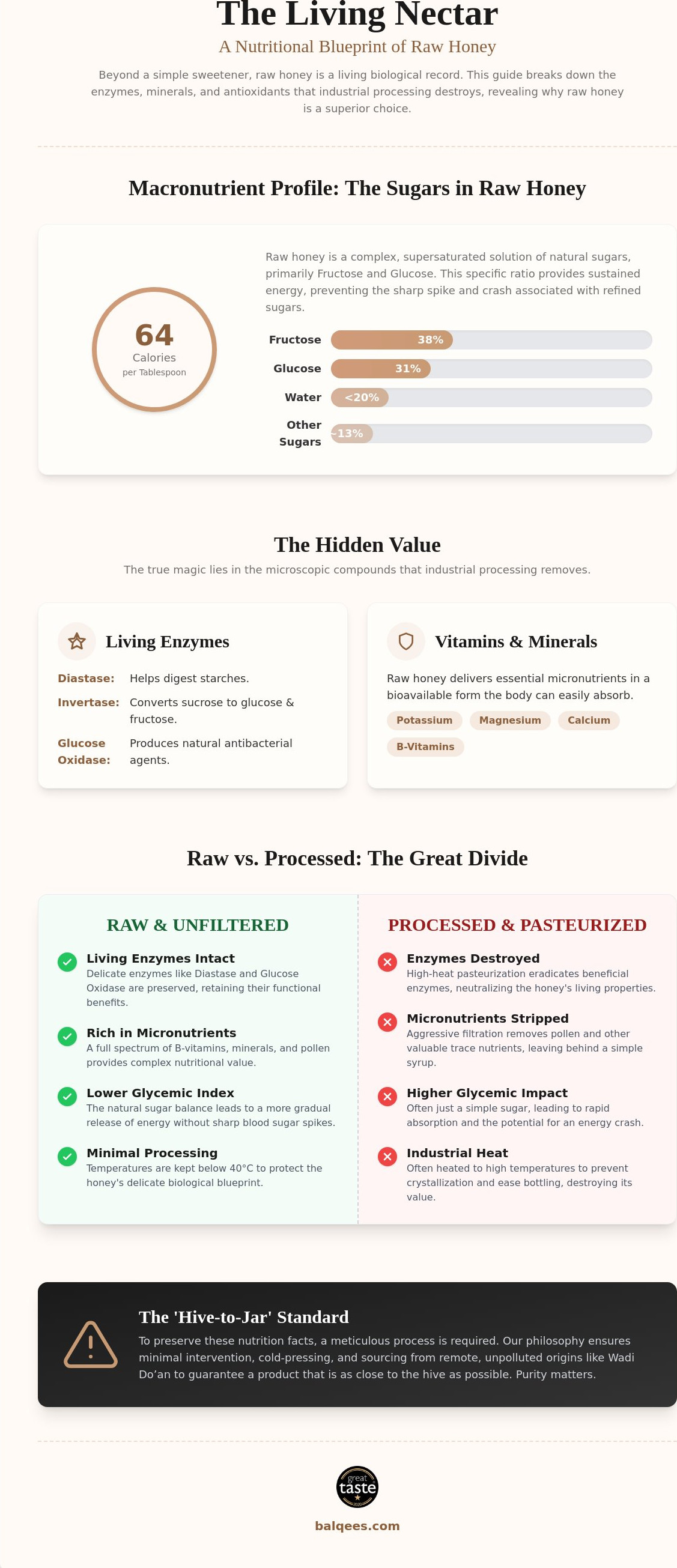
The primary components are two simple sugars: fructose and glucose. In a typical batch of raw nectar, fructose accounts for approximately 38% of the weight, while glucose makes up about 31%. These aren't the only players. Raw honey contains a tapestry of rare disaccharides and trisaccharides, such as melezitose. These complex sugars are often entirely absent in processed alternatives. From a caloric perspective, raw honey is dense and potent. A single tablespoon offers between 60 and 64 calories of pure, unadulterated energy. It's a concentrated gift from the natural world.
Fructose vs. Glucose: The Energy Dynamics
The ratio between these two sugars determines more than just the flavor profile. It dictates how the honey behaves over time. Consider our Raw Yemeni Sidr Do'ani Honey. It possesses a naturally high fructose content. This specific balance acts as a stabilizer. It prevents the rapid crystallization that often occurs in lower-grade or highly processed honeys. For the athlete or the active individual, this sugar bond structure is vital. It provides a sustained release of energy rather than a sharp spike. You won't experience the jagged sugar crash associated with refined high-fructose corn syrup. It is steady fuel for the body and the mind.
The Role of Water Content in Nutrient Density
Water is the enemy of preservation, yet raw honey masters the balance. Most artisanal honey contains less than 18-20% moisture. This low water content is a natural shield. It acts as a preservative for the delicate vitamins and antioxidants within the nectar. We prioritize patience in our harvesting. A master beekeeper knows that the honey must be "ripe" before it is extracted. This means waiting for the bees to fan the nectar with their wings until the moisture levels are perfect. Only then do they cap the cells with wax. This meticulous timing ensures that the raw honey nutrition facts remain intact, offering you a product that is as close to the hive as possible.
Micronutrients and Bioactive Compounds: The Hidden Value
Beyond the sugars discussed previously, the true magic of the hive lies in the microscopic. Raw honey serves as a dense, living delivery system for trace minerals that are essential for physiological balance. These include potassium, magnesium, and calcium. While the quantities may seem small, their presence in a bioavailable form makes them significant. Unlike synthetic supplements, these minerals arrive in a natural matrix that the body recognizes and absorbs with ease. Purity is paramount. The raw honey nutrition facts reveal a depth of character that processed alternatives simply cannot replicate.
The B-vitamin complex found in unfiltered honey is equally impressive. You'll find riboflavin (B2), niacin (B3), pantothenic acid (B5), and pyridoxine (B6) tucked within the nectar's amber folds. These vitamins are often stripped away during the aggressive filtration and pasteurization used in commercial products. When you examine the data regarding Raw Honey vs. Regular Honey, the absence of these micronutrients in the latter is a stark reminder of what is lost to industrial heat. Bioactive compounds are the substances that provide honey its medicinal reputation.
Enzymes: The Living Component of Raw Honey
Enzymes are the delicate architects of honey's health benefits. Diastase, also known as amylase, plays a critical role in breaking down complex starches into simpler sugars. Glucose oxidase is perhaps the most fascinating; it facilitates the production of natural hydrogen peroxide, which provides honey with its legendary antibacterial properties. Finally, invertase is essential for the maturation of honey, converting sucrose into the stable fructose and glucose blend we enjoy. These enzymes are fragile. They are the primary reason why we insist on cold-pressing and minimal intervention to preserve the raw honey nutrition facts.
Antioxidant Capacity: Beyond the Label
The antioxidant profile of raw honey is driven by a sophisticated array of polyphenols and flavonoids. One standout is pinocembrin, an antioxidant unique to honey and bee propolis that acts as a powerful protector of cellular health. Generally, the darker the honey, the more potent its antioxidant capacity. Our Raw Yemeni Sidr Do'ani Honey is a prime example, boasting a deep hue and a high concentration of these protective compounds. For those who prefer a different sensory experience, the white mountain honey benefits offer a unique perspective on purity and rare floral nectars. If you're ready to taste the difference that minimal intervention makes, exploring our collection of artisanal honeys is the next step in your journey.
Raw vs. Processed: How Pasteurization Alters Nutrition Facts
The difference between industrial honey and nature's living nectar is profound. One is a product of convenience. The other is a product of the earth. Most commercial honeys found on supermarket shelves are essentially "dead" calories. They've been stripped of their biological activity to ensure they remain clear and liquid indefinitely. It's a trade-off. You get a shelf-stable syrup, but you lose the vibrant raw honey nutrition facts that an artisanal jar provides. When honey is pasteurized, it's subjected to intense heat to prevent crystallization and kill yeast. This process makes the honey look aesthetically pleasing, but it destroys the very essence of what makes it a superfood.
Heat is the primary thief of vitality. Once temperatures exceed 40°C, the essential enzymes like glucose oxidase and diastase begin to denature. They lose their shape. They lose their function. The delicate phytonutrients and volatile aromatic compounds that give honey its complex, floral flavor profile simply evaporate into the air. What remains is a sugary shadow of the original substance. Research into Raw honey nutrition and benefits confirms that this thermal processing significantly reduces the antioxidant levels and antibacterial potency that health-conscious consumers seek. It's a sterile version of a once-living food.
The Problem with Ultra-Filtration
Industrial processors often push honey through extremely fine filters under high pressure. This removes every trace of sediment, including bee pollen. While this results in a crystal-clear liquid that appeals to the eye, it also removes a significant source of amino acids and vitamins. Pollen is the primary delivery vehicle for trace minerals within the honey matrix. Knowing how to identify authentic Sidr honey involves looking for that characteristic natural cloudiness. That opacity isn't a flaw. It's a signature of nutritional density.
Cold Pressed Purity
To protect the raw honey nutrition facts, we utilize cold pressing. This method ensures the honey is never heated beyond the natural temperature of the beehive. It preserves the honey's original chemical state, keeping every enzyme and aromatic molecule exactly where nature intended. For those interested in the technical mastery of this craft, our guide on cold pressed honey UAE offers a deeper look into why temperature control is the single most critical factor in honey nutrition. Purity isn't just about what is added; it's about what is carefully and respectfully preserved.
Functional Nutrition: How Raw Honey Impacts the Body
The body does not process all sweetness equally. When you consider the raw honey nutrition facts, you see a functional food that communicates with your physiology on multiple levels. Unlike refined sucrose, which is a blunt instrument for the metabolism, raw honey possesses a relatively low Glycemic Index. This is largely due to the specific ratio of fructose to glucose we explored earlier, which ensures a more tempered rise in blood sugar. Organic acids, particularly gluconic acid, further support this metabolic harmony by assisting in various enzymatic reactions. It's a concept known as nutritional synergy. The enzymes, minerals, and sugars work in concert. They provide benefits that no single isolated compound could achieve on its own. This is the difference between a supplement and a living food.
Raw Honey as a Prebiotic
Your gut is a garden that requires specific cultivation. Raw honey contains complex carbohydrates known as oligosaccharides. These are non-digestible by humans but serve as a vital food source for beneficial bifidobacteria. When these "good" bacteria thrive, they strengthen the intestinal barrier and modulate the immune system. A flourishing gut microbiome doesn't just aid digestion; it actually enhances the body's ability to absorb the very minerals and vitamins found in the nectar. Regular consumption of raw honey creates a virtuous cycle of digestive wellness and nutrient efficiency.
The Athlete’s Fuel: Glycemic Response
For those who push their physical limits, the quality of fuel is non-negotiable. Synthetic energy gels often trigger a violent insulin spike followed by an exhausting crash. Raw honey offers a steady, reliable glycemic response that sustains performance over longer durations. It's the perfect companion for glycogen replenishment after a demanding session, helping to repair and refuel tired muscles. To elevate this natural performance, many connoisseurs turn to specialized infusions like our Raw Honey & Ginseng Fusion. It combines the living energy of the hive with adaptogenic power for a truly functional boost. If you're seeking to integrate these benefits into your own wellness ritual, explore our range of functional honey blends to find your perfect match.
The Balqees Standard: Protecting the Nutritional Blueprint
Purity is not a destination; it's a continuous practice of restraint. To preserve the intricate raw honey nutrition facts we have discussed, one must resist the urge to interfere with nature's timing. At Balqees, our commitment is rooted in a "Hive-to-Jar" philosophy. This means we act as guardians rather than manufacturers. We source our nectars from the most remote, untouched regions of the world, such as the legendary Wadi Do’an in Yemen. These high-altitude landscapes are free from the industrial pollutants and pesticides that often contaminate commercial honey supplies. By protecting the environment of the bee, we protect the biological integrity of the honey.
We work exclusively with artisanal beekeepers who view their craft as a sacred heritage. These masters prioritize the health and longevity of the colony over the high-pressure demands of mass production. They allow the bees to complete their work naturally, ensuring the honey is fully ripened and sealed before harvest. This patience is what keeps the enzyme counts high and the antioxidant profile robust. When you choose to buy raw honey online UAE through Balqees, you're securing a product that has been handled with the reverence it deserves. We ensure that every fact on the label is backed by a process of absolute transparency and minimal intervention.
Heritage and Purity
Traditional Yemeni beekeeping methods have remained virtually unchanged for centuries. This lack of "modernization" is precisely why Raw Yemeni Sidr Do'ani Honey is globally recognized as the pinnacle of nutritional potency. The bees forage on the ancient Sidr tree, producing a nectar that is exceptionally thick and rich in bioactive compounds. We don't just sell honey; we act as mentors and storytellers for this ancient craft. Our role is to bridge the gap between these traditional methods and your modern wellness journey, ensuring that the soul of the hive remains intact.
Functional Blends for Targeted Wellness
While raw honey is powerful on its own, it can also serve as a sophisticated carrier for other potent botanicals. Our Black Seed Fusion and Raw Honey & Ginseng Fusion are crafted to amplify the honey's natural nutrition without compromising its base profile. We carefully fold these ingredients into the nectar, respecting the delicate balance of enzymes and minerals already present. These blends are designed for the connoisseur who seeks a targeted approach to health. We invite you to explore our full collection and discover how nature's living nectar can become a transformative part of your daily life.
Embrace the Living Legacy of the Hive
Choosing honey is an act of trust. You now understand that the golden liquid in your jar is more than a sweetener; it's a complex delivery system of life. By prioritizing nectars that avoid the destructive heat of pasteurization, you ensure that every spoonful remains biologically active. These raw honey nutrition facts serve as your guide to distinguishing between a processed syrup and a genuine superfood. True quality is found in the cloudiness of the pollen and the preservation of delicate enzymes that nature intended for your well-being.
At Balqees, we remain dedicated to the slow, respectful methods that have defined Yemeni heritage for generations. Our honey is artisanally sourced from the remote Wadi Do’an, remaining unfiltered and cold-pressed to preserve all 22 amino acids. It's a nectar rich in natural enzymes and living polyphenols, untouched by industrial intervention. We invite you to experience the nutritional potency of our Raw Yemeni Sidr Honey and see how nature’s living nectar can elevate your daily wellness. Let the ancient traditions of the hive become a cornerstone of your modern health journey.
Frequently Asked Questions
Is raw honey higher in calories than regular sugar?
Raw honey is slightly higher in calories by volume than white table sugar. A single tablespoon typically contains 60 to 64 calories, while the same amount of granulated sugar holds about 48 calories. Because honey is significantly sweeter and more complex in flavor, you'll likely find that you need a smaller amount to reach the same level of sensory satisfaction. It's a trade-off that favors depth and quality over simple quantity.
Does raw honey contain vitamins and minerals?
Yes, raw honey contains a diverse spectrum of micronutrients that are entirely absent in refined sweeteners. When you examine the raw honey nutrition facts, you'll find trace amounts of potassium, magnesium, and calcium. It also carries a delicate B-vitamin complex, including riboflavin and niacin. These nutrients remain intact because the honey hasn't been subjected to the aggressive heat of industrial pasteurization, which typically destroys such fragile compounds.
What are the main enzymes found in raw honey?
The primary enzymes are diastase, glucose oxidase, and invertase. These living components are the biological architects of the hive. Diastase helps break down complex starches; glucose oxidase facilitates the production of natural hydrogen peroxide for antibacterial support. Invertase is responsible for converting sucrose into the more easily digestible fructose and glucose. These enzymes are the reason we treat our nectar with such reverence, ensuring it's never overheated during the bottling process.
Can people with diabetes eat raw honey based on its nutrition facts?
Individuals with diabetes may find raw honey a more manageable alternative to white sugar because it has a lower glycemic index. The specific ratio of fructose to glucose provides a steadier release of energy. It doesn't cause the same sharp insulin spikes as synthetic sweeteners. However, it's still a concentrated carbohydrate. You should always discuss the raw honey nutrition facts with your physician to see how they fit into your specific metabolic management plan.
Does the nutritional value of raw honey change over time?
The core mineral content remains stable, but the living enzyme activity can diminish if the honey is stored poorly. While honey is famous for its eternal shelf life, its most delicate biological qualities are best preserved in a cool, dark place. Exposure to direct sunlight or high temperatures will eventually denature the enzymes and soften the antioxidant profile. For the best experience, enjoy your honey within a few years of its harvest date.
Why does raw honey have more antioxidants than processed honey?
Raw honey retains a higher antioxidant count because it bypasses the thermal processing that destroys heat-sensitive polyphenols and flavonoids. Industrial brands often heat honey to high temperatures to ensure it remains clear and liquid on the shelf. This process kills the very compounds, like pinocembrin, that provide honey its protective qualities. By choosing a raw, cold-pressed variety, you're consuming the full, unadulterated antioxidant power that the bees intended.
Is the pollen in raw honey nutritionally significant?
Pollen is exceptionally significant as it's the primary source of amino acids and fatty acids within the nectar. It's the nutritional signature of an authentic, unfiltered product. These microscopic grains contribute to the honey’s overall density and provide the trace minerals that make raw honey a functional food rather than a simple syrup. Removing the pollen through ultra-filtration might make the honey look clearer, but it strips away a vital part of its soul.
How much raw honey should I consume daily for health benefits?
Most wellness practitioners suggest one to two tablespoons daily to experience the functional benefits without overconsuming sugars. This moderate amount allows you to enjoy the prebiotic and antioxidant support while maintaining a balanced diet. It's best enjoyed in its raw state, perhaps stirred into lukewarm water or drizzled over a morning bowl of fruit. This ensures the living enzymes remain active and ready to support your digestive health.


