


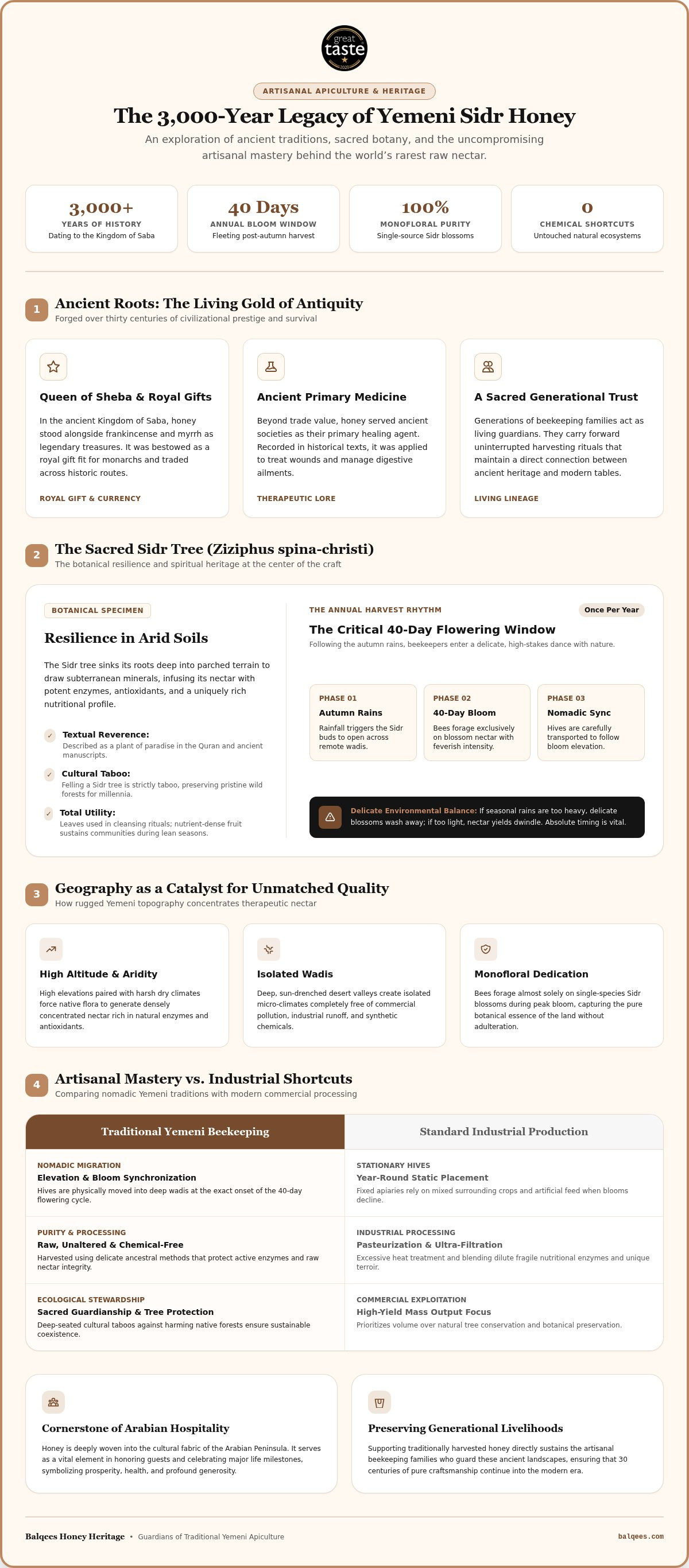
Yemeni honey heritage is best understood through the people who produce it and the food shared around it. Sidr and regional names connect a jar to flowers and places, while individual beekeeper stories show the work behind the harvest.
A tradition that continues to change
Heritage does not mean every beekeeper uses the same tools or that methods have stayed unchanged. A 2023 FAO account describes training and equipment supplied to Yemeni beekeepers. Traditional knowledge and practical improvements can be part of the same working craft.
Ask about the actual producer, region and harvest when exploring a honey’s story. A dramatic age claim or royal association is less informative than a named place and a clear account of the relationship.
Honey at the table
One way to explore Yemeni food is Bint al Sahn, a layered bread-like cake served with honey. Our recipe shares a practical route into that tradition. Serving honey with food lets its flavour speak without requiring a medical promise.
Sidr Do’ani combines a floral name with Wadi Doan in Hadramaut. Wildflower describes a mixed floral harvest. Learning those distinctions makes the cultural story more precise rather than treating every Yemeni jar as identical.
The Balqees connection
Founder Riath Hamed’s Yemeni family roots and upbringing in South Yorkshire are part of the brand’s story. Our published beekeeper and food articles extend that interest to people and places beyond Yemen as well.
Enjoy that heritage while keeping provenance and evidence clear. A sourcing story adds context; it is not an organic certificate, a laboratory report or proof that a particular jar treats disease. Those claims should be assessed separately.


