


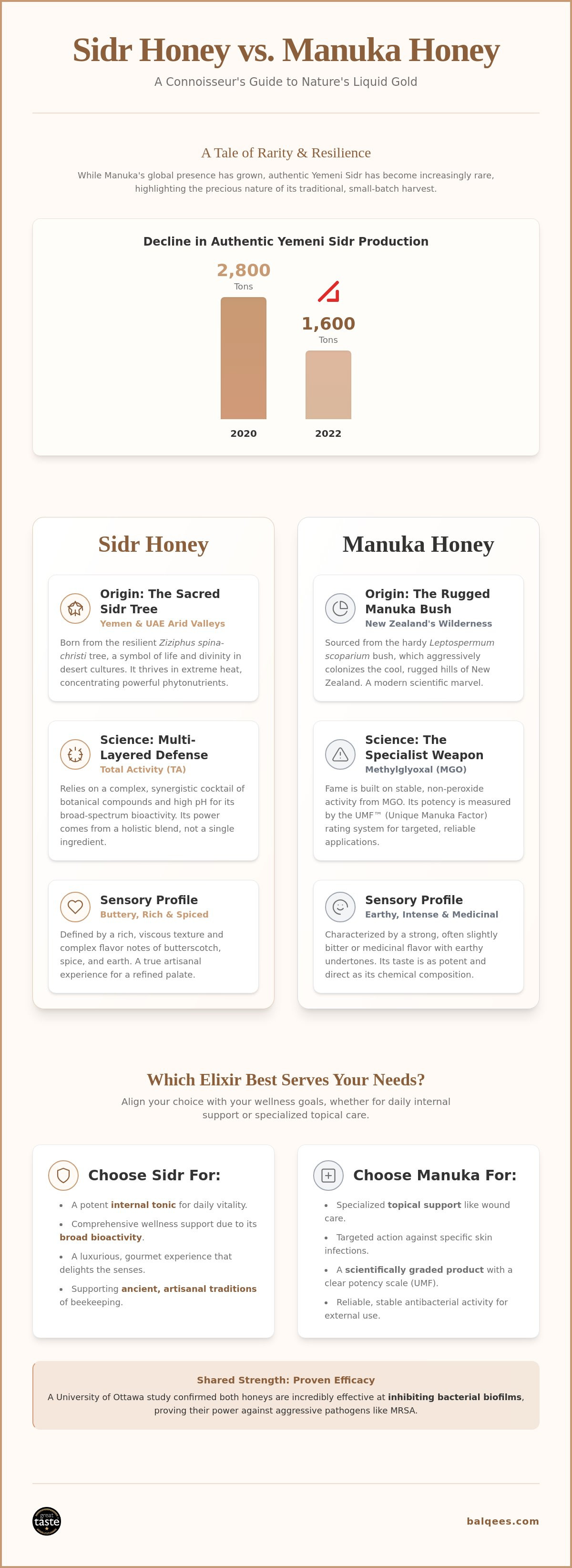
The most expensive honey in your cabinet isn't always the one that serves your body best. When you weigh the merits of Sidr honey vs Manuka honey, you aren't just comparing two sweeteners; you're choosing between two entirely different philosophies of healing. You likely already know that both are revered as liquid gold, yet the confusing maze of UMF ratings and provenance claims can make the choice feel overwhelming. It's frustrating to pay a premium price when you aren't certain if you're buying a therapeutic powerhouse or a clever imitation, especially as authentic Yemeni production has faced a sharp decline from 2,800 tons in 2020 to just 1,600 tons in 2022.
We believe your wellness journey deserves clarity and uncompromising purity. This guide offers the definitive comparison between these two prestigious elixirs, helping you decide which one aligns with your specific health needs. We'll look past the marketing to explore the scientific strength of New Zealand's Manuka and the deep, ancestral heritage of Yemeni Sidr. By the end, you'll have the confidence to select the perfect jar for your home and a true appreciation for the artisanal craft behind every drop.
Key Takeaways
- Contrast the sacred botanical heritage of the Sidr tree with the resilient Manuka bush to understand how geographical origin shapes their unique healing properties.
- Understand the scientific distinctions between Sidr honey vs Manuka honey, comparing the targeted power of Methylglyoxal (MGO) with the complex, multi-layered bioactivity found in Sidr.
- Refine your sensory palate by discovering the buttery, spiced notes and rich textures that define a true artisanal harvest.
- Identify which elixir best serves your specific wellness goals, whether you require specialized topical support or a potent internal tonic for daily vitality.
- Gain the expertise to navigate grading systems and labels, ensuring you invest only in authentic, raw, and unfiltered jars that honor ancient traditions.
The Sacred vs. The Rugged: Understanding Botanical Origins
To understand the soul of these elixirs, one must first look at the soil that birthed them. The comparison of Sidr honey vs Manuka honey begins in the landscape. One is born from the scorching, arid valleys of the Middle East; the other emerges from the cool, rugged wilderness of the Southern Hemisphere. These environments don't just host the trees. They dictate the very chemistry of the nectar. While one thrives in the silence of the desert, the other stands firm against the winds of the Pacific.
The Sacred Sidr Tree: A Desert Legend
The Sidr tree, or Ziziphus spina-christi, is a living testament to resilience. It's deeply woven into the cultural fabric of Yemen and the United Arab Emirates, appearing in ancient texts as a symbol of life and divinity. The tree survives where most life falters. It draws minerals from deep within the parched earth, enduring intense heat to bloom in a fleeting window during the winter months. This brevity makes every drop of nectar a precious rarity. The Sidr tree is a botanical fortress of nutrients. This extreme environmental stress forces the plant to concentrate its phytonutrients, which our bees then harvest to create Raw Yemeni Sidr Do'ani Honey. Our beekeepers maintain a nomadic tradition, guiding hives into the remote Wadi Do’an to ensure the bees forage exclusively from these ancient, untouched groves.
The Manuka Bush: A Modern Scientific Marvel
Thousands of miles away, the landscape shifts to the damp, wind-swept hills of New Zealand. Here, the Manuka bush, or Leptospermum scoparium, defines the terrain. For decades, it was viewed as a nuisance shrub, a hardy plant that colonised cleared land with aggressive speed. This perception changed when researchers began to uncover the unique properties hidden within its white and pink blossoms. Exploring Manuka honey botanical origins reveals a species adapted to a cold, temperate climate, far removed from the desert heat. While the Sidr harvest remains a deeply artisanal, low-yield endeavor, the New Zealand industry has evolved into a sophisticated operation. This industrial scale allows for a consistent global presence, yet it lacks the small-batch intimacy of the Yemeni valleys, where beekeepers must navigate roadless canyons to reach their hives.
The difference in scale is palpable. In the valleys of Yemen, beekeeping is a heritage passed down through generations, a slow and careful process that respects the natural rhythm of the desert. In New Zealand, helicopters and high-tech tracking are often used to manage the vast bushlands. Both methods aim to capture the essence of the plant, but the resulting honeys carry the distinct energy of their origins. One is a product of scientific precision; the other is a gift of ancient tradition preserved against the odds.
The Science of Healing: MGO vs. Multi-Weapon Bioactivity
Science strips away the romance of the desert and the bush to reveal a fascinating chemical landscape. When evaluating Sidr honey vs Manuka honey, we must look at how they achieve their therapeutic status. Manuka relies on a specific chemical marker for its fame. Sidr draws its power from a complex cocktail of botanical compounds. Both have been validated by rigorous testing, including a significant study at the University of Ottawa. This research demonstrated that both honeys are incredibly effective at bacterial biofilm inhibition, proving that these aren't just sweet treats; they're biologically active tools capable of tackling aggressive pathogens like MRSA.
Manuka’s Specialist Weapon: Methylglyoxal (MGO)
Methylglyoxal, or MGO, is the heart of Manuka’s reputation. It provides what scientists call "non-peroxide" antibacterial activity. Unlike the hydrogen peroxide found in standard honey, MGO doesn't break down easily when exposed to heat or light. This stability makes it a reliable choice for topical applications, such as dressing wounds or treating skin infections. To help consumers, the industry uses the Unique Manuka Factor (UMF) grading system. It's a simple scale that measures MGO levels along with other markers of authenticity. A higher UMF rating means a higher concentration of this specialist weapon, offering a targeted approach to healing.
Sidr’s Multi-Layered Defense
Sidr honey takes a different path. It doesn't rely on a single "hero" ingredient. Instead, it utilizes Total Activity (TA), a synergistic blend of high pH levels, flavonoids, and phenolic compounds. These elements work in harmony to provide a comprehensive health boost. While Manuka targets bacteria directly, Sidr’s chemistry also focuses on reducing internal inflammation and neutralizing free radicals. Sidr honey’s high antioxidant levels rival the world’s most potent superfoods.
This "multi-weapon" approach is vital because it attacks pathogens from multiple angles simultaneously. It makes it far more difficult for bacteria to develop resistance compared to honeys that rely on a single active compound. By combining high mineral content with these potent antioxidants, Sidr acts as a generalist that supports the body's entire ecosystem. For those seeking this broad-spectrum support, exploring our Raw Yemeni Sidr Do'ani Honey reveals the true potential of desert-harvested bioactivity. In the ongoing debate of Sidr honey vs Manuka honey, Sidr stands out as the choice for those prioritizing internal wellness and complex, natural defense mechanisms.
A Sensory Showdown: Comparing Taste, Texture, and Aroma
Beyond the lab reports and ancient legends lies the most intimate part of the journey: the tasting. For the true connoisseur, the choice in the Sidr honey vs Manuka honey debate often comes down to the palate rather than the prescription. These two elixirs sit at opposite ends of the sensory spectrum. One offers a warm, sun-drenched embrace of the desert, while the other provides a sharp, bracing encounter with the wild New Zealand bush. Their visual presence alone tells a story of their origins. You'll see the clear, deep amber of Raw Yemeni Sidr Do’ani Honey glowing like a gemstone, contrasting sharply with the opaque, creamy tan of high-UMF Manuka varieties.
The Palate of the Desert
Tasting Sidr honey is a lesson in elegance. Its texture is famously velvet-like, coating the tongue with a buttery smoothness that feels substantial yet refined. Because we prioritize raw, unfiltered methods, the honey retains its natural pollen and propolis. This lack of processing ensures a complex, multi-dimensional aroma that hits you the moment the jar is opened. You'll find notes of cedar wood and subtle spice, balanced by a medicinal undertone that speaks to its potency. The sweetness is profound but never cloying. It finishes with a lingering warmth, a characteristic trait of the Ziziphus nectar that leaves the palate feeling satisfied and clean. It's a sophisticated profile that pairs beautifully with aged cheeses or simply enjoyed from a silver spoon.
The Earthy Profile of the Island
Manuka honey offers a more rugged, assertive experience. It's known for being thixotropic, a scientific term for its unique, jelly-like consistency. It's thick, often slightly grainy, and requires a firm scoop. The flavor is a complex tug-of-war between bitter and sweet. You'll likely detect notes of "damp earth" and "herbal" undertones, reminiscent of the hardy shrubs from which it's sourced. High-MGO varieties often carry a distinct medicinal aftertaste. This isn't necessarily a flaw; for many, it's a mark of authenticity and strength. It's a functional, bold profile that doesn't shy away from its wild roots. While Sidr is a silk scarf, Manuka is a woollen blanket; both are luxurious, but they serve very different sensory moods. Choosing between Sidr honey vs Manuka honey is ultimately a decision of whether you prefer the refined spice of the East or the herbal intensity of the South.
Therapeutic Intent: Which Liquid Gold Suits Your Wellness Needs?
Choosing between Sidr honey vs Manuka honey isn't about finding a definitive winner. It's about matching a specific remedy to your personal wellness goals. A common question arises for many: is Manuka superior simply because it carries a standardized UMF or MGO rating? Not necessarily. While these ratings offer scientific reassurance for clinical applications, they don't capture the full bio-complexity of an artisanal harvest. A number on a label is a measure of a single compound. It isn't a measure of heritage or the synergistic power of a multi-weapon defense system. Understanding your intent allows you to choose the right elixir for your cabinet.
Internal Vitality: The Sidr Advantage
Sidr honey is the preferred choice for those seeking internal restoration and systemic balance. It acts as a potent prebiotic, feeding the beneficial bacteria in your gut to support overall digestive harmony. Traditionally, it's been used to soothe respiratory tracts and provide relief during seasonal shifts. Beyond general wellness, there is a deep history of using men’s health and vitality secrets rooted in the Sidr harvest. Its high antioxidant load works from the inside out, fortifying the immune system against the stressors of a modern lifestyle. If you're looking for a daily tonic to support your body's natural defenses, Sidr's complex profile offers a broader range of internal benefits.
External Recovery: The Manuka Specialty
If your goal is skin deep, Manuka is your specialist. It's the gold standard in clinical settings for dressing burns and stubborn wounds because its MGO content remains active even when diluted by bodily fluids. For those struggling with acne or localized skin inflammation, a high-UMF Manuka acts as a targeted antibacterial shield. To get the most value, use it topically. Don't simply stir it into hot tea where its specific wound-healing enzymes might be underutilized. By applying it directly to the skin, you harness its unique non-peroxide activity where it's most effective. It's a functional tool for recovery, making it a staple in any first-aid kit or skincare routine.
Understanding these differences allows you to curate your own natural apothecary. If you're ready to experience the deep, internal benefits of a desert-born legend, we invite you to explore our Raw Yemeni Sidr Do'ani Honey. Whether you're seeking to support your digestive health or looking for a potent antioxidant boost, selecting the right honey ensures your wellness journey is both effective and deeply rewarding.
The Connoisseur’s Choice: Sourcing Authentic Purity
The global reputation of these elixirs has a shadow side. High demand often leads to a marketplace crowded with adulterated or diluted products. When you're deciding between Sidr honey vs Manuka honey, the integrity of the source is your most important metric. Authentic Yemeni Sidr, especially from the fertile valleys of Wadi Do’an, is a rare treasure. This region produces only a few tons annually, a tiny fraction of the world’s total honey output. This scarcity, coupled with the artisanal, nomadic methods we've discussed, is what justifies the price point. If a jar of Sidr seems too accessible or suspiciously cheap, it likely isn't the ancient medicine you're seeking.
Purity isn't just about the absence of additives. It's about what is kept inside. You should always look for "Raw" and "Unfiltered" on the label. Standard supermarket honeys are often pasteurized at high heat, a process that destroys the delicate enzymes and antioxidants that give these honeys their therapeutic edge. By keeping the honey raw, we preserve the pollen and propolis, ensuring the multi-weapon bioactivity remains intact from the hive to your home. It's a difference you can taste and feel.
The Balqees Standard of Purity
We see ourselves as guardians of a tradition that spans centuries. Our commitment to quality starts with the Sidr Tree in specific heritage regions known for their potent nectar. We don't use industrial processing or high-heat filtration. Every jar is cold-pressed and handled with the reverence it deserves. For those looking to find pure Sidr honey online, we provide a transparent link to the source, ensuring the honey reaches you in its most potent, untouched state.
A Final Verdict on the Showdown
The debate over Sidr honey vs Manuka honey doesn't require a winner, only a choice of purpose. Manuka is a formidable specialist, a scientific marvel that belongs in every medicine cabinet for topical recovery and wound care. Sidr is a generalist, an ancient elixir that feeds the soul and supports daily internal wellness. It's the choice for the connoisseur who values sensory complexity and heritage as much as health. We encourage you to experience both. Taste the sharp, herbal intensity of the island and the buttery, spiced warmth of the desert. In doing so, you'll discover that honey isn't just a sweetener; it's a bridge between ancient tradition and modern health.
Elevate Your Ritual with Nature’s Finest
The choice between Sidr honey vs Manuka honey rests on your body's unique needs. While Manuka offers a specialized shield for topical recovery, Yemeni Sidr provides a broad-spectrum embrace for internal vitality. You now understand that true value lies in the purity of the process. It's found in the nomadic traditions that respect the desert's rhythm and the meticulous, raw handling that preserves every bioactive compound.
Choosing a honey is an investment in your health and a commitment to preserving ancient heritage. Since 2013, we've stood as the guardian of Yemeni honey traditions, sourcing exclusively from the legendary Wadi Do’an valley. We ensure every drop remains raw and unfiltered, capturing the full medicinal potency of the desert for your daily wellness journey.
Experience the Rarity of Raw Yemeni Sidr Do’ani Honey
Take the next step in your wellness journey by inviting this liquid gold into your home. Your path to vitality is clear. Let the wisdom of the hive guide your way.
Frequently Asked Questions
Is Sidr honey more powerful than Manuka honey?
Power is subjective and depends entirely on your therapeutic goal. In the comparison of Sidr honey vs Manuka honey, Manuka is the undisputed specialist for topical wound care due to its stable MGO levels. However, Sidr honey acts as a multi-weapon generalist that supports the body's internal systems through a complex blend of antioxidants and high pH levels. It offers a broader range of benefits for those seeking systemic vitality rather than localized skin treatment.
Why is Yemeni Sidr honey so expensive compared to other types?
The high price point reflects the extreme scarcity and the perilous nature of the harvest in the Wadi Do’an valley. Unlike industrial honey production, Yemeni Sidr is gathered by nomadic beekeepers who must navigate remote, roadless canyons during a very brief winter flowering season. This artisanal process results in a low annual yield. When you invest in this elixir, you're paying for a rare, labor-intensive craft that preserves an ancient heritage.
Can I take Sidr honey every day for immune support?
You can certainly incorporate Sidr honey into your daily ritual as a powerful tonic for immune support. A single teaspoon each morning provides a concentrated dose of antioxidants and minerals that help fortify your body against environmental stressors. Because it acts as a natural prebiotic, consistent daily use also promotes a healthy gut microbiome. It's a gentle yet effective way to maintain internal balance throughout the changing seasons.
What is the best way to consume Sidr honey for maximum benefit?
The most effective way to enjoy Sidr honey is to consume it raw and undiluted on an empty stomach. This allows your body to absorb its enzymes and nutrients without interference from other foods. If you prefer a drink, stir it into lukewarm water or tea. Never use boiling water, as high temperatures can destroy the delicate bioactive compounds that make this honey so beneficial for your health.
How can I tell if my Sidr honey is authentic and raw?
Authentic Sidr honey is characterized by its deep amber color and a thick, buttery texture that doesn't easily crystallize. You should look for labels that explicitly state the honey is raw and unfiltered. Real Sidr has a distinct, complex aroma of wood and spice rather than a simple sugary scent. Always source from a trusted provider who can verify the specific heritage region to avoid diluted supermarket imitations.
Does Sidr honey expire or lose its medicinal properties over time?
Pure honey doesn't technically expire if it's stored in a sealed glass jar away from direct sunlight and moisture. While it remains safe to eat for years, some of its most delicate medicinal properties may gradually diminish over a long period. To experience the peak bioactivity of our Sidr honey vs Manuka honey offerings, we recommend consuming your jar within two years of purchase. Proper storage ensures the flavor and potency remain as vibrant as the day it was harvested.


