


The clinical precision of New Zealand’s Manuka has long dominated the wellness conversation, yet the world’s most discerning connoisseurs often find the true liquid gold in the rugged, sun-drenched valleys of Yemen. Choosing between Yemeni Sidr honey vs Manuka often feels like a choice between a laboratory and a legacy. It’s easy to feel overwhelmed by the technical jargon of MGO ratings and UMF seals. You might wonder if a laboratory certificate can ever truly measure the soul of a harvest or the depth of an ancient tradition. We understand that skepticism. When you're seeking a medicinal elixir, you want more than just a number. You want a connection to the earth and a guarantee of purity.
This guide explores these two giants through a lens of both science and heritage. You’ll discover the sensory nuances of the desert’s rare Sidr trees compared to the island’s clinical marvel. We provide a clear framework to help you navigate commercial grading systems with total confidence. By the end, you’ll understand the nomadic craftsmanship behind our Raw Yemeni Sidr Do'ani Honey. From the 1.2 million native bee colonies in Yemen to the strictly regulated forests of New Zealand, we’re here to help you choose the elixir that resonates with your well-being.
Key Takeaways
- Understand the sacred heritage of the Ziziphus spina-christi tree and why its ancient lineage offers a more complex biological profile than the Manuka shrub.
- Compare the "specialist" antibacterial power of MGO with the broader, multi-layered bioactive defense found in Yemeni Sidr honey vs Manuka.
- Discover the thermal advantages of the 'Oud', the traditional Yemeni log hive that protects the honey's delicate enzymes from the harsh desert heat.
- Learn to identify the sensory hallmarks of authentic Sidr, including its signature buttery texture and spicy, malty flavour profile that resists granulation.
- Master a simple decision framework to help you choose the right elixir based on your specific therapeutic needs and intended wellness rituals.
The Living Legacy: Comparing the Sacred Sidr Tree and the Manuka Shrub
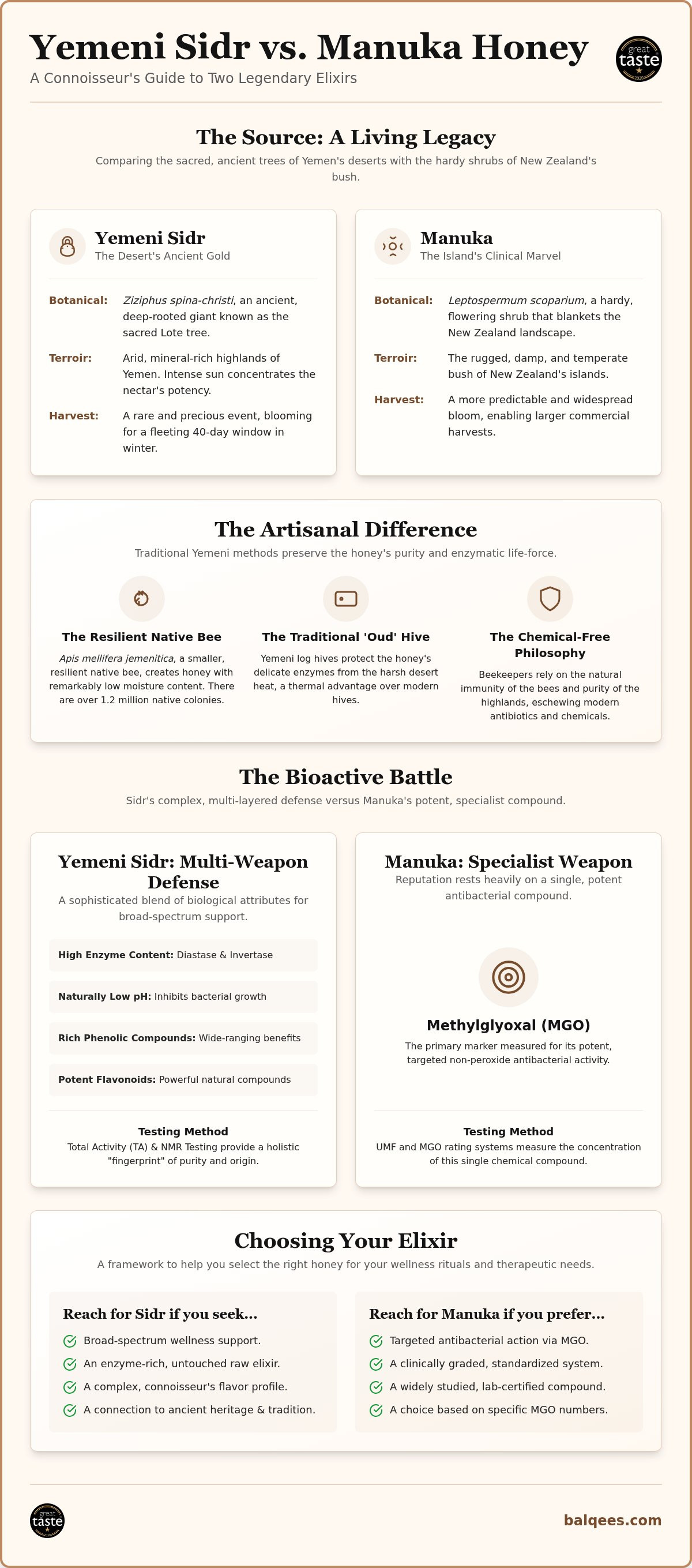
The desert of Yemen and the islands of New Zealand offer two distinct portraits of nature’s power. When comparing Yemeni Sidr honey vs Manuka, we first look at the botanical source. The Sidr tree, known scientifically as Ziziphus spina-christi, is an ancient, deep-rooted giant that thrives in the arid highlands. In contrast, the Manuka (Leptospermum scoparium) is a hardy, flowering shrub that blankets the New Zealand landscape. While Manuka is celebrated for its modern clinical utility, the Sidr tree holds a sacred status. It is mentioned in ancient religious texts as the Lote tree, a symbol of strength and divine connection that has served as a cornerstone of Yemeni heritage for millennia. The uncultivated, wild valleys of Hadramout present a starkly different terroir than the rugged, damp New Zealand bush. Sidr honey is a sacred dialogue between the land and the hive, whispered through the centuries.
The Desert vs. The Island: Terroir and Nectar
Yemen’s arid, mineral-rich soil forces the Sidr tree to produce a nectar of exceptional density and potency. In the high-altitude valleys, the air is thin and the sun is intense, creating a unique stress on the flora. This environment concentrates the aromatic profile of the bloom, resulting in a honey that is thick, pungent, and rich in trace minerals. The Sidr bloom is a fleeting winter event, often lasting only forty days. This brief window makes every drop a precious rarity, unlike the more predictable commercial harvests found in the temperate New Zealand bush. The result is a honey that carries the concentrated essence of the desert’s resilience.
Apis mellifera jemenitica: The Resilient Native Bee
The architect of this liquid gold is the Apis mellifera jemenitica, a native honeybee smaller and far more resilient than Western varieties. These bees have adapted over centuries to water-scarce environments, producing honey with a remarkably low moisture content. When evaluating Yemeni Sidr honey vs Manuka, the bee's role is often overlooked. There are approximately 1.2 million native bee colonies in Yemen, and they are managed with a strict chemical-free philosophy. Traditional beekeepers eschew modern antibiotics, relying instead on the natural immunity of the bees and the purity of the unpolluted highlands. This commitment to artisanal integrity ensures that our Raw Yemeni Sidr Do'ani Honey remains an untouched reflection of the wild.
Bioactive Battle: MGO vs. the Multi-Weapon Defense of Yemeni Sidr
Manuka honey’s reputation rests heavily on Methylglyoxal (MGO), a potent antibacterial compound. It’s a specialist weapon. However, when examining Yemeni Sidr honey vs Manuka, the Sidr variety offers a more complex, multi-layered defence. Instead of relying on a single marker, Sidr utilizes a sophisticated blend of biological attributes:
- High enzyme content, including Diastase and Invertase, which facilitate metabolic processes.
- Naturally low pH levels that create an inhospitable environment for bacterial growth.
- A rich array of phenolic compounds and flavonoids that provide broad-spectrum support.
A landmark study from the University of Ottawa demonstrated that Sidr honey was remarkably effective against biofilm-forming bacteria, such as MRSA and MSSA, often outperforming clinical alternatives in specific laboratory settings. For those seeking a deeper scientific dive, our guide on Raw Yemeni Sidr Do’ani Honey explores these biological pathways in detail.
Beyond the Numbers: Why Sidr Doesn’t Use UMF
Grading systems like UMF are useful for measuring a single chemical, but they often fail to capture the full biological integrity of wild-harvested honey. Sidr doesn't use UMF because its value isn't tied to a laboratory-isolated compound. Instead, we look at Total Activity (TA) and Nuclear Magnetic Resonance (NMR) testing. These methods provide a holistic view of purity and the unique "fingerprint" of the botanical origin. For the true connoisseur, the harvest season and the specific valley in Hadramout are the most reliable markers of quality. This mono-floral purity is a direct result of "Tazeeb," the ancient nomadic tradition where beekeepers transport hives to follow the bloom. This ensures the bees forage exclusively on the Sidr tree, concentrating the bioactive defence mechanisms within the nectar.
Internal Vitality vs. External Recovery
In the debate of Yemeni Sidr honey vs Manuka, the decision often rests on whether you value a single clinical marker or a broad-spectrum biological profile. Manuka is a modern marvel for topical wound care and clinical skin applications. Its high MGO content makes it an excellent external barrier. Conversely, Yemeni Sidr honey is the preferred choice for internal vitality. It’s celebrated for supporting gut health, boosting immunity, and providing respiratory relief. The high concentration of antioxidants in Sidr offers superior protection against internal oxidative stress. This makes it a perfect companion for your daily wellness ritual. If you’re looking to experience this internal resilience, our Raw Yemeni Sidr Do'ani Honey offers a pure, unfiltered taste of this ancient defence.
The Artisanal Difference: Why Traditional Yemeni Methods Surpass Modern Hives
While the global market often focuses on the clinical metrics of Yemeni Sidr honey vs Manuka, the physical environment of the hive tells a much deeper story. Most Manuka is produced in modern, commercial apiaries using standardized Langstroth boxes designed for industrial efficiency. In Yemen, beekeepers still honour the 'Oud', a traditional horizontal log hive meticulously carved from cedar or date palm. These hives are not just vessels; they are protective sanctuaries. They represent a commitment to sustainable beekeeping honey practices that have remained unchanged for centuries. This artisanal approach ensures that the honey is never a mere commodity, but a living reflection of ancient wisdom.
Thermal Excellence and Enzyme Preservation
The desert sun is unforgiving. In the highlands of Yemen, temperatures fluctuate wildly, threatening the delicate biological integrity of the nectar. The thick, natural walls of the Oud provide superior thermal regulation compared to the thin wood or plastic used in modern commercial hives. This insulation is critical. It preserves the heat-sensitive enzymes that give Sidr its medicinal potency. Within these logs, bees are permitted to build natural comb without the interference of movable plastic frames. This freedom allows for a more harmonious hive environment. When the honey is finally harvested, traditional cold-pressing ensures a higher concentration of propolis remains intact, enhancing the honey’s overall bioactive profile.
The Nomadic Quest for Purity
Achieving true mono-floral purity requires more than just placing a hive near a tree. It demands a nomadic spirit. Through the tradition of Tazeeb, Yemeni beekeepers embark on a logistical odyssey, transporting their colonies across rugged, high-altitude terrain to follow the fleeting Sidr bloom. This ensures the bees forage exclusively on the Ziziphus spina-christi tree, far from the reach of industrial pollutants or competing flora. This level of dedication is what separates a commercial product from the world’s most rare honey varieties. While Manuka production has scaled into a massive global industry, the harvest of Sidr remains a slow, seasonal ritual. It’s a testament to the fact that some of the finest things in life cannot be rushed or automated.
A Sensory Showdown: Texture, Flavour, and the Connoisseur’s Palate
To truly understand the distinction between Yemeni Sidr honey vs Manuka, one must look beyond the laboratory certificate and engage the senses. The experience of tasting authentic Yemeni Sidr is often described as a revelation. It possesses a buttery, luxurious thickness that coats the palate with a velvet-like grace. Unlike many other varieties, high-quality Sidr is naturally non-granulating. It remains in a pristine liquid state for years, a testament to its unique chemical composition and low moisture content. The aroma is equally evocative. A deep, woodsy scent serves as a primary indicator of its cold-pressed integrity, signaling that the delicate volatile compounds haven't been damaged by heat. The flavour of Yemeni Sidr honey possesses a remarkable, lingering finish that evolves from floral sweetness into a deep, resonant warmth.
The Palate of the Desert
A premium Sidr harvest offers a complex tapestry of flavours. You'll first notice a dominant sweetness, which quickly gives way to sophisticated, spicy, and malty notes. These woodsy undertones are a direct result of the bees foraging on the Ziziphus spina-christi bloom in the high-altitude valleys of Hadramout. This "first press" honey is prized for its nutrient density and its ability to resist crystallisation. For the connoisseur, this stability is a hallmark of purity. It ensures that every spoonful, whether taken today or a year from now, maintains the same exquisite texture and potent bioactive profile.
The Earthy Profile of the Island
Manuka honey offers a starkly different sensory journey. It is famously thixotropic, meaning it is naturally gel-like but becomes liquid when stirred or agitated. The flavour profile is decidedly earthy and medicinal, often carrying a slightly bitter finish, especially in batches with high MGO ratings. While Sidr is round and warm, Manuka is sharp and herbaceous. These distinct profiles make both honeys excellent candidates for specific honey for wellness rituals. While you might reach for Manuka for its clinical edge, the sensory richness of Sidr makes it a soul-stirring addition to your morning routine. If you are ready to experience the desert's most refined harvest, you can explore our Raw Yemeni Sidr Do'ani Honey to discover these nuances for yourself.
Choosing Your Elixir: When to Reach for Sidr vs. Manuka
The choice between these two extraordinary elixirs ultimately depends on your wellness goals and your appreciation for the craft. When weighing Yemeni Sidr honey vs Manuka, consider your intended use. If you require a specialist tool for topical wound care or clinical skin applications, Manuka’s high MGO levels offer a modern, verified solution. However, if your focus is on internal vitality, gut health, and daily immune support, the broad-spectrum bioactivity of Yemeni Sidr is unparalleled. Choosing Sidr is more than a wellness decision; it's a commitment to global heritage. By selecting honey from the 1.2 million native bee colonies in Yemen, you’re supporting a biodiversity that has been protected by nomadic families for generations. It’s a vote for a world where ancient traditions still thrive.
The Connoisseur’s Checklist
In a market where authenticity is often clouded by commercial interests, a discerning eye is essential. Because Yemeni honey lacks a centralized commercial grading system like New Zealand’s UMF, transparency from the seller becomes the most vital currency. When sourcing your honey, look for these specific markers of quality:
- Raw and Unfiltered: Ensure the honey hasn't been heat-treated or fine-filtered, which destroys delicate enzymes.
- Cold-Pressed Integrity: The honey should be extracted using traditional methods that preserve its natural propolis and pollen content.
- Specific Provenance: Authentic Sidr should be traceable to a specific region, such as the renowned Wadi Do’an in the Hadramout highlands.
- Harvest Season: Premium Sidr is a winter harvest, reflecting the brief forty-day bloom of the Ziziphus spina-christi tree.
Balqees: A Commitment to Authenticity
At Balqees, we act as a bridge between these ancient uncultivated valleys and your modern lifestyle. We don't just sell honey; we honour the Tazeeb tradition by ensuring our harvests remain in their raw, untouched state. Our beekeepers follow the bloom across rugged terrain, maintaining a sacred dialogue with the land that has existed for millennia. This dedication ensures that every jar is a piece of living history, vibrating with the energy of the desert. We invite you to experience the heritage of our Raw Yemeni Sidr Do’ani Honey and discover a level of purity that transcends modern laboratory metrics. It’s an invitation to join a community that values slow, intentional craftsmanship over industrial speed.
Embracing the Legacy of Liquid Gold
The choice between Yemeni Sidr honey vs Manuka is more than a simple health decision. It is an invitation to choose between a clinical marvel and a living legacy. While Manuka offers specialized antibacterial strength, Yemeni Sidr provides a broad-spectrum biological profile that supports your body from within. You now understand that the traditional 'Oud' log hives and the nomadic 'Tazeeb' tradition aren't just cultural footnotes. They're essential practices that protect the delicate enzymes and potent antioxidants of the desert’s most precious nectar.
Balqees remains a dedicated guardian of these ancient methods. We source our honey directly from artisanal beekeepers in Yemen, ensuring every jar is raw, unfiltered, and cold-pressed to preserve its medicinal integrity. This award-winning quality honours traditions that have survived for millennia. We invite you to experience the heritage of our Raw Yemeni Sidr Do’ani Honey and bring the soul of the highlands into your daily ritual. Your journey into the world of rare elixirs has only just begun.
Frequently Asked Questions
Why is traditional Yemeni honey so much more expensive than regular honey?
Traditional Yemeni honey is priced higher because of its extreme rarity and the intensive labour required for its harvest. The Sidr tree blooms for only forty days each year in the rugged highlands of Yemen. Beekeepers must navigate difficult terrain and use manual, artisanal methods to collect small yields. Unlike mass-produced supermarket varieties, this honey is a seasonal treasure that reflects the resilience of the desert and the craftsmanship of generations.
What is the Tazeeb method in Yemeni beekeeping?
Tazeeb is the ancient nomadic tradition where beekeepers transport their colonies across the country to follow the flowering seasons. This migratory practice is essential for ensuring mono-floral purity. By moving hives to isolated valleys during the Sidr bloom, beekeepers prevent the bees from foraging on other plants. This dedication is a key factor when comparing Yemeni Sidr honey vs Manuka, as it results in a more concentrated and biologically potent nectar.
Are traditional log hives better for the bees than modern boxes?
Yes, traditional log hives, known as 'Oud', offer significant biological advantages over modern plastic or thin wood boxes. The thick walls of the cedar or date palm logs provide superior thermal insulation, protecting the bees and their delicate enzymes from the intense desert heat. This stable environment allows the bees to build natural comb without the stress of movable frames, preserving the honey's raw integrity and high propolis content.
What makes the Sidr tree so important for Yemeni beekeepers?
The Sidr tree, or Ziziphus spina-christi, is revered for its sacred status and its ability to thrive in mineral-rich, arid soil. For beekeepers, it represents the pinnacle of medicinal nectar. The tree’s deep roots extract unique nutrients from the earth, which the bees then concentrate into a thick, non-granulating honey. This botanical source is what gives the honey its signature malty flavour and its powerful multi-layered bioactive defence mechanisms.
Is traditional Yemeni honey truly raw and unfiltered?
Authentic Yemeni honey, such as our Raw Yemeni Sidr Do'ani Honey, is absolutely raw and unfiltered. We ensure that the honey is cold-pressed and never exposed to high temperatures that could damage its natural enzymes or volatile aromas. By avoiding fine filtration, we preserve the beneficial pollen and propolis that are often removed in commercial processing. This commitment to purity ensures you receive a living product that retains its full medicinal potency.
How do beekeepers transport hives during the migratory season?
Beekeepers transport their hives through the rugged highlands using traditional methods adapted to the difficult terrain. During the migratory season, colonies are carefully packed and moved at night when the bees are less active. This logistical feat requires deep knowledge of the land and the weather patterns. It is a slow, methodical process that ensures the bees arrive safely in isolated valleys, far from industrial pollutants and competing floral sources.
What is the difference between Sidr honey and Wildflower honey from Yemen?
The primary difference lies in the botanical source and the resulting potency. Yemeni Sidr honey is a mono-floral variety, meaning the bees forage almost exclusively on the Sidr tree during its brief bloom. Yemeni Wild Flower Honey is multi-floral, gathered from various blossoms across the highlands. While Wild Flower honey offers a beautiful, diverse flavour profile, Sidr is prized for its higher concentration of antioxidants and its unique, buttery texture.
Can I find authentic Yemeni honey produced through these traditional methods in the UAE?
You can certainly find authentic honey in the United Arab Emirates through Balqees Honey. We deliver our pure, raw, and unfiltered Yemeni harvests nationally to customers across the country. By sourcing directly from artisanal beekeepers who honour the Tazeeb tradition, we provide a transparent link to the ancient valleys of Hadramout. When choosing Yemeni Sidr honey vs Manuka, you can trust that our offerings represent the highest standards of traditional nomadic craftsmanship.


