


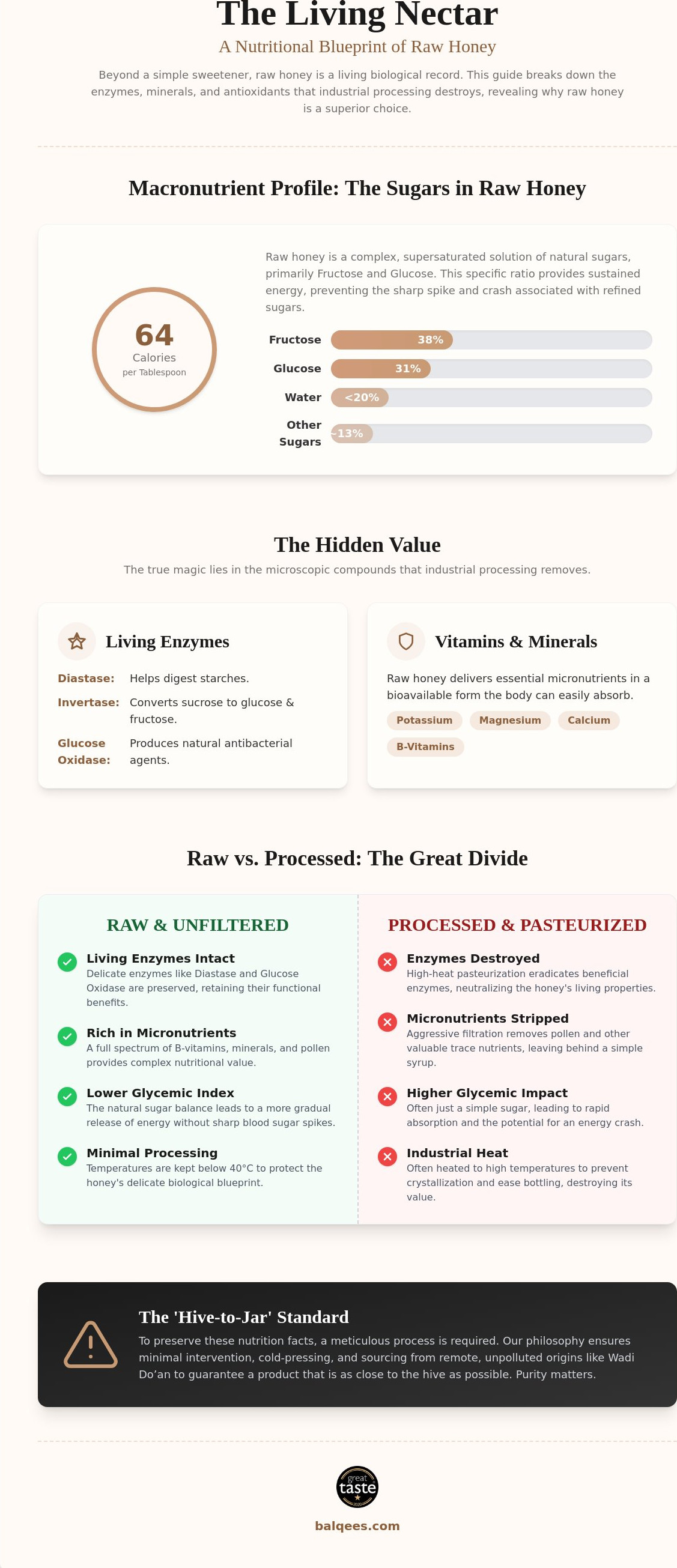
Honey is primarily a source of sugars and energy. Raw handling does not make it sugar-free, and trace compounds should not be mistaken for a substantial serving of vitamins, minerals or protein.
Start with the nutrition panel
Compare the same basis: per 100 g figures allow comparison between products, while the serving size helps you understand the amount you actually eat. Check energy, carbohydrate and sugars together. For a fusion, use that blend’s label because added ingredients can change its composition.
Do not add the sugars figure to total carbohydrate: sugars are included within carbohydrate. Nor should a spoonful be assumed to weigh the same number of grams for every ingredient. Weigh your portion if you need an accurate calculation.
Calculate your portion
Multiply each per-100-g value by your portion in grams, then divide by 100. A 10 g portion is one tenth of the stated per-100-g amount. Use the same calculation for energy and sugar. This avoids treating a heaped household spoon as a precise nutrition measure.
Raw does not mean a free portion
Heat and handling can affect honey’s flavour and some components, but they do not remove the need to consider sugar. Choosing raw honey for its character is different from choosing a vitamin supplement. Honey added to tea, porridge or yoghurt still contributes to the meal’s total sweetness and energy.
For diabetes, honey is not a sugar-free alternative: follow your individual dietary advice. Choose a portion for flavour and use the actual label rather than a general internet estimate for a specific jar. Honey is not suitable for babies under 12 months.


