


Did you know that nearly half of the honey tested in major international markets is suspected of being fraudulent? It's a startling reality that many jars on supermarket shelves across the Emirates aren't quite what they claim to be. You've likely felt that sting of frustration while trying to decipher labels like "pure" or "natural" only to worry about hidden high-fructose corn syrup. This rise in global honey laundering makes it harder than ever to trust the golden liquid you bring into your home. Understanding the common honey additives to avoid is the first step toward reclaiming the health benefits and rich heritage of this ancient food.
In this guide, we'll help you peel back the layers of commercial marketing to find truly raw, artisanal nectar. You'll gain the confidence to spot red-flag ingredients and industrial processes that strip honey of its living essence. We will also explore why rare, untouched varieties like Yemeni Sidr command a premium for their absolute purity. At Balqees Honey, our goal is to ensure you know exactly how to choose honey that remains as honest and vibrant as the blossoms it came from.
Key Takeaways
- Understand the reality of "honey laundering" and why nearly half of the honey in the global supply chain is suspected of being intentionally manipulated for profit.
- Identify the common honey additives to avoid, including industrial fillers like high-fructose corn syrup and rice syrup designed to evade standard purity tests.
- Learn why excessive heat and ultra-filtration are considered invisible additives that strip honey of its beneficial enzymes and unique floral heritage.
- Master simple sensory techniques, such as the thumb and water tests, to confidently verify the viscosity and purity of your honey at home.
- Discover the value of the "hive to jar" journey and why minimally processed varieties like Yemeni Sidr offer superior nutritional and medicinal benefits.
The Hidden Reality of Commercial Honey Adulteration
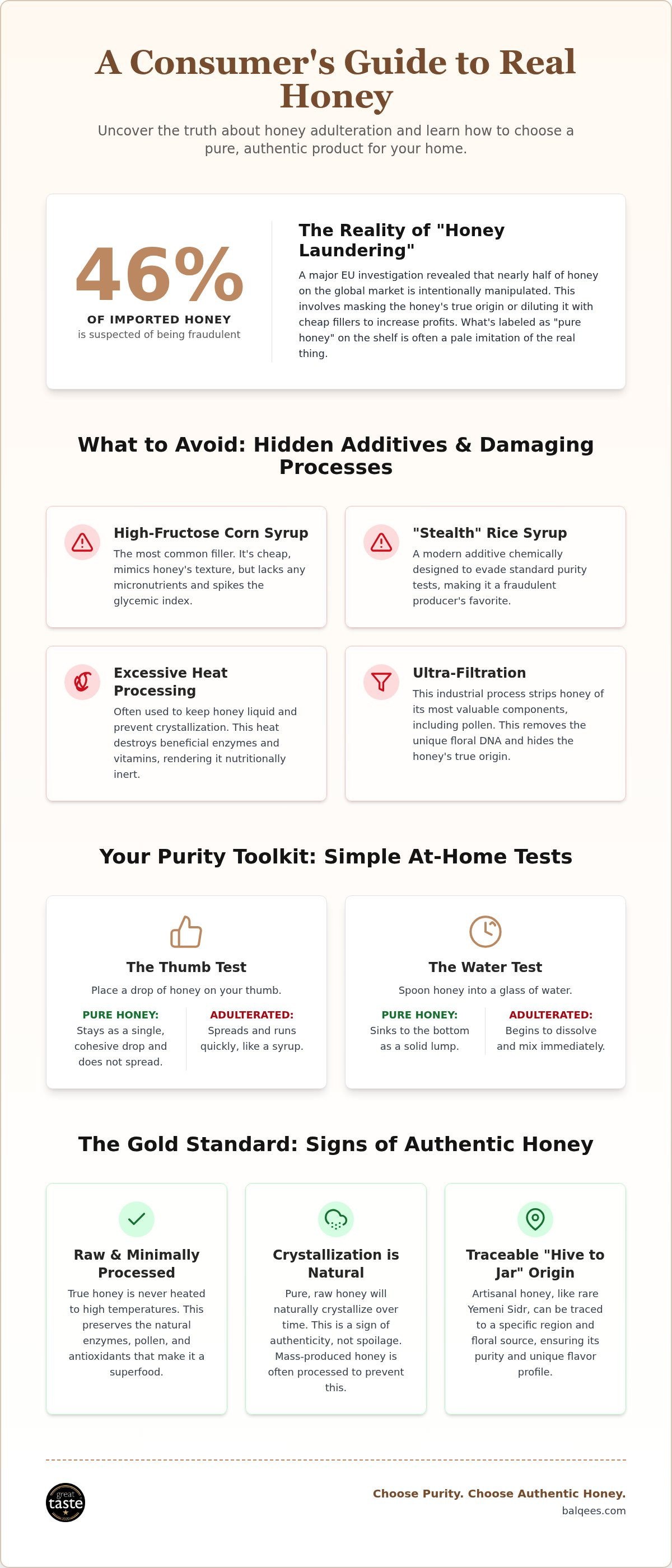
Honey adulteration is far more than a simple labeling error; it's the intentional manipulation of purity for profit. In the global food supply chain, this practice has evolved into what experts call "honey laundering." This involves masking the origin of low-quality honey or stretching it with cheap fillers to meet the insatiable demands of mass-market retail. A recent European Union investigation highlighted the scale of this issue, finding that 46% of imported honey samples were suspected of being adulterated. When you browse the shelves in the UAE, it's vital to recognize that the golden liquid in a generic jar might be a shadow of the real thing. Understanding the history and methods of honey adulteration is the first step in protecting your health and supporting honest beekeepers.
Many consumers are misled by terms like "unfiltered" or "clover honey." While "unfiltered" sounds rustic, it doesn't guarantee the honey is raw or free from heat damage. Similarly, mass-produced clover honey is frequently a blend of origin-less syrups sourced from multiple countries, stripped of the unique floral DNA that defines true nectar. This industrial approach prioritizes a uniform look and a permanent liquid state over the complex nutritional profile found in artisanal varieties. To ensure you're getting a genuine product, you must learn which common honey additives to avoid and why they are used in the first place.
The Economic Drive Behind Dilution
The motivation for adulteration is purely financial. Mass production prioritizes shelf-stability, ensuring that honey never crystallizes and remains perfectly clear for months. Achieving this requires ultra-filtration and high heat, which destroys the very enzymes that make honey a superfood. There's a vast cost difference between artisanal Yemeni honey, harvested by hand in remote valleys, and industrial blends produced in factories. If a large jar of honey is priced suspiciously low in a local market, it's a significant red flag. Purity has a price. Authentic raw honey reflects the labor of the bees and the skill of the guardian beekeeper, factors that industrial fillers simply can't match.
Honey vs. 'Honey-Flavoured' Syrups
Some products on the market are essentially "honey-flavoured" syrups rather than true nectar. Manufacturers often use legal loopholes to list honey as a primary ingredient while hiding the presence of unlisted sweeteners. These additives are designed to mimic the taste and texture of honey without providing any of the biological benefits. It's a pale imitation of the real thing. True honey is a biological miracle, a living tapestry of enzymes and pollen that no laboratory can ever hope to replicate. By choosing raw, single-origin honey, you're opting for a substance that remains untouched by these industrial shortcuts.
Common Liquid Additives: Syrups and Sweeteners to Evade
When you hold a jar of honey, you should be holding the distilled essence of a specific landscape. Instead, industrial fillers often take centre stage. High-Fructose Corn Syrup (HFCS) remains the most prevalent filler due to its low cost and liquid consistency. It's one of the primary common honey additives to avoid because it lacks the complex micronutrients found in raw nectar. Rice syrup has also become a modern favourite for those looking to deceive. It's chemically designed to evade standard purity tests, making it a "stealth" additive in many commercial blends found across the UAE.
Beyond sweeteners, some manufacturers use malt extract or artificial colouring agents. These are employed to mimic the deep, amber hues of premium varieties like Yemeni Sidr. While authentic honey gains its colour from the minerals and pollen of specific blossoms, these imitations are merely aesthetic. They offer no nutritional value and dilute the medicinal potency of the final product. They turn a sacred gift of nature into a mass-produced commodity.
The Problem with C4 Plant Sugars
Bees naturally forage on C3 plants, which produce a specific isotopic signature. Corn and sugarcane are C4 plants. When these sugars are added, they fundamentally alter the biological makeup of the honey. This isn't just about authenticity; it's about your health. Industrial fructose from C4 plants can spike the glycaemic index, whereas raw honey has a more balanced metabolic profile. These additives strip the honey of its anti-inflammatory properties, turning a healing food into a simple sweetener. If you want to experience the true, unadulterated power of bees, it's better to choose raw Yemeni Sidr honey that has never seen a factory floor.
Hidden Preservatives and Artificial Flavours
Pure honey is naturally eternal. Archeologists have found edible honey in ancient tombs. It doesn't need preservatives. If you see ingredients like potassium sorbate or citric acid on a label, put the jar back. These are signs of a product that has been diluted or contains high moisture levels that would otherwise cause fermentation. They are crutches for an inferior product.
Be wary of synthetic floral notes too. Some low-quality brands add artificial aromas to mask the blandness of sugar syrup. To read a label like a connoisseur, look for a single country of origin and avoid anything that lists "honey flavouring" or "syrup." A true guardian of tradition knows that nature's own recipe requires no improvement. Real honey speaks for itself through its texture and its lingering, complex aftertaste.
The 'Invisible' Additive: Excessive Heat and Ultra-Filtration
Heat is the silent ghost in the machine of industrial honey production. While we have explored physical fillers like corn syrup, many consumers overlook the damage caused by industrial processing. Heat acts as a "process additive" that fundamentally alters the honey’s character. When honey is pasteurised, it's subjected to intense temperatures to prevent crystallisation and ensure it flows easily through factory pipes. This might make the product look pretty on a shelf in Dubai, but it destroys the biological value that makes honey a superfood. The link between cold pressed honey UAE and nutritional integrity is absolute; without careful temperature control, you're simply buying flavored sugar.
Ultra-filtration is the second half of this industrial duo. This process involves forcing honey through extremely fine meshes under high pressure. It removes everything: bits of wax, propolis, and most importantly, the bee pollen. While this results in a clear, sparkling liquid that stays runny forever, it strips away the honey's "fingerprint." When identifying common honey additives to avoid, you must also look for the absence of these vital natural components. A honey that is too clear and too consistent is often a honey that has been stripped of its soul.
The Death of Enzymes: Diastase and Invertase
Enzymes are the heartbeat of raw honey. Diastase and invertase are the primary biological workers that facilitate the honey's medicinal efficacy. These enzymes are incredibly sensitive to heat. Once honey is warmed beyond 45°C, these delicate compounds begin to break down, rendering the honey biologically "dead." Raw honey is a living food; it's an active, changing substance that interacts with your body's own chemistry. Industrial honey, by contrast, is a static product. It has been sterilized for the sake of convenience, sacrificing the very enzymes that support digestion and immune health. If your honey has been "cooked" to stay liquid, it has lost its status as a traditional medicine.
Why Pollen Matters
Bee pollen is a nutritional powerhouse, containing amino acids, vitamins, and minerals that are unique to the floral source. It's also the only way to verify exactly where a honey comes from. Ultra-filtration is frequently used by large-scale distributors to hide the geographic origin of their product, a key tactic in "honey laundering." By removing the pollen, they make it impossible for laboratories to trace the nectar back to its home. The sensory difference is profound. When you experience the unfiltered raw honey benefits, you'll notice a richer texture and a more complex, layered flavor profile. True honey shouldn't be perfectly clear; it should be a cloudy, textured map of the landscape from which it was gathered.
How to Detect Impurities: The Connoisseur’s Sensory Test
Identifying pure honey in your own kitchen is an art form. While laboratory analysis is the gold standard, your own senses are the first line of defence against common honey additives to avoid. You can begin with the Thumb Test. Place a small drop of honey on your thumbnail. Does it spread or spill immediately? Pure nectar stays put. It possesses a structural integrity and surface tension that industrial syrups simply cannot mimic. Next, try the Water Test. Drop a spoonful into a glass of room-temperature water. Adulterated honey, often stretched with rice or corn syrup, will begin to dissolve instantly. Authentic honey remains a solid, cohesive weight that sinks directly to the bottom of the glass.
Your nose and palate offer even deeper clues to the honey's soul. Real honey should smell like a landscape, evoking the wild flora of its origin. If the aroma is non-existent or purely "sugary," you are likely dealing with a processed product. The true mark of identifying high quality raw honey lies in what experts call the "finish." Industrial honey has a flat, one-dimensional sweetness that disappears quickly. Raw nectar, however, leaves a complex, lingering tingle on the back of the throat. This is the biological signature of a living food.
Visual Clues and Crystallisation
Many consumers in the UAE mistakenly believe that crystallisation means the honey has spoiled. This is a myth. In reality, turning solid or "sugary" is a hallmark of purity. It confirms the presence of natural glucose and bee pollen. This is a vital part of raw honey nutrition facts that industrial brands hide through ultra-filtration. You might notice a beautiful, creamy "bloom" on the surface of certain varieties. This is particularly evident when exploring white mountain honey benefits, where the natural texture is thick and opaque rather than suspiciously clear.
The Flame and Paper Tests
The matchstick test provides a dramatic reveal for those seeking absolute certainty. Pure honey is flammable because it has very low moisture content. Dip a dry matchstick into the honey and try to strike it against the box. If it lights, the honey is pure. If the match fails to ignite, it suggests the presence of excess water or industrial syrups. You can also use the blotting paper test. Place a drop of honey on a piece of paper. Pure honey will sit on the surface like a bead. Adulterated honey, thinned with additives, will be absorbed into the fibres, leaving a wet mark behind. Witnessing the viscous, slow-moving grace of pure Sidr honey as it resists absorption is a sensory lesson in quality.
Don't settle for industrial imitations that compromise your well-being. Protect your health by choosing authentic raw honey directly from the guardians of tradition.
Choosing Purity: The Balqees Commitment to Raw Integrity
At Balqees Honey, we believe that honey is a sacred trust. It's a conversation between the bee, the blossom, and the earth. In a global market flooded with industrial fillers, knowing the common honey additives to avoid is only half the battle. The other half is finding a source that honors the living essence of the hive. We source our nectar directly from the most remote regions of Yemen, where ancient traditions remain untouched by modern industrial shortcuts. This isn't just business; it's a commitment to raw integrity and the preservation of a craft that dates back millennia.
Our "Hive to Jar" journey is defined by minimal intervention. We don't use high-pressure filtration or excessive heat, which we've identified as the invisible additives of the commercial world. Instead, we rely on cold-pressed extraction to ensure that every jar maintains its maximum potency and nutritional profile. This is why our Raw Yemeni Sidr Do'ani Honey is so highly regarded by connoisseurs across the UAE. It remains a living food, rich in the enzymes and pollen that industrial processes strip away. Every spoonful is a testament to the landscape it was gathered from, offering a depth of flavor that sugar-syrup blends can never hope to achieve.
We also offer functional fusions like our Black Seed Fusion and Raw Honey & Ginseng Fusion. These aren't factory-made concoctions. We enhance nature with pure botanicals, never chemicals, synthetic aromas, or malt extracts. By blending high-activity raw honey with time-honored herbs, we create a product that serves as both food and medicine. It's a bridge between traditional wisdom and a modern lifestyle, designed for those who refuse to compromise on what they put into their bodies.
Artisanal Beekeeping as a Guardian of Quality
The secret to our purity lies in the hands of the beekeepers. Yemeni apiculture is rooted in traditional methods that have been passed down through generations. These guardians of the hive avoid the chemical treatments and antibiotics common in large-scale commercial operations, ensuring that the nectar remains as pure as the wildflowers themselves. We believe that sustainable beekeeping honey is the only way to ensure a truly clean product for our community in the Emirates. By focusing on small-batch production, we can maintain a level of quality control that industrial brands simply can't match. This dedication is what allows us to confidently exclude the common honey additives to avoid from our entire collection.
Your Ritual of Purity
Integrating raw honey into your daily wellness routine is about more than just sweetness. It's about a ritual of health, heritage, and sensory delight. When you choose Balqees Honey, you gain the peace of mind that comes with lab-tested, artisanal quality. You don't have to worry about hidden syrups or "invisible" heat damage. Every jar is a map of a wild landscape, meticulously handled to preserve its natural power and biological miracle. It's time to reclaim the authenticity of your food and experience the true vitality of the hive. Discover the Balqees Honey collection of pure, raw honeys and experience the difference that true integrity makes to your wellbeing.
Reclaiming the Essence of True Nectar
At Balqees, we stand as guardians of this ancient craft. Our award-winning honey is sourced directly from traditional Yemeni beekeepers and remains unfiltered and unpasteurised for maximum health benefits. Every drop is a testament to the untouched landscapes of the Middle East. It's time to elevate your daily rituals with nectar that respects both nature and your well-being. Experience the purity of artisanal nectar; Shop the Balqees collection. Trust your palate, embrace the heritage, and enjoy the vibrant vitality of the hive.
Frequently Asked Questions
How can I tell if honey has added sugar at home?
You can use the water test by dropping a spoonful into a glass of room-temperature water. Pure honey sinks and remains a solid mass at the bottom, while honey with added sugar begins to dissolve almost immediately. This happens because industrial syrups have a different density and lack the cohesive structure of natural nectar. Another method is the thumb test; if a drop spreads quickly across your skin, it likely contains common honey additives to avoid.
Is it true that real honey never goes bad?
Pure honey is naturally eternal due to its low moisture content and acidic pH. These factors create an environment where bacteria and microorganisms simply cannot survive. Archeologists have even discovered edible honey in ancient Egyptian tombs that is thousands of years old. While its texture may change or crystallise over time, it remains perfectly safe and nutritious to eat as long as it's kept in a sealed jar, away from excess moisture.
Why is some honey very clear while others are cloudy?
Clarity is usually a sign of ultra-filtration, a process that removes beneficial bee pollen. Raw honey is naturally cloudy because it retains these microscopic particles, along with traces of propolis and wax. Industrial producers prefer clear honey because it looks consistent on supermarket shelves and resists crystallisation for longer. However, that cloudiness is actually a visual guarantee that the honey's nutritional profile remains intact and untouched by heavy industrial processing.
Does crystallisation mean the honey is fake or has additives?
Quite the opposite; crystallisation is a hallmark of authentic, raw honey. It occurs when natural glucose separates from water and forms crystals. If your honey stays liquid and transparent forever, it has likely been over-heated or ultra-filtered to destroy its natural character. Real honey, especially varieties high in pollen, will eventually become thick or solid. You can gently return it to a liquid state by placing the jar in a bowl of warm water.
What is the most common additive in supermarket honey?
High-fructose corn syrup and rice syrup are the most frequent fillers found in commercial blends. These are among the most common honey additives to avoid because they are cheap to produce and mimic the appearance of nectar. Rice syrup is particularly difficult for standard tests to detect, making it a favorite for "honey laundering." These industrial sweeteners offer no health benefits and significantly spike the glycaemic index compared to raw, unadulterated honey.
Can I trust honey that is labelled as 'organic' but is very cheap?
Price is often the most honest indicator of quality. True organic honey requires meticulous beekeeping practices and remote, chemical-free environments, which naturally increase production costs. If a jar is priced similarly to refined sugar in a local UAE market, the "organic" label is likely a marketing tactic rather than a guarantee of purity. Always look for a specific country of origin and a reputable brand that prioritises transparency over mass-market convenience.
What happens to honey when it is heated or pasteurised?
Intense heat destroys the biological miracle of honey. When temperatures exceed 45 degrees Celsius, essential enzymes like diastase and invertase are neutralised, rendering the honey biologically "dead." This process is used by industrial packers to prevent fermentation and keep the honey runny for longer shelf life. While the resulting product is still sweet, it has lost the anti-inflammatory and antibacterial properties that make raw honey a powerful traditional medicine.
Is 'pure honey' the same as 'raw honey'?
No, these terms represent very different standards. "Pure" simply means the product hasn't had other ingredients added, but it can still be pasteurised and ultra-filtered. "Raw" honey, however, is honey exactly as it existed in the hive. It hasn't been heated above hive temperatures or stripped of its pollen. For the connoisseur seeking health benefits and authentic flavour, the "raw" designation is the only one that truly matters for quality.


