


Could the most famous medicinal honey in the world actually be playing second fiddle to an ancient desert treasure? While New Zealand’s clinical darling often takes the spotlight, the true connoisseur knows that the story of Sidr honey vs Manuka honey is one of two very different souls. You've likely felt the sting of confusion while staring at complex UMF labels or wondered if a high price tag truly guarantees purity. It's a common hesitation when seeking the finest nature has to offer. We've spent years as guardians of these traditions, and we're here to offer you clarity.
This guide provides the definitive comparison between these two prestigious elixirs to help you choose the right partner for your wellness journey. We'll explore the scientific potency of the Manuka bush and the artisanal heritage of the Sidr trees in Wadi Do’an. From demystifying grading systems to identifying the deep, sensory notes of each harvest, you'll gain the confidence to select a honey that resonates with your specific needs. Let's begin this journey of discovery together.
Key Takeaways
- Trace the ancestral roots of the Ziziphus spina-christi tree. Discover why its sacred status in Yemen contrasts so deeply with New Zealand’s rugged Manuka bush.
- Unpack the complex bioactivity of Sidr honey vs Manuka honey. We move beyond simple MGO ratings to explore how pH levels and phenolic compounds drive internal wellness.
- Refine your palate. Learn to identify the buttery, spiced notes of Yemeni Sidr and how its texture differs from the earthy profile of premium Manuka.
- Match the elixir to your health journey. Whether you need clinical wound care or deep internal support, you'll know exactly which jar to reach for.
- Secure your investment by learning to spot authentic, raw Yemeni Sidr Do'ani Honey. Don't let adulterated supermarket imitations compromise your health.
The Sacred vs. The Rugged: Understanding Botanical Origins
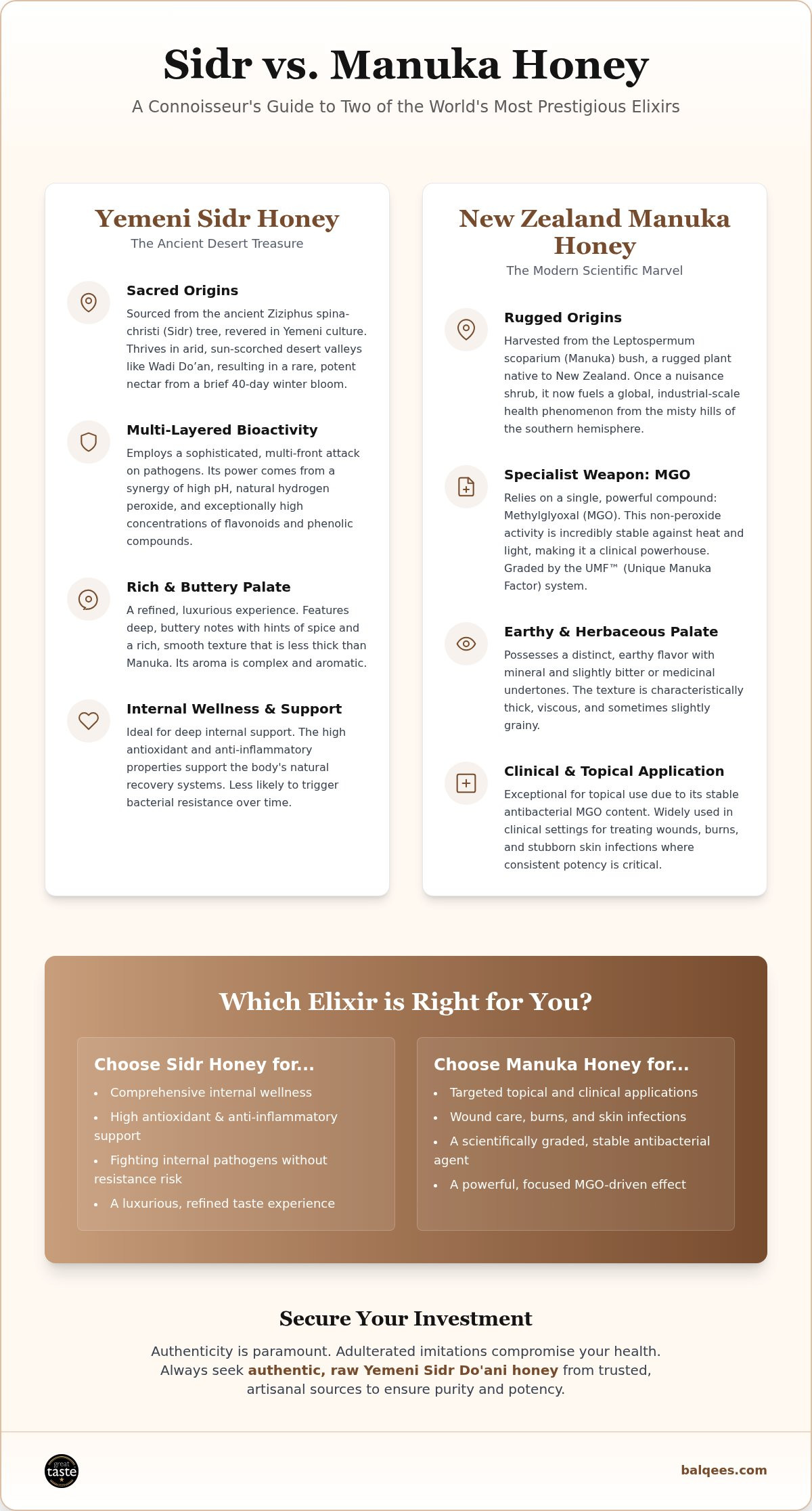
To understand the soul of a honey, one must first walk the land where it begins. The debate of Sidr honey vs Manuka honey isn't just about chemistry; it's a tale of two vastly different landscapes. One is born from the sun-scorched, arid valleys of the Middle East, while the other emerges from the damp, windswept hills of New Zealand. The desert is a harsh teacher. It demands resilience from everything that grows within its borders, and it's this very struggle that defines the character of the honey we harvest.
The Sacred Sidr Tree: A Desert Legend
The Sidr tree, or Ziziphus spina-christi, is more than a plant; it's a cultural icon. In the United Arab Emirates and Yemen, it's guarded with a sense of artisanal reverence. Mentioned in ancient scriptures and revered for its longevity, it thrives in the most unforgiving environments. Understanding the botanical origins of Sidr reveals a species that has served as a source of medicine and shade for thousands of years. The honey produced from its nectar is incredibly rare, largely because the tree only flowers for a brief forty-day window during the winter months. This scarcity is compounded by the extreme desert conditions, which force the tree to concentrate its nutrients into a potent, life-sustaining nectar. The Sidr tree is a botanical fortress of nutrients, forged by the relentless heat of the Arabian sun.
The Manuka Bush: A Modern Scientific Marvel
In contrast, the Manuka bush (Leptospermum scoparium) tells a story of transformation. Once dismissed by New Zealand farmers as a nuisance shrub to be cleared for grazing, it's now a global health phenomenon. It flourishes in the cold, misty climates of the southern hemisphere, a far cry from the parched earth of Yemen. Comparing the harvesting scale of Sidr honey vs Manuka honey highlights a divide between industrial efficiency and nomadic tradition. While Manuka production has moved toward a more industrial, large-scale operation to meet global demand, Sidr honey remains tethered to heritage. In the fertile valleys of Wadi Do’an, nomadic beekeepers practice an ancient craft. They move their hives across the mountains to ensure the bees feed exclusively on Sidr blossoms, preserving a level of purity that industrial methods simply can't replicate. It's a slow, methodical process that honors the natural rhythm of the earth.
The Science of Healing: MGO vs. Multi-Weapon Bioactivity
Science loves a single hero. In the world of Manuka, that hero is Methylglyoxal (MGO). It's a powerful, stable compound that defines the honey's clinical reputation. But nature is rarely that simple. When we compare Sidr honey vs Manuka honey, we're looking at a specialist versus a polymath. One relies on a concentrated chemical strike; the other employs a sophisticated, multi-layered defense system that addresses wellness from several angles at once.
Manuka’s Specialist Weapon: Methylglyoxal (MGO)
MGO is the compound that grants Manuka its "non-peroxide" antibacterial power. Unlike other honeys that lose potency when exposed to light or heat, MGO remains stubbornly effective. To help consumers, the UMF (Unique Manuka Factor) grading system provides a clear yardstick. It's a simple scale: the higher the number, the more MGO is present. This stability makes it an exceptional choice for topical applications, such as treating burns or stubborn skin infections where a consistent antibacterial presence is required.
Sidr’s Multi-Layered Defense
Sidr honey takes a different path. Its strength isn't tied to a single molecule but to a synergy of high pH levels, hydrogen peroxide, and an extraordinary concentration of flavonoids and phenolic compounds. This is often measured as Total Activity (TA). Researchers have documented different mechanisms of bactericidal activity when comparing the two, noting that Sidr's approach is more like a multi-front war than a single strike.
A landmark study at the University of Ottawa highlighted this distinction. While both honeys were tested against MRSA biofilms, Sidr showed remarkable effectiveness, often outperforming its counterparts in breaking down these protective bacterial shields. Because Sidr attacks bacteria through multiple pathways simultaneously, it's less likely to trigger bacterial resistance over time. Sidr honey’s high antioxidant levels rival the world’s most potent superfoods. It doesn't just kill pathogens; it fights internal inflammation and supports the body’s own recovery systems. If you're seeking a comprehensive approach to internal wellness, exploring the complex profile of Raw Yemeni Sidr Do'ani Honey offers a level of bioactivity that science is only just beginning to fully map.
A Sensory Showdown: Comparing Taste, Texture, and Aroma
To the true connoisseur, honey is more than a wellness supplement; it's a sensory journey that tells the story of its origin. The visual contrast alone is striking. When observing Sidr honey vs Manuka honey, you'll notice that the desert variety glows with a clear, deep amber hue. In contrast, high-UMF Manuka often presents as an opaque, creamy caramel. This difference in appearance is just the first clue to the unique character waiting within each jar.
The Palate of the Desert
Tasting Raw Yemeni Sidr Do’ani Honey is an experience of pure velvet. It's buttery and thick, yet it glides across the tongue with an effortless elegance. Because our harvest remains raw and unfiltered, it retains the precious pollen and propolis that nature intended. This preserves a complex aroma that hints at wood, spice, and sun-baked earth. The sweetness is rich but never cloying. It leaves a lingering, warm finish that feels like a gentle embrace from the desert sun. It's a flavor profile that speaks of ancient traditions and untouched valleys.
- Aroma: Smoked wood, dried spices, and floral nectar.
- Taste: Deeply buttery with a sophisticated, medicinal undertone.
- Finish: Long, warming, and elegantly sweet.
The Earthy Profile of the Island
Manuka honey offers a completely different landscape for the senses. It's rugged and bold. The flavor is decidedly herbal, often carrying notes of damp earth and wild shrubs. For those accustomed to supermarket varieties, the initial bite of high-MGO Manuka can be surprising. It possesses a bitter-sweet complexity and a medicinal aftertaste that lingers. This isn't a honey for those seeking simple sweetness; it's a honey for those who appreciate the raw power of the New Zealand wilderness.
The texture of Manuka is equally distinctive. It's thixotropic, meaning it's naturally thick and jelly-like. If you stir it, it becomes more fluid, only to return to its solid state once at rest. This grainy, substantial mouthfeel is a hallmark of the Leptospermum species. While Sidr is liquid silk, Manuka is a dense, earthy paste. When choosing between Sidr honey vs Manuka honey for your culinary or wellness rituals, these sensory nuances are just as important as the scientific data. One offers the refined grace of the desert, while the other provides the unyielding strength of the island.
Therapeutic Intent: Which Liquid Gold Suits Your Wellness Needs?
Choosing between these two legendary elixirs isn't a matter of which is objectively superior. It's about matching the honey to your body's specific intent. A common hurdle for many is the belief that Manuka is the better choice simply because it possesses a standardized rating system like UMF or MGO. While these numbers offer scientific reassurance for clinical applications, they don't capture the ancestral wisdom or the broad-spectrum efficacy of the Sidr tree. Comparing Sidr honey vs Manuka honey is like comparing a surgical specialist to a holistic guardian.
Internal Vitality: The Sidr Advantage
When invited into the body, Sidr honey acts as a sophisticated prebiotic, nourishing the beneficial bacteria in your gut while soothing the digestive tract. Its high pH and unique mineral density make it a traditional favorite for clearing respiratory congestion during the colder months. Beyond simple immunity, many cultures have long revered Sidr for its role in men’s health and vitality. This isn't just folklore. The dense antioxidant load helps the body manage internal stress and inflammation, making it a perfect daily companion for long-term well-being. Fortifying your system from within is where the multi-layered chemistry of the Sidr tree truly shines.
External Recovery: The Manuka Specialty
The island harvest excels in a different arena. Manuka honey is the undisputed gold standard for skin and wound care. In professional clinical settings, it's used to dress burns and treat chronic infections that resist standard treatments. Its high MGO content creates a targeted antibacterial environment that is exceptionally stable. If you're dealing with acne, eczema, or skin inflammation, a high-UMF Manuka can be a transformative topical treatment. To get the most out of your investment, we recommend using these potent varieties specifically for the skin. Consuming a high-MGO honey purely for taste is often a waste of its clinical potential. Use it where its scientific strength shines brightest: on the surface of the body where it can work its restorative magic undisturbed.
Ready to experience the internal benefits of the desert's most prestigious harvest? Discover the purity of our Raw Yemeni Sidr Do'ani Honey and begin your wellness journey today.
The Connoisseur’s Choice: Sourcing Authentic Purity
Authenticity is the ultimate luxury in the world of premium elixirs. When you invest in a jar of rare honey, you aren't just buying a sweetener; you're acquiring a piece of an ecosystem. Unfortunately, the prestige of these varieties makes them targets for adulteration. Spotting real Yemeni Sidr among supermarket imitations requires a discerning eye. While Manuka benefits from a centralized grading system, Sidr relies on the integrity of the harvest and the reputation of the guardian who brings it to your table. If the price feels suspiciously low, it's a clear signal that the honey may be blended with corn syrup or sourced from regions that lack the heritage of the Arabian Peninsula.
Scarcity is the primary driver of value. The fertile valleys of Wadi Do’an produce only a few tons of high-grade honey annually. This limited yield, dictated by a short flowering season and traditional nomadic practices, ensures that every drop of authentic Sidr is precious. To preserve this potency, look for labels that specify "Raw" and "Unfiltered." These terms aren't mere marketing; they're a promise that the honey hasn't been heated or fine-filtered. High temperatures destroy the delicate enzymes and antioxidants that define the bioactivity of Sidr honey vs Manuka honey. Purity is found in the sediment, the pollen, and the untouched character of the raw state.
The Balqees Standard of Purity
We take our role as storytellers and guardians seriously. The Balqees commitment to raw, cold-pressed honey ensures that the life-force of the nectar remains intact from the hive to your home. We source exclusively from the Sidr Tree in specific heritage regions where beekeeping remains a sacred craft. Finding pure Sidr honey online can be a journey fraught with uncertainty, which is why we prioritize radical transparency in our sourcing. Every jar represents a direct link to the artisanal traditions of Yemen, delivered in its most potent and evocative form.
A Final Verdict on the Showdown
The choice between Sidr honey vs Manuka honey eventually comes down to your personal wellness philosophy. Manuka is the specialist for your medicine cabinet, unmatched for clinical skin recovery and topical healing. Sidr is the generalist for your soul, a daily companion for internal vitality, digestive grace, and sensory delight. Don't feel pressured to choose just one. We invite you to experience both and discover how each landscape speaks to your body. In the end, these honeys serve as a profound bridge between ancient tradition and modern health.
Embarking on Your Own Wellness Legacy
The journey through the landscapes of these two extraordinary elixirs reveals a simple truth. While the debate of Sidr honey vs Manuka honey often focuses on numbers and ratings, the true choice lies in your personal intent. You now understand that Manuka serves as a clinical specialist for external recovery, while Sidr acts as a multi-layered guardian for internal vitality and sensory delight. Choosing between them is an act of honoring your body's unique needs and respecting the artisanal craftsmanship that makes these honeys possible.
Since 2013, we've stood as the guardian of Yemeni honey heritage, ensuring that the ancient traditions of nomadic beekeepers reach your table untouched. Our Raw Yemeni Sidr Do’ani Honey is sourced directly from the legendary Wadi Do’an valley. It remains artisanal, raw, and unfiltered to preserve the full spectrum of its natural bioactivity. This is honey as it was intended to be: potent, pure, and deeply connected to the earth. We invite you to Experience the Rarity of Raw Yemeni Sidr Do’ani Honey and discover a new standard of well-being. Your path to a more vibrant, balanced life is just a spoonful away.
Common Enquiries for the Honey Connoisseur
Is Sidr honey more powerful than Manuka honey?
Power depends entirely on your therapeutic goal. While Manuka is a surgical specialist for topical wound care, Sidr honey acts as a multi-weapon guardian for internal wellness. The debate of Sidr honey vs Manuka honey often overlooks that they use different mechanisms to fight bacteria. Sidr’s complex blend of flavonoids and high pH levels makes it exceptionally effective for systemic support and respiratory relief. Both are titans in their own right.
Why is Yemeni Sidr honey so expensive compared to other types?
The price reflects an extraordinary scarcity and a commitment to ancient, labor-intensive traditions. Authentic Sidr trees in the Wadi Do’an valley only bloom for a brief forty-day window each winter. Nomadic beekeepers must navigate remote, mountainous terrain to harvest this liquid gold without industrial machinery. You aren't just paying for honey; you're supporting the preservation of a rare botanical heritage that produces only a few tons annually.
Can I take Sidr honey every day for immune support?
Daily consumption is a time-honored ritual for maintaining long-term vitality. A single spoonful each morning provides a dense load of antioxidants that help the body manage internal inflammation and seasonal stress. Because it's a natural prebiotic, it also fosters a healthy gut environment. It's a gentle, sustainable way to fortify your immune system without the harshness of synthetic supplements.
What is the best way to consume Sidr honey for maximum benefit?
To protect the delicate enzymes, always enjoy your honey raw and unheated. Taking a spoonful on an empty stomach in the morning allows for optimal absorption of its bioactive compounds. If you prefer a drink, stir it into lukewarm water or tea. Never use boiling water, as high temperatures destroy the very nutrients that define the profile of Sidr honey vs Manuka honey.
How can I tell if my Sidr honey is authentic and raw?
Authenticity reveals itself through the senses and the source. True Yemeni Sidr has a deep, glowing amber color and a thick, buttery texture that feels like velvet on the tongue. It should have a complex, woody aroma rather than a simple sugary scent. Always look for unfiltered labels, as the presence of trace pollen and propolis is a hallmark of a raw, potent harvest.
Does Sidr honey expire or lose its medicinal properties over time?
Pure honey is one of nature's only immortal foods, but its medicinal potency requires care. While it won't spoil, the delicate enzymes and antioxidants can degrade if exposed to direct sunlight or high heat. Store your jar in a cool, dark place to ensure the bioactivity remains at its peak. When handled with respect, the honey’s restorative properties will endure for years.


