


Could a jar of honey pass every rigorous laboratory test and still be a shadow of what nature intended? Many health conscious families in the UAE now find themselves questioning the golden liquid in their kitchen cupboards. When you compare the Dabur honey adulteration test vs raw unfiltered honey, you're not just looking at chemical markers. You're choosing between industrial standardization and a living, artisanal craft. It's deeply frustrating to seek wellness only to realize your honey might be ultra-filtered or heat-treated until it's biologically inert, lacking the very enzymes you're looking for.
We agree that a "pass" on a lab report shouldn't be the ceiling for quality. You deserve to know exactly what distinguishes a mass-market blend from a jar of Raw Yemeni Sidr Do’ani Honey. In this guide, you'll discover how to navigate "NMR-tested" labels and why the sensory experience of raw honey is your best guide to purity. We will provide a clear framework to help you move past "honey-flavored syrup" and regain confidence in your next purchase. Let's explore the journey from the remote hive to your table, ensuring every spoonful is as pure as the earth provided.
Key Takeaways
- Understand why the Dabur honey adulteration test vs raw unfiltered honey comparison hinges on NMR technology as a safety baseline rather than a hallmark of artisanal excellence.
- Learn how industrial processes like ultra-filtration and high-heat pasteurization remove the vital pollen and enzymes that define true, medicinal honey.
- Discover why the "runny" consistency of commercial brands often signals heavy processing, while the complex viscosity of raw varieties is a sign of natural integrity.
- Identify the limitations of common home purity tests and why label literacy is your first line of defense against hidden sugar syrups.
- Gain a clear framework for sourcing honey from transparent, artisanal producers who honor traditional beekeeping methods from hive to jar.
The NMR Controversy: Why Dabur Honey Adulteration Tests Matter
For families in the UAE, honey isn't just a sweetener; it's a legacy of wellness. Discovering that a staple in your pantry might be a sophisticated "designer syrup" feels like a betrayal of that heritage. The evolution of honey fraud has moved far beyond simple sugar water. Today, industrial producers use complex C3 and C4 syrups derived from rice and corn, specifically engineered to mimic the natural honey composition. This level of deception is why the discussion around the Dabur honey adulteration test vs raw unfiltered honey has reached a fever pitch.
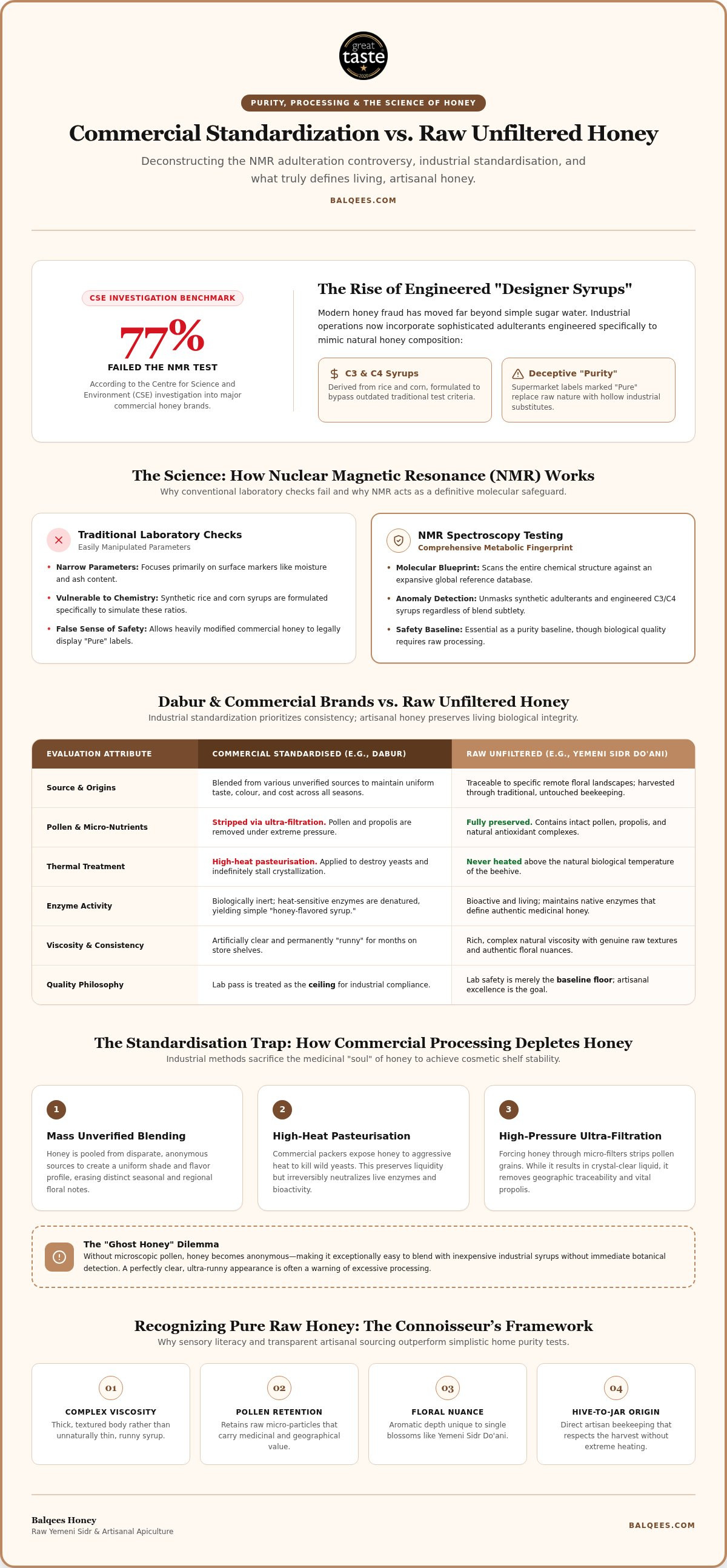
In a landmark investigation by the Centre for Science and Environment (CSE), 77% of commercial honey samples failed the NMR test. This data point sent shockwaves through health-conscious communities. It highlighted a painful truth: a "Pure" label on a supermarket shelf doesn't always guarantee the integrity of what's inside. For a connoisseur, the emotional impact of food fraud is profound, as it replaces a sacred natural product with a hollow, industrial substitute.
What is NMR Testing and Why is it Necessary?
Nuclear Magnetic Resonance (NMR) testing acts as a comprehensive metabolic fingerprint. Traditional laboratory checks often focus on narrow parameters like moisture or ash content, which are easily manipulated by clever adulterants. NMR is different because it scans the entire chemical structure against a global database to identify anomalies. NMR spectroscopy serves as the ultimate molecular safeguard, exposing even the most sophisticated synthetic syrups by mapping the entire chemical blueprint of the hive's gift.
The Problem with Mass-Market Standardisation
Consistency is the hallmark of the factory, not the forest. Brands like Dabur strive for a uniform taste, color, and texture in every jar, regardless of the season. To achieve this, honey is often blended from various unverified sources and subjected to high heat. This standardisation process strips away the unique floral nuances found in artisanal varieties like Raw Yemeni Sidr Do’ani Honey. While the result may be officially "safe for consumption," it's often nutritionally incomplete. True purity isn't found in a factory's blend, but in the untouched, raw integrity of the harvest. When you weigh the Dabur honey adulteration test vs raw unfiltered honey, you're choosing between a mass-produced commodity and a living, medicinal food.
Processing vs. Purity: The Unfiltered Truth About Raw Honey
True honey is a living thing. It's a complex tapestry of enzymes, pollen, and floral essences that begin to unravel the moment they meet extreme heat or industrial pressure. When we speak of "Raw and Unfiltered" honey, we're describing a product that has never been heated above the natural temperature of the hive. This preservation of integrity is the core of the debate when examining the Dabur honey adulteration test vs raw unfiltered honey. While a lab test might look for sugar levels, it often ignores the biological "soul" that processing destroys.
The CSE investigation into honey adulteration shed light on how easily the industry manipulates this golden liquid. Beyond the addition of syrups, the very act of standardisation for mass-market appeal involves stripping the honey of its character. You've likely noticed that supermarket honey remains perfectly clear and runny for months. This isn't a sign of quality. It's a sign of a product that has been processed into submission.
Ultra-Filtration: Stripping Away the Soul of Honey
Industrial packers use ultra-filtration under high pressure to remove every microscopic speck of debris. This includes bee pollen, the very element that allows experts to trace honey back to its geographic origin. Without pollen, the honey becomes a "ghost" product, anonymous and easier to blend with cheap fillers. This process also removes the vital raw honey nutrition facts that health-conscious consumers seek. For the connoisseur, a perfectly clear jar is a warning. It suggests a lack of propolis, antioxidants, and the natural textures that define a genuine harvest.
Heat Treatment: The Enemy of Bioactivity
Heat is the most common tool used to ensure honey stays liquid on the shelf. Pasteurisation kills the natural yeasts to prevent fermentation, but it also destroys heat-sensitive enzymes like diastase and invertase. These are the "living" parts of honey responsible for its medicinal reputation. In contrast, artisanal brands prioritize a cold-pressed method, ensuring the honey never exceeds 40 degrees Celsius. This is especially critical for rare varieties like Raw Yemeni Sidr Do’ani Honey, where the bioactivity is the primary reason for its value. When honey is "standardised" with heat, it loses its floral depth and begins to taste like a simple, one-dimensional syrup. The choice between the Dabur honey adulteration test vs raw unfiltered honey ultimately comes down to whether you value a shelf-stable commodity or a potent, medicinal food. If you wish to experience the true, unadulterated power of the hive, you might explore our collection of cold-pressed treasures.
Dabur vs. Raw Unfiltered Honey: A Connoisseur’s Comparison
To the untrained eye, all honey looks similar. To the connoisseur, the difference is as vast as that between a mass-produced soda and a vintage wine. When examining the Dabur honey adulteration test vs raw unfiltered honey, we must look beyond the lab report and into the jar itself. Mass-market brands often present a thin, runny consistency that remains unchanged for years. This is a result of ultra-filtration and high heat. In contrast, raw honey possesses a complex viscosity, a texture that feels substantial and alive on the tongue. It carries the weight of the landscape from which it was gathered.
Aroma is the heartbeat of pure honey. It should evoke the blossoms from which it was born. If your honey lacks a distinct floral scent, it has likely lost its volatile compounds during aggressive processing. Then there is the matter of crystallisation. Many consumers mistakenly believe that honey "turning to sugar" is a sign of spoilage. In truth, it is one of the most reliable markers of purity. Raw honey naturally crystallises because its glucose and fructose haven't been stripped of the natural particles that trigger the process. It's a sign that the honey is still "alive" and untouched by the industrial methods used to keep commercial honey indefinitely liquid.
The Sensory Profile of High-Quality Honey
Evaluating the deep, earthy notes of rare honey varieties reveals the profound influence of terroir. Whether it's the rugged valleys of Yemen or the pristine slopes of the White Mountains, the environment dictates the flavour profile. Mass-market honey, blended for consistency, lacks a "finish," that lingering aftertaste that tells the story of the hive's journey. This lack of transparency is why FDA guidance on honey labeling emphasizes the importance of accurate representation, protecting consumers from economically motivated adulteration that disguises syrup as nectar.
Functional Benefits: Beyond Basic Sweetness
The prebiotic power of raw honey is lost when it is pasteurised. For these enzymes to support gut health, they must remain intact. This is why learning how to use functional honey blends effectively requires a raw, cold-pressed base. When you choose an artisanal Sidr honey over a commercial brand, you're investing in significantly higher antioxidant levels. The Dabur honey adulteration test vs raw unfiltered honey debate isn't just about sugar; it's about the difference between a simple sweetener and a potent wellness ritual that respects the ancient traditions of the hive.
How to Identify Pure Honey: Home Tests and Label Literacy
While the digital world is rife with "quick fixes" for checking purity, discerning the difference between an industrial brand and a true harvest requires a more nuanced approach. Many people rely on the Water Test: dropping a spoonful into a glass of water to see if it remains a solid lump or dissolves instantly. While raw honey should indeed resist dissolving, modern synthetic syrups are often engineered to mimic this density. This is why the debate of Dabur honey adulteration test vs raw unfiltered honey cannot be settled by a kitchen experiment alone. These tests are helpful indicators, but they are not definitive proof against the sophisticated adulterants exposed in recent food fraud investigations.
Price is another silent witness to quality. Real, artisanal honey is a result of meticulous labor and remote sourcing, meaning it cannot be produced at industrial price points. If a large jar costs less than a simple meal in a UAE cafe, it's a sign that the contents have likely been "stretched" with sugar syrups. Purity has a cost that reflects the integrity of the beekeeper's craft and the health of the bees.
Decoding the Honey Label
Your first line of defense is a well-informed eye. When using a how to identify pure honey guide, look for red flags such as "Honey Blend" or "Product of multiple countries." These phrases often mask a lack of traceability and the mixing of various low-quality batches. Seek out single-origin labels that name a specific region, such as the valleys of Yemen. Terms like "Artisanal" and "Cold-Pressed" carry significant weight, as they signal that the honey has been handled with reverence rather than industrial force.
The Myth of the Perfect Liquid
The supermarket shelf has conditioned us to expect a perfectly clear, amber liquid. For the connoisseur, cloudiness, tiny bubbles, and sediment are marks of a high-quality, unfiltered product. These are the particles of pollen and propolis that hold the medicinal value of the hive. Natural honey also undergoes seasonal variations; the color and taste may shift depending on the rainfall and the specific flora in bloom. Consistency in mass-market honey is a sign of industrial intervention. If every jar looks identical regardless of the year or season, the honey has been standardized in a factory, not gathered in the wild. To ensure you are receiving the untouched gift of nature, choose a honey with a clear story of provenance from our curated collection.
Beyond the Supermarket: Why Artisanal Sourcing is the Ultimate Purity Test
Purity is not merely a data point on a laboratory report. It's the integrity of a journey that begins in the remote, sun-drenched valleys of Yemen and ends only when the jar reaches your table. While the Dabur honey adulteration test vs raw unfiltered honey comparison provides a necessary baseline for food safety, the true connoisseur looks for something deeper. They look for a relationship. Trust in the producer is often more valuable than a label on a supermarket shelf because it guarantees a chain of custody that values quality over volume. By choosing artisanal sources, you are actively supporting sustainable beekeeping honey practices. These traditional methods ensure that the bees are respected and the land remains vibrant for generations to come.
We believe that honey should be a partnership in wellness. At Balqees, we act as storytellers and guardians, ensuring that the ancient traditions of the hive are never sacrificed for the sake of standardization. This commitment to transparency allows you to move beyond the confusion of industrial marketing and into a world of genuine, sensory delight. When you know the beekeeper and the landscape, the need for complex lab tests begins to fade, replaced by the confidence of true quality.
The Balqees Commitment to Purity
Our approach is simple yet uncompromising. We source our Raw Yemeni Sidr Do’ani Honey directly from small-batch beekeepers who refuse to take shortcuts. By rejecting ultra-filtration and high-heat pasteurization, we ensure that our honey remains a living food, teeming with the enzymes that define its medicinal character. This raw integrity is the foundation of our functional honey blends. Without a pure, cold-pressed base, the added botanicals and fusions would lose their synergistic power. We handle every jar with the same reverence the beekeeper shows the hive, preserving the delicate balance of nature.
Investing in Your Health
The decision to choose artisanal honey is an investment in nutritional density and peace of mind. While industrial prices may be lower, they often reflect a product that has been stripped of its inherent value. The cost of genuine raw honey is a reflection of its rarity and the careful, slow nature of traditional extraction. When you buy raw honey online UAE through a trusted partner, you are securing a product that is as pure as nature intended. It's time to move beyond the supermarket aisle and experience the profound difference of honey that has never been compromised. Your wellness deserves nothing less than the untouched, golden heritage of the wild.
Choosing a Legacy of Purity
The journey from a supermarket shelf to a remote Yemeni valley is a path of rediscovery. You've learned that while lab reports offer a necessary safety net, they don't capture the living essence of the hive. When you weigh the Dabur honey adulteration test vs raw unfiltered honey, you're choosing between a standardized commodity and a potent, medicinal food. True purity is found in the cloudiness of an unfiltered jar and the rich, complex aroma of the wild. It's about trusting a process that honors nature rather than trying to outsmart it with industrial shortcuts.
At Balqees, we remain dedicated to the slow, careful traditions of our craft. Every jar is sourced from the heart of Yemen, cold-pressed, and never ultra-filtered to ensure the natural enzymes remain intact. This commitment to integrity is why we are trusted by honey connoisseurs across the UAE who prioritize both heritage and health. Experience the difference of a harvest that has never been compromised.
Savour the Purity of Artisanal Honey at Balqees
Step into a world where every spoonful tells a story of the earth's untouched beauty and timeless wellness.
Frequently Asked Questions
Is Dabur honey really pure according to NMR tests?
Dabur claims its honey complies with all local FSSAI standards, yet independent investigations have raised concerns. In a significant 2020 report by the Centre for Science and Environment (CSE), many major Indian brands failed Nuclear Magnetic Resonance (NMR) testing conducted in German laboratories. NMR acts as a metabolic fingerprint, uncovering sophisticated rice syrups that standard tests miss. When comparing the Dabur honey adulteration test vs raw unfiltered honey, a "pass" on a basic test doesn't always equal the biological integrity of an artisanal harvest.
What is the difference between raw honey and commercial honey?
Raw honey is nectar exactly as it exists in the hive, untouched by high heat or pressure. It retains its natural enzymes, antioxidants, and pollen grains. Commercial honey, however, is often pasteurised and ultra-filtered to ensure a uniform appearance and an indefinite shelf life. This industrial standardisation removes the "living" components of the honey, resulting in a product that serves as a simple sweetener rather than a nutritionally complete, medicinal food.
Why does raw honey crystallise while Dabur honey stays liquid?
Crystallisation is a natural process where glucose precipitates out of the liquid nectar, proving the honey is pure and unprocessed. Raw honey contains tiny particles of pollen and propolis that act as catalysts for this change. Commercial brands often stay liquid indefinitely because they are ultra-filtered to remove these particles and heat-treated to melt micro-crystals. A jar that never crystallises is frequently a sign of heavy industrial intervention rather than superior quality.
Can I test for honey adulteration at home with 100% accuracy?
No, common home tests like the water drop or matchstick test cannot provide 100% accuracy against modern adulterants. Sophisticated C3 and C4 rice syrups are specifically engineered to mimic the density and moisture levels of natural honey, allowing them to bypass simple kitchen experiments. While these tests are helpful indicators, the only way to ensure absolute purity is through professional laboratory analysis like NMR or by sourcing from transparent, artisanal producers who value heritage over volume.
Why is raw unfiltered honey more expensive than supermarket brands?
The price reflects the meticulous, slow nature of traditional beekeeping and the rarity of single-origin harvests. Producing Raw Yemeni Sidr Do’ani Honey requires remote sourcing and artisanal extraction methods that don't allow for industrial shortcuts or mass-blending. Supermarket brands benefit from global supply chains that prioritize volume and shelf stability over nutritional density. When you invest in raw honey, you're paying for the integrity of a living product that hasn't been "stretched" with cheap syrups.
Does ultra-filtration remove the health benefits of honey?
Yes, ultra-filtration significantly reduces the medicinal value of honey by stripping away pollen, propolis, and wax fragments. These components are rich in antioxidants and prebiotics that support gut health and immunity. By removing these "impurities" to create a clear liquid, industrial processors also remove the botanical markers that prove the honey's origin. True wellness benefits require the presence of these natural, bioactive elements found only in raw, cold-pressed varieties that respect the hive's gift.
What should I look for on a honey label to ensure it is raw?
Seek out specific terms like "unfiltered," "cold-pressed," and "raw" on the packaging. A high-quality label should identify a single geographic origin rather than a vague "blend of countries." Avoid jars that list additives or fail to provide a clear story of the beekeeper's practices. In the debate of the Dabur honey adulteration test vs raw unfiltered honey, a transparent supply chain is your most reliable indicator that the natural enzymes and floral character remain intact.
Is Yemeni Sidr honey less likely to be adulterated?
Authentic Yemeni Sidr honey is prized for its purity, but its high value makes it a frequent target for counterfeiters in the global market. This is why sourcing from a dedicated partner like Balqees is essential for connoisseurs in the UAE. We work directly with artisanal beekeepers in remote regions to ensure our Raw Yemeni Sidr Do’ani Honey is never compromised. Trusting the producer's heritage and commitment to traditional methods is the only way to secure genuine, medicinal nectar.


