


True Sidr honey is a biological archive of the Yemeni desert, yet a staggering amount of what sits on global shelves is little more than sophisticated sugar syrup. It's a bold claim, but for a connoisseur, the distinction is everything. You've likely felt that flicker of doubt while holding a premium jar, wondering how to identify authentic Sidr honey amidst a sea of raw and organic labels. It's frustrating to seek the healing heritage of the Wadi Do'an only to worry about heat-treatment or hidden additives.
We believe you deserve absolute clarity. You'll master the sensory and scientific markers that define this ancient nectar, moving beyond confusing terminology to explore the real biological fingerprint of the honey. We'll examine everything from its enzyme-rich viscosity to its distinct, earthy aroma. This guide provides a clear checklist for home testing and the confidence to source genuine Yemeni products that remain untouched by industrial processing. Discover how to separate artisanal excellence from processed imitations with the wisdom of a true honey mentor.
Key Takeaways
- Recognize the botanical signature of the Ziziphus spina-christi tree and why the presence of active enzymes like diastase is non-negotiable for purity.
- Master a structured sensory evaluation to understand how to identify authentic Sidr honey by looking for natural cloudiness rather than industrial clarity.
- Explore the concept of terroir and how the high-altitude climate of Wadi Do'an in Yemen dictates the unique potency and flavor of the nectar.
- Distinguish between common folklore tests and the "Living Honey" method to observe how raw, cold-pressed honey reacts to physical movement.
- Learn the essential storage protocols for the UAE climate to protect your honey from light, heat, and moisture, ensuring its medicinal properties remain intact.
Defining Authentic Sidr Honey: Botanical Origins and Biological Markers
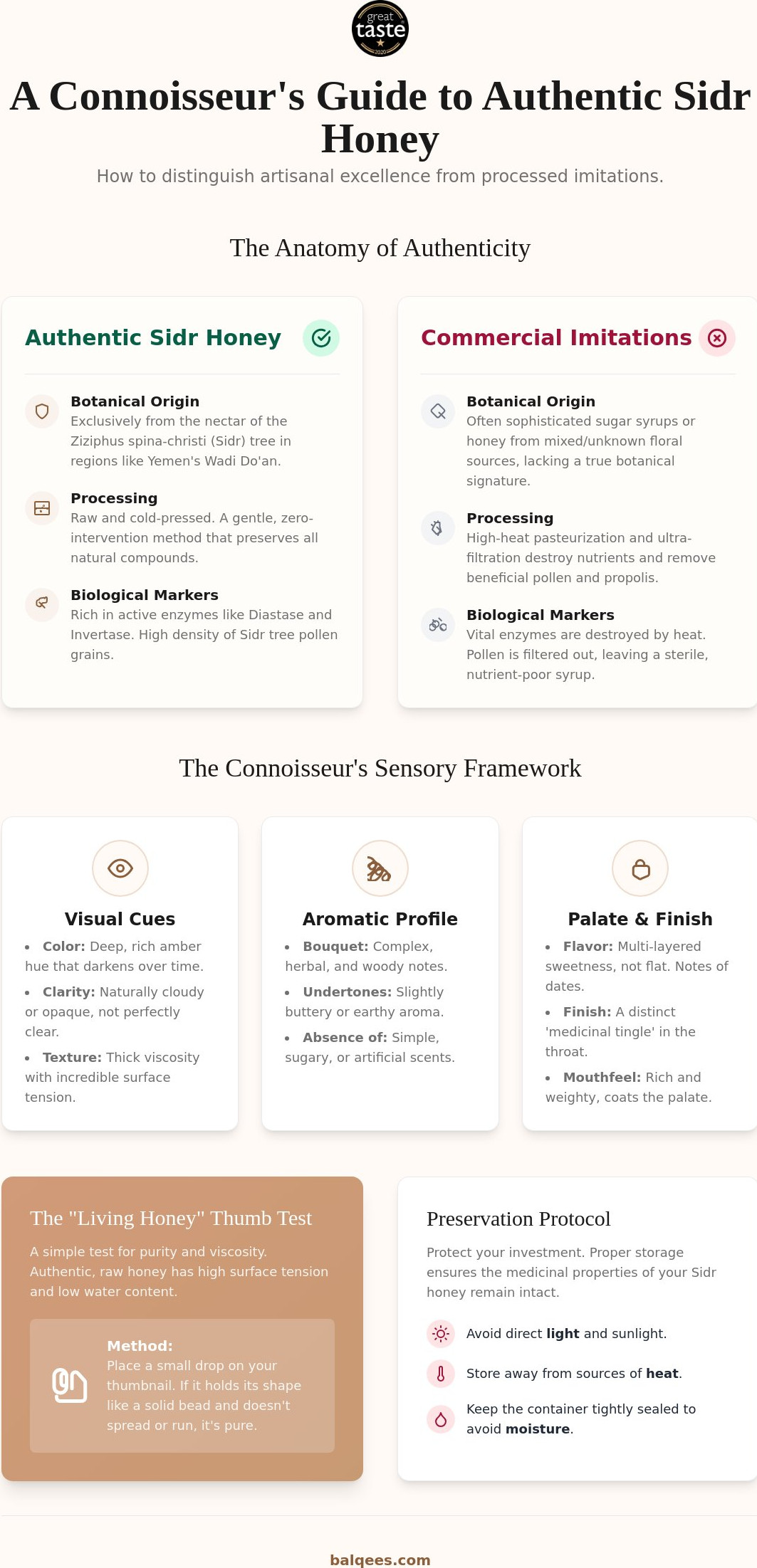
To understand how to identify authentic Sidr honey, one must first look at the source. It isn't just a label. It's a biological reality. The nectar must come exclusively from the Sidr tree (Ziziphus spina-christi). This ancient, thorny evergreen is the heart of monofloral Sidr honey. If the bees wander to other blossoms, the unique chemical profile is diluted. It loses its soul. Authentic honey is a snapshot of a specific time and place, captured by the bees in the wild landscapes of Yemen.
The Sacred Sidr Tree: A Botanical Powerhouse
The Sidr tree thrives in the harsh, arid landscapes of the Arabian Peninsula. Its resilience is legendary. This survival instinct is concentrated in its nectar, creating a substance with immense potency. Harvesting this liquid gold is a race against time. The blooming season lasts only 40 to 60 days each year. This short window is why authentic Sidr is so rare compared to the 1.8 million tonnes of honey produced globally. In the tradition of Wadi Do'an, the tree's medicinal reputation is seen as directly transferable to the honey. It's a legacy of healing passed from root to blossom to bee.
Raw vs. Commercial: The Processing Gap
Industrial honey is often a ghost of its former self. Mass production relies on high-heat pasteurization to prevent crystallization and ensure a clear, uniform appearance. This process kills the "living" spirit of the product. Specifically, it destroys vital enzymes like diastase and invertase. These enzymes are the biological markers of quality. Choosing cold pressed honey UAE enthusiasts trust is the only way to ensure these markers remain intact. Cold-pressing is a gentle, zero-intervention method. It avoids the heat that denatures proteins and preserves the geographic "fingerprint" found in the pollen.
When you are learning how to identify authentic Sidr honey, look for these biological indicators:
- Diastase Activity: An enzyme that breaks down starches, used as a primary indicator of honey freshness and heat exposure.
- Invertase: Critical for the conversion of sucrose into glucose and fructose, adding to the honey's complex profile.
- Pollen Density: Microscopic analysis of pollen grains confirms the honey originated in the specific soil and climate of Yemen.
Ultra-filtration is another enemy of authenticity. It removes propolis and pollen, leaving behind a sterile syrup. True connoisseurs look for the subtle cloudiness and sediment that signals a rich, unfiltered life. Perfection is often a sign of over-processing. Authentic Sidr honey is raw, slightly opaque, and carries the weight of its heritage in every drop.
The Connoisseur’s Sensory Framework: How to Test Sidr Honey at Home
Learning how to identify authentic Sidr honey requires a return to your senses. It's an intimate process. While lab reports verify the biochemical markers of authentic Sidr honey, your eyes, nose, and palate are the first line of defense against imitation. Authentic Sidr isn't a factory-made product; it's a seasonal masterpiece that carries the subtle imperfections of nature. If a jar looks too perfect, it usually is.
Visual and Aromatic Indicators
Begin with the light. Authentic Sidr honey typically presents a deep amber hue. This color isn't static. It deepens over time as the mineral content interacts with the environment. High-quality raw honey possesses incredible surface tension. Try the "Thumb Test": place a small drop on your thumbnail. If it holds its shape like a gleaming bead, it's pure. If it spreads or runs immediately, it's likely been diluted with water or syrups. Before tasting, inhale deeply. You should detect a complex bouquet that's herbal, woody, and slightly buttery. It shouldn't smell like simple sugar.
The Palate and the 'Medicinal Tingle'
The first taste should be a revelation. Unlike industrial syrups that offer a flat, one-dimensional sweetness, Sidr honey is multi-layered. You might notice notes of dates or a faint earthiness. Pay attention to the finish. A hallmark of high bioactivity is a slight "burning" sensation or a medicinal tingle in the back of the throat. This isn't unpleasant; it's the signature of living enzymes at work. While Sidr is known for its thick viscosity, other rare varieties like white mountain honey benefits from a naturally creamy, almost velvet-like texture. Each variety tells a different story of the landscape it was born in.
Understanding Crystallization in Raw Honey
There's a persistent myth that crystallized honey is spoiled. This couldn't be further from the truth. Crystallization is a natural process dictated by the ratio of glucose to fructose. Because Sidr honey is exceptionally high in fructose, it remains liquid for much longer than other varieties. However, it can still "cloud" over time. If your honey begins to set, don't worry. It's a sign that the honey is raw and unfiltered. To return it to a liquid state, gently place the jar in warm water. Never exceed 37°C. Going higher will destroy the very enzymes you're seeking to preserve.
Trusting your senses is the first step toward becoming a true guardian of your health. If you're ready to experience these sensory markers for yourself, explore our curated selection of Raw Yemeni Sidr Do'ani Honey and discover the difference that zero-intervention beekeeping makes.
The Terroir of Authenticity: Yemeni Heritage and Nomadic Beekeeping
Terroir is the silent architect of flavor and medicinal potency. In the world of premium nectar, it represents the living synergy between soil chemistry, altitude, and climate. For anyone learning how to identify authentic Sidr honey, understanding the landscape of Yemen is essential. It's not just about the tree. It's about the specific earth it grows in. The rugged terrain of the Arabian Peninsula forces the Sidr tree to concentrate its nutrients, a process that reflects directly in the honey's complex profile.
Nomadic beekeeping is the heartbeat of this tradition. Unlike industrial hive management, which relies on stationary boxes and chemical miticides to maintain colony health, Yemeni beekeepers are true nomads. They move their hives across the desert and mountains to follow the blossoming cycles. This movement ensures the bees are always foraging on fresh, wild nectar. It keeps the colonies vibrant without the need for synthetic interventions. This "zero-chemical" approach is a hallmark of artisanal quality that mass-market brands simply cannot replicate. For those who appreciate this level of dedication to traditional craft, you can learn more about Biryani House to see how similar values are applied to authentic South Asian cuisine.
The Wadi Do’an Distinction
The Hadramaut mountains produce the world's most coveted Sidr nectar. Within these valleys, Raw Yemeni Sidr Do'ani Honey is harvested using methods that have remained unchanged for centuries. Beekeepers use hand-carved tools and traditional techniques to ensure the "living" qualities of the honey are never compromised. In this region, honey is a sacred gift of health. It's a cultural pillar, often presented as a symbol of deep respect and hospitality. The reverence for the craft in Wadi Do'an is what makes its honey a global benchmark for purity.
Altitude and Purity
High-altitude nectars are nature's last sanctuary from modern pollutants. At these elevations, the air is untouched by the pesticides and industrial runoff common in lower-lying agricultural areas. The result is a mineral-rich profile that feels incredibly clean on the palate. This is why artisanal honey brands UAE connoisseurs are increasingly returning to these remote mountain sources. They're seeking a product that hasn't been touched by the modern world. When you taste honey from these heights, you're tasting a landscape that remains as it was a thousand years ago.
Authenticity is found in the struggle of the tree and the journey of the bee. By choosing honey from these specific terroirs, you aren't just buying a sweetener; you're supporting a nomadic heritage that protects the bees and the land they inhabit. Facilitating this vital link between traditional producers and international connoisseurs, Global Exclusive Trading (GET) helps ensure these authentic treasures can be ethically sourced globally. It's a connection to the earth that industrial processes can never provide.
Home Testing vs. Laboratory Science: Distinguishing Fact from Folklore
Folklore is a charming companion to heritage, but it often lacks the precision required for absolute certainty. When exploring how to identify authentic Sidr honey, many enthusiasts start in their own kitchens. While your senses provide the first clues, home tests offer a practical, if sometimes incomplete, secondary layer of verification. It's about moving from intuition to observation. These methods help you understand the physical properties of the nectar before you rely on the definitive word of a laboratory.
Reliable Home Evaluation Methods
The Water Test remains a classic for a reason. Drop a teaspoon of honey into a glass of room-temperature water. Pure, high-viscosity Sidr honey will settle at the bottom in a solid clump or "ribbon" without dissolving immediately. If it begins to cloud the water or break apart into streaks, it likely contains added syrups or has been diluted. Another effective tool is the Blotter Test. Place a small drop on a paper towel or a high-quality napkin. Authentic honey, which has a naturally low moisture content, will sit on the surface. If a wet ring forms around the drop, it indicates the presence of added water or a high moisture level common in lower-grade harvests.
Be cautious of the popular "Fire Test." While many claim that lighting a honey-soaked match is the ultimate proof, it can be misleading. Raw honey naturally contains a small amount of moisture. If the match doesn't light, it doesn't always mean the honey is fake; it might just be a fresh, raw harvest that hasn't been dehydrated. Instead, try the "Living Honey" test. Gently shake your jar. Because raw Sidr is packed with active enzymes, you should see tiny, persistent bubbles or a fine foam forming at the top. This "breath" of the honey is a sign of life that processed, heat-treated products cannot mimic.
The Science of Freshness: HMF and Enzymes
While home tests are helpful, professional analysis is the only 100% guarantee of purity. Scientists look for HMF (Hydroxymethylfurfural), a chemical compound that serves as the "barcode" of heat damage. In fresh, unheated honey, HMF levels are extremely low. If honey is old or has been pasteurized, these levels spike. This is why we adhere to a strict zero-heat policy. We also measure diastase activity. This enzyme is the key indicator of medicinal grade honey. If the diastase is gone, the honey's "spirit" and its health benefits have been compromised by industrial processing.
Transparency is the cornerstone of trust. We believe every connoisseur should have access to the data behind their jar. To experience the difference that verified purity makes, buy authentic Yemeni Sidr honey from a source that prioritizes batch testing and artisanal integrity over mass-market convenience.
Ultimately, the goal is to find a balance between the wisdom of the senses and the rigor of science. Home tests connect you to the physical reality of the product, while lab markers protect your investment. Together, they ensure that the heritage of the Sidr tree remains untouched in your home.
Preserving the Potency: Sourcing and Storage for the Connoisseur
Finding a genuine harvest is only half the journey. Once you understand how to identify authentic Sidr honey, you become the guardian of its life force. Raw honey is a delicate biological system. It's a collection of active enzymes, antioxidants, and volatile aromatic compounds that require specific conditions to survive. In the high-temperature environment of the UAE, preservation isn't just a suggestion; it's a necessity to keep the "living" qualities of your nectar intact.
The integrity of your honey depends on your defense against three primary enemies: light, heat, and moisture. UV rays from sunlight can rapidly degrade the delicate enzymes and antimicrobial properties that make Sidr honey so valuable. Heat is equally destructive. Any temperature sustained above 37°C begins to denature the proteins, effectively "killing" the honey's medicinal potential. Finally, moisture is the catalyst for fermentation. Because raw honey is hygroscopic, it pulls water from the air. If the moisture content rises, natural yeasts can wake up and turn your premium honey into vinegar.
The Golden Rules of Honey Storage
Store your jars in a cool, dark cupboard away from the stove or windows. Glass is the only material fit for a connoisseur. Unlike plastic, which can leach chemicals and is slightly porous to oxygen, glass is inert. It protects the honey's purity for years. When it's time for your daily spoonful, remember the "Never Heat" rule. Never stir your honey into boiling tea or water. Wait for the liquid to reach a drinkable temperature to ensure you don't destroy the enzymes you worked so hard to find. Always use a clean, dry wooden or stainless steel spoon to avoid cross-contamination.
Navigating the Market as an Informed Buyer
When you look to buy raw honey online UAE, the labels tell a story if you know how to read them. Look for "unfiltered," "cold-pressed," and "raw." Be wary of the "Organic" label alone. While it suggests the bees foraged on pesticide-free flowers, it doesn't guarantee the honey hasn't been pasteurized or ultra-filtered. A truly raw product will often show signs of its artisanal origin, such as a fine layer of foam or a slight cloudiness.
Heritage-focused branding is often the hallmark of quality. These producers focus on rare honey varieties that are tied to specific seasons and nomadic traditions. They prioritize transparency over volume. By choosing a source that respects the slow, careful nature of the Sidr harvest, you ensure that every drop on your palate is as potent as it was in the hives of Wadi Do'an. True authenticity is a commitment to quality that lasts from the blossom to the very last spoonful in your jar.
Embracing the Legacy of the Sidr Tree
Identifying true Sidr is a journey of reconnection with nature's rhythms. It's about moving beyond superficial labels and learning how to identify authentic Sidr honey through its deep amber hue, its signature medicinal tingle, and its complex botanical markers. You now possess the framework to distinguish between sterile industrial syrups and the living, enzyme-rich nectar of the Yemeni desert. By prioritizing cold-pressed purity and nomadic heritage, you protect both your well-being and a craft that has survived for millennia.
We invite you to experience this integrity firsthand. Our harvests are sourced directly from nomadic beekeepers in Wadi Do'an and remain 100% cold-pressed and unfiltered to preserve their vital bioactivity. Trusted by connoisseurs across the UAE for over a decade, we are proud to be the bridge between ancient tradition and your modern lifestyle. Explore the Balqees Collection of Authentic Raw Sidr Honey and bring the spirit of the Hadramaut mountains into your home. Trust your senses and enjoy the profound vitality that only nature in its purest, untouched form can provide.
Frequently Asked Questions
Is crystallized honey a sign that it contains added sugar?
No, crystallization is a natural process and doesn't mean your honey has added sugar. It's actually a hallmark of raw, unfiltered honey. While many believe that "setting" honey is a sign of spoilage, it's just the glucose separating from the water. Because Sidr honey is naturally high in fructose, it remains liquid much longer than other varieties. If a jar never crystallizes over several years, it might have been ultra-filtered or pasteurized.
How can I tell if my Sidr honey has been heat-treated?
You can detect heat treatment by observing the honey's clarity and its lack of a complex aroma. Authentic honey is often slightly cloudy because it hasn't been ultra-filtered to remove beneficial pollen. If a jar is perfectly transparent and lacks a woody or herbal scent, it's likely been pasteurized. Learning these visual cues is a vital part of how to identify authentic Sidr honey in a crowded market.
What is the 'Water Test' and is it actually reliable?
The Water Test is a helpful indicator of density, but it isn't a 100% scientific guarantee. To perform it, drop a spoonful of honey into a glass of water. Pure Sidr honey should sink to the bottom and stay intact as a solid clump. If it starts to dissolve or "bloom" into the water immediately, it's a sign of high moisture or added syrups. Use this alongside sensory checks for the best results.
Why does authentic Yemeni Sidr honey cost more than other varieties?
The higher cost of Yemeni Sidr honey reflects its extreme rarity and the nomadic traditions required to harvest it. The Sidr tree blooms for only 40 to 60 days each year in remote valleys like Wadi Do'an. Beekeepers must transport hives through rugged terrain without using chemicals or modern machinery. This labor-intensive process ensures a purity and medicinal potency that industrial honey can't match.
Can I use a metal spoon with raw Sidr honey?
Yes, you can safely use a high-quality stainless steel spoon with your raw honey. The idea that metal "kills" honey enzymes is a lingering myth from a time when spoons were made of reactive metals like copper. Modern food-grade stainless steel is non-reactive. It won't cause any chemical changes or degrade the bioactivity of the honey during the few seconds it takes to serve a portion.
Does high quality raw honey ever expire or lose its potency?
Pure honey doesn't expire if it's kept in an airtight glass container. It's a naturally preserved substance with low moisture and an acidic pH that prevents bacteria from growing. While the color might darken or the texture might change through crystallization, the medicinal properties remain stable. Just ensure you keep it away from direct sunlight and heat to prevent enzyme degradation over time.
What is the difference between Sidr honey and Manuka honey?
The primary difference is the chemical profile and the botanical origin. Manuka honey is famous for its MGO (Methylglyoxal) content, which provides its antibacterial strength. Yemeni Sidr honey is prized for its exceptionally high antioxidant levels and live enzymes. While both are medicinal, Sidr offers a more traditional, buttery flavor profile that's deeply rooted in the desert terroir of the Arabian Peninsula.
How can I identify if honey has been diluted with corn syrup?
Honey diluted with corn syrup usually lacks the "medicinal tingle" and the thick surface tension of the real product. If you place a drop on your thumb and it runs off immediately, it's likely been thinned with syrup. Authentic Sidr has a rich, multi-layered sweetness and a distinct herbal aroma. Knowing these sensory differences is the best way to understand how to identify authentic Sidr honey without a laboratory.


