


The most expensive jar in your collection isn't always the one your body needs most. You’ve likely stood before a shelf of premium jars, paralyzed by the choice between Sidr honey vs Manuka honey, wondering if the high price tag reflects true potency or just clever branding. It’s a common frustration. Between the clinical complexity of New Zealand’s UMF ratings and the rare, nomadic heritage of Yemeni Sidr, the path to choosing a functional elixir feels clouded by jargon and the fear of buying a counterfeit.
This guide serves as your definitive map through the world’s most prestigious apiaries. You’ll discover why Manuka excels as a scientific specialist in wound care, while Sidr remains the ancient, multi-layered generalist for internal vitality. We’ll break down the grading systems, from MGO levels to Total Activity (TA) ratings, ensuring you have the confidence to invest in purity. By the end, you’ll understand the artisanal craftsmanship behind every drop and exactly which honey belongs in your daily wellness ritual.
Key Takeaways
- Uncover the distinct histories of the sacred Sidr tree and the rugged Manuka bush to appreciate the cultural heritage behind every jar.
- Understand the core differences in Sidr honey vs Manuka honey bioactivity, specifically how Manuka’s MGO levels compare to Sidr’s complex antioxidant profile.
- Master the connoisseur’s palate by identifying the buttery, spicy notes of Sidr against the earthy, medicinal profile of high-grade Manuka.
- Learn to align your choice with your wellness goals, whether you need a specialist for external care or a generalist for internal vitality.
- Gain the tools to identify authentic, raw, and unfiltered varieties to ensure you’re investing in a pure, potent elixir.
The Sacred vs. The Rugged: Understanding Botanical Origins
To truly appreciate the nuance of Sidr honey vs Manuka honey, one must first look to the landscapes that birth them. These are not merely food products; they are the distilled essence of two vastly different ecosystems. One emerges from the sun-drenched, ancient valleys of the Middle East, while the other is forged in the mist-veiled, wind-swept hills of New Zealand. The environment dictates the chemistry, the rarity, and the very spirit of the nectar.
The Sacred Sidr Tree: A Desert Legend
The Sidr tree, known scientifically as Ziziphus spina-christi, holds a position of deep reverence in the heritage of Yemen and the United Arab Emirates. Mentioned in ancient spiritual texts and historical chronicles, it's a tree that has provided shade, fruit, and medicine for millennia. It thrives in the most unforgiving arid climates, where temperatures soar and water is a luxury. This environmental pressure is exactly what makes the honey so potent. When a plant survives extreme stress, it concentrates its secondary metabolites, minerals, and antioxidants within its nectar.
The harvest itself is a feat of patience. The Sidr tree flowers only for a brief window during the winter months. This narrow timeframe, combined with the tree's remote locations, makes the resulting honey exceptionally rare. In the fertile valleys of Wadi Do’an, nomadic beekeepers practice a craft passed down through generations. They move their hives by hand, following the bloom to ensure the bees forage exclusively on the Sidr blossom, maintaining a level of purity that is increasingly rare in the modern world. The Sidr tree is a botanical fortress of nutrients, forged in the fires of the desert to provide a nectar of unparalleled resilience.
The Manuka Bush: A Modern Scientific Marvel
Contrast this with the Leptospermum scoparium, or the Manuka bush. For much of New Zealand’s modern history, this rugged shrub was considered a "nuisance shrub" by farmers, often cleared to make way for pasture. It was only in the late 20th century that science caught up with indigenous knowledge, revealing the plant’s extraordinary antibacterial properties. Unlike the desert-dwelling Sidr, the Manuka bush flourishes in cold, damp, and rugged environments, often clinging to steep hillsides where little else can grow.
The scale of production also marks a significant difference. While Yemeni Sidr remains an artisanal, small-batch endeavor rooted in nomadic tradition, the New Zealand Manuka industry has evolved into a sophisticated, industrial-scale operation. This allows for high global availability and rigorous standardized testing, but it lacks the intimate, hand-tended connection to the earth found in the ancient valleys of Yemen. While both are prestigious, they represent two different philosophies: the raw, untouched heritage of the desert versus the scientific precision of the southern wilderness.
The Science of Healing: MGO vs. Multi-Weapon Bioactivity
While their botanical origins tell a story of landscape and heritage, the true distinction in Sidr honey vs Manuka honey lies within their molecular architecture. These aren't just sweeteners; they're complex biological toolkits. If Manuka is a surgical laser, precisely tuned to a specific frequency, Sidr is a broad-spectrum shield. Both offer profound healing potential, yet they achieve their results through remarkably different chemical pathways.
Manuka’s Specialist Weapon: Methylglyoxal (MGO)
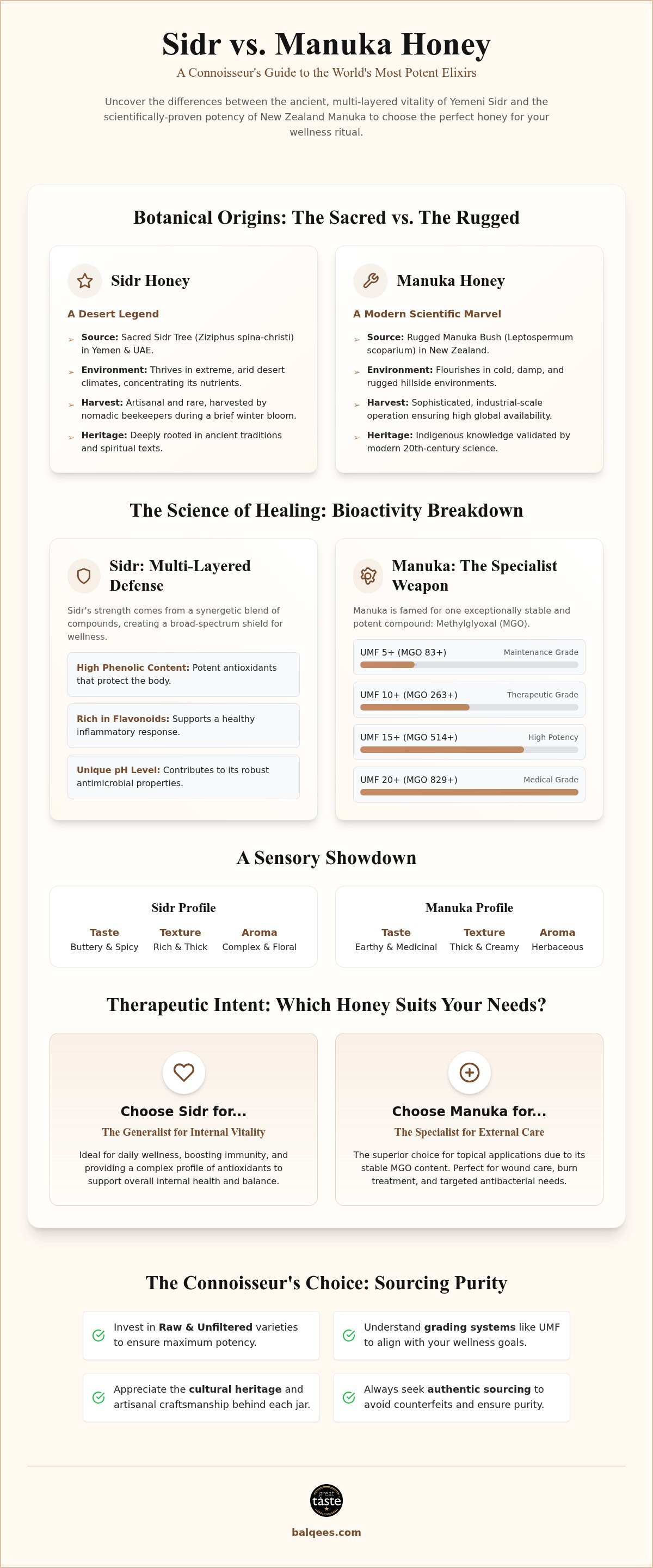
The primary driver of Manuka’s fame is a compound called Methylglyoxal, or MGO. This substance provides what scientists call "non-peroxide" antibacterial activity. Most honeys rely on hydrogen peroxide for their potency, which can break down when exposed to heat or light. MGO is different. It's exceptionally stable, allowing the honey to maintain its strength even in demanding conditions. This is why the Antibacterial activity of Manuka honey is so highly regarded for topical applications like wound care and burn treatment.
To help consumers navigate this potency, the industry uses the UMF (Unique Manuka Factor) grading system. This rating doesn't just measure MGO; it verifies the presence of Leptosperin and DHA, ensuring the honey is authentic and medicinal. It's a scientific standard that has turned a humble shrub into a global pharmaceutical phenomenon. It's reliable, measurable, and highly specialized.
Sidr’s Multi-Layered Defense
Sidr honey takes a more traditional, "multi-weapon" approach to wellness. It doesn't rely on a single dominant compound like MGO. Instead, its strength comes from a synergetic blend of high phenolic content, flavonoids, and a uniquely high pH level. While Manuka is acidic, Sidr is closer to neutral, which some practitioners believe makes it more harmonious for internal use. Sidr honey’s high antioxidant levels rival the world’s most potent superfoods, offering a systemic boost that goes beyond simple surface-level healing.
Research, including a notable study from the University of Ottawa, has compared these two giants against aggressive MRSA biofilms. The findings were startling: both honeys were effective at killing the bacteria, but they did so through different mechanisms. Sidr’s complexity is its greatest asset. By using an array of chemical "weapons" rather than just one, it may be more effective at preventing bacterial resistance. Bacteria can often adapt to a single compound, but they struggle to evolve against the multi-layered defense found in Raw Yemeni Sidr Do'ani Honey.
- Manuka: High MGO, acidic pH, best for targeted topical use.
- Sidr: High phenolic content, near-neutral pH, best for internal vitality and systemic inflammation.
- Synergy: Sidr uses a diverse chemical profile to fight infection from multiple angles.
Choosing between them isn't about finding which is "better," but rather which tool fits your specific need. If you're looking for a specialist to treat a specific skin ailment, Manuka's MGO is a proven choice. However, for those seeking a generalist that supports the body’s overall resilience through ancient, complex chemistry, Sidr remains the connoisseur's preference.
A Sensory Showdown: Comparing Taste, Texture, and Aroma
For the true enthusiast, the debate of Sidr honey vs Manuka honey isn't settled in a lab. It’s decided on the tongue. Beyond the clinical data of bioactivity, these elixirs offer a sensory journey that reflects their origins. One is a liquid sun, captured in the arid valleys of Yemen. The other is a dense, herbal concentrate from the rugged New Zealand bush. Their visual contrast alone tells a story of different worlds. Raw Yemeni Sidr Do’ani Honey presents as a clear, deep amber, glowing with clarity. In contrast, high-UMF Manuka is often opaque, ranging from a dark cream to a rich, muddy brown.
The Palate of the Desert
To taste Sidr is to experience a velvet-like embrace. It's buttery and smooth, possessing a richness that feels almost heavy on the spoon. The flavor profile is complex. You’ll find notes of cedarwood and warm spice, underpinned by a subtle medicinal sharpness that reminds you of its potency. Because it's raw and unfiltered, it retains the delicate particles of pollen and propolis. These elements don't just add health benefits; they deepen the aroma, giving it a floral, sun-baked scent. The finish is a masterclass in balance. It leaves a lingering, warm sweetness that stays with you, yet it never feels cloying or artificial. It's the taste of a desert in bloom.
The Earthy Profile of the Island
Manuka honey offers a more challenging, albeit rewarding, experience. It’s known for being "thixotropic," a scientific term for its jelly-like consistency. It’s thick. It’s dense. It often has a slightly grainy texture that sits firmly on the palate. The flavor is far less sweet than traditional honeys, leaning into earthy and herbal notes. Imagine the scent of damp earth after a rainstorm or the bitter-sweet tang of wild herbs. As the MGO levels increase, the medicinal aftertaste becomes more pronounced. It’s a rugged flavor for a rugged landscape. It doesn't seek to please everyone; it seeks to command respect through its intensity.
- Sidr: Clear amber, buttery texture, notes of wood and spice.
- Manuka: Opaque cream, thixotropic (jelly-like) body, earthy and herbal profile.
- Aroma: Sidr is floral and warm; Manuka is herbal and damp.
Therapeutic Intent: Which Liquid Gold Suits Your Wellness Needs?
Choosing between these two elixirs requires a shift in perspective. It's not a matter of which is superior, but which is suited for your specific goal. A common hurdle in the Sidr honey vs Manuka honey debate is the perception that Manuka is more powerful simply because it carries a numerical rating like UMF or MGO. While these systems provide excellent scientific clarity for New Zealand’s harvest, they don't tell the whole story. Sidr honey’s potency is rooted in ancient, nomadic traditions and a complex chemical profile that science is only beginning to quantify through Total Activity (TA) testing. Think of Manuka as a surgical specialist and Sidr as a holistic generalist.
Internal Vitality: The Sidr Advantage
If your wellness journey focuses on internal health, Sidr is often the preferred choice. Its near-neutral pH and rich phenolic content make it exceptionally gentle on the digestive tract. It acts as a potent prebiotic, nourishing the beneficial bacteria in your gut while soothing inflammation. In the traditional practices of the Middle East, it has long been revered for its role in men’s health and vitality, serving as a natural tonic for resilience. During seasonal shifts, its high antioxidant load provides a systemic shield, offering respiratory relief and immune support that feels both immediate and enduring.
External Recovery: The Manuka Specialty
Manuka honey shines brightest when applied to the skin. In clinical settings, it's the gold standard for dressing wounds and treating burns. This is where that stable MGO content becomes vital. It creates a protective, antibacterial barrier that promotes rapid healing without the risk of bacterial resistance. For those struggling with acne or chronic skin inflammation, a high-grade Manuka mask can be transformative. It draws out impurities while calming redness. A practical tip for the connoisseur: use your medical-grade Manuka topically for targeted recovery to ensure you don't waste its specialized external benefits when a more complex, internal-focused honey might serve your digestive needs better.
- Topical Care: Manuka for acne, minor burns, and wound healing.
- Digestive Support: Sidr for gut health, bloating, and prebiotic benefits.
- Immune Resilience: Sidr for seasonal allergies and respiratory health.
Ultimately, your choice depends on where your body needs support. Are you seeking a clinical solution for a skin ailment, or are you looking to fortify your system from within? If you're ready to experience the deep, systemic benefits of a desert legend, you can explore our range of Raw Yemeni Sidr Do'ani Honey and begin your journey toward ancient vitality. Both honeys are extraordinary, but understanding their therapeutic intent ensures you get the most value from every drop.
The Connoisseur’s Choice: Sourcing Authentic Purity
Identifying authentic purity in the world of premium nectars is an exercise in discernment. When weighing Sidr honey vs Manuka honey, you aren't just comparing botanical sources; you're navigating a market often clouded by adulteration. Supermarket shelves frequently house blends that have been heat-treated and stripped of their life-giving enzymes. To find the real treasure, look for "Raw" and "Unfiltered" labels. These aren't just marketing terms. They're a guarantee that the honey hasn't been heated above the temperature of the hive, preserving the delicate bioactivity you’ve invested in.
Why does the price of these elixirs remain so high? Scarcity is the primary driver. In the remote, sun-baked valleys of Wadi Do’an, the annual harvest of high-grade Sidr is measured in mere tons, not industrial tankers. This limited supply, combined with the logistical challenge of nomadic beekeeping in rugged terrain, ensures that every drop of authentic Sidr is a rare commodity. When a harvest is this small and difficult to obtain, the price reflects the artisanal labor required to bring it from the hive to your table.
The Balqees Standard of Purity
At Balqees, we act as guardians of this ancient tradition. Our commitment is simple: we never compromise on the raw, cold-pressed nature of our harvest. We source exclusively from the Sidr Tree in heritage regions where the soil and climate have remained untouched for centuries. This meticulous oversight ensures that when you seek pure Sidr honey online, you receive a product that is as potent as the day it was gathered. We believe in transparency, bridging the gap between the nomadic beekeeper and the modern connoisseur.
A Final Verdict on the Showdown
The choice between Sidr honey vs Manuka honey ultimately depends on your wellness intent. Think of Manuka as a clinical specialist for your medicine cabinet, ideal for targeted topical recovery. Sidr, however, is an elixir for the soul and a daily partner in systemic wellness. Its complex, buttery profile and multi-layered antioxidant defense make it a versatile companion for internal vitality. Don't feel pressured to choose just one. Many collectors keep both, using them as distinct tools in their daily wellness kit.
Experience both to find which resonance aligns with your body's needs. Whether you prefer the herbal intensity of the island or the spiced warmth of the desert, you're participating in a ritual that spans millennia. Honey is more than a sweetener; it's a golden bridge between the wisdom of ancient tradition and the needs of modern health.
Choosing Your Path to Ancient Vitality
Your journey into the world of premium nectars shouldn't end with a choice; it should begin with an experience. Whether you're drawn to the scientific precision of Manuka for your topical recovery or the ancient, buttery depth of Sidr for systemic vitality, you now possess the knowledge to choose with confidence. The debate of Sidr honey vs Manuka honey isn't about finding a singular winner. It's about aligning your personal wellness goals with the right botanical partner from the natural world.
At Balqees, we've served as the guardian of Yemeni honey heritage since 2013. We remain dedicated to the slow, careful traditions of nomadic beekeeping that have existed for millennia. Every jar is sourced from the legendary Wadi Do’an valley, ensuring the honey remains artisanal, raw, and unfiltered to protect its maximum bioactivity. This isn't just a sweetener; it's a living testament to a desert landscape that concentrates its power into every golden drop.
Are you ready to transform your daily ritual? Experience the Rarity of Raw Yemeni Sidr Do’ani Honey and taste the legacy of the desert for yourself. Let the warmth of the Sidr tree guide you toward a deeper connection with ancient traditions and your own well-being.
Frequently Asked Questions
Is Sidr honey more powerful than Manuka honey?
Both varieties are exceptionally potent, but they serve different physiological needs. Manuka’s strength is concentrated in its MGO content, making it a peerless specialist for topical wound care and skin recovery. Sidr honey utilizes a complex chemical profile, including high phenolic compounds and antioxidants, to support systemic wellness and internal vitality. The debate of Sidr honey vs Manuka honey isn't about finding a winner; it's about choosing the right tool for your specific health goal.
Why is Yemeni Sidr honey so expensive compared to other types?
The price reflects the extreme scarcity and artisanal labor involved in every harvest. Yemeni Sidr is gathered by hand in remote valleys like Wadi Do’an during a narrow flowering window of only a few weeks each year. Nomadic beekeepers move hives through difficult, arid terrain to ensure the bees forage exclusively on the Sidr tree. This limited annual yield, combined with the logistical challenges of the region, makes it one of the world's rarest and most sought-after elixirs.
Can I take Sidr honey every day for immune support?
Taking a daily spoonful of raw Sidr honey is a time-honored tradition for maintaining resilience. Its high antioxidant load and near-neutral pH make it gentle enough for regular consumption without upsetting the stomach. It works as a natural prebiotic to nourish gut health, which is the foundation of a strong immune system. Consistent use helps the body manage internal inflammation and adapt to seasonal changes more effectively throughout the year.
What is the best way to consume Sidr honey for maximum benefit?
For maximum benefit, consume the honey directly from the spoon or dissolved in lukewarm water on an empty stomach. Never mix it with boiling liquids, as high heat destroys the living enzymes and delicate bioactivity that make it medicinal. If you're adding it to tea, wait until the water has cooled to a drinkable temperature. This ensures you receive the full spectrum of nutrients and antioxidants in their most potent, untouched form.
How can I tell if my Sidr honey is authentic and raw?
Authenticity is verified through a combination of laboratory testing and sensory cues. High-quality Sidr should have a rich, buttery texture and a distinct wood-and-spice aroma that lingers on the palate. Reputable sellers provide third-party testing for pollen analysis to confirm its monofloral origin. Real, raw honey will never be perfectly clear or uniform; look for the presence of fine pollen particles and a deep, glowing amber color that reflects its desert heritage.
Does Sidr honey expire or lose its medicinal properties over time?
Pure honey is one of the few foods that doesn't expire if stored correctly in a sealed jar. While its taste and texture may evolve over several years, its fundamental medicinal properties remain remarkably stable. To preserve its bioactivity, keep your jar in a cool, dark place away from direct sunlight. Avoid refrigerating it, as cold temperatures can cause crystallization, though this natural process doesn't affect the quality or the purity of the honey.


