


What if the "wildflower" label on your pantry shelf is hiding a complex story of survival and seasons that you haven't yet learned to read? It's a common frustration for the modern connoisseur. You see varying prices and cryptic origins, wondering if the investment in a single-origin jar truly translates to a superior experience. The debate of mono-floral vs poly-floral honey is not merely about taste; it's about understanding the soul of the hive.
You likely value purity and the healing traditions of the natural world, yet the global market in 2026 feels more crowded than ever. With raw honey prices rising by up to 25 percent this year due to environmental shifts, making an informed choice is essential for both your palate and your wellness rituals. This guide will demystify the nuances of honey "terroir," from the medicinal precision of Yemeni Sidr Do'ani to the broad-spectrum vitality of multi-flower blends. We will provide a clear framework to help you identify genuine artisanal products and select the perfect honey for your specific health needs.
Key Takeaways
- Understand the botanical distinction between the focused precision of single-source nectar and the vibrant, seasonal tapestry of multi-flower blends.
- Learn why remote, untouched landscapes and the intuition of a master beekeeper are vital for preserving the integrity of raw, cold-pressed honey.
- Discover how to navigate the mono-floral vs poly-floral honey debate by evaluating visual cues like color and mineral density to find your preferred profile.
- Identify which varieties serve as targeted medicinal tools and which act as broad-spectrum nutritional foundations for your daily wellness ritual.
- Gain the confidence to curate a sophisticated honey pantry by prioritizing transparency and heritage when sourcing premium artisanal products.
Defining the Botanical Landscape: What Sets Mono-floral and Poly-floral Apart?
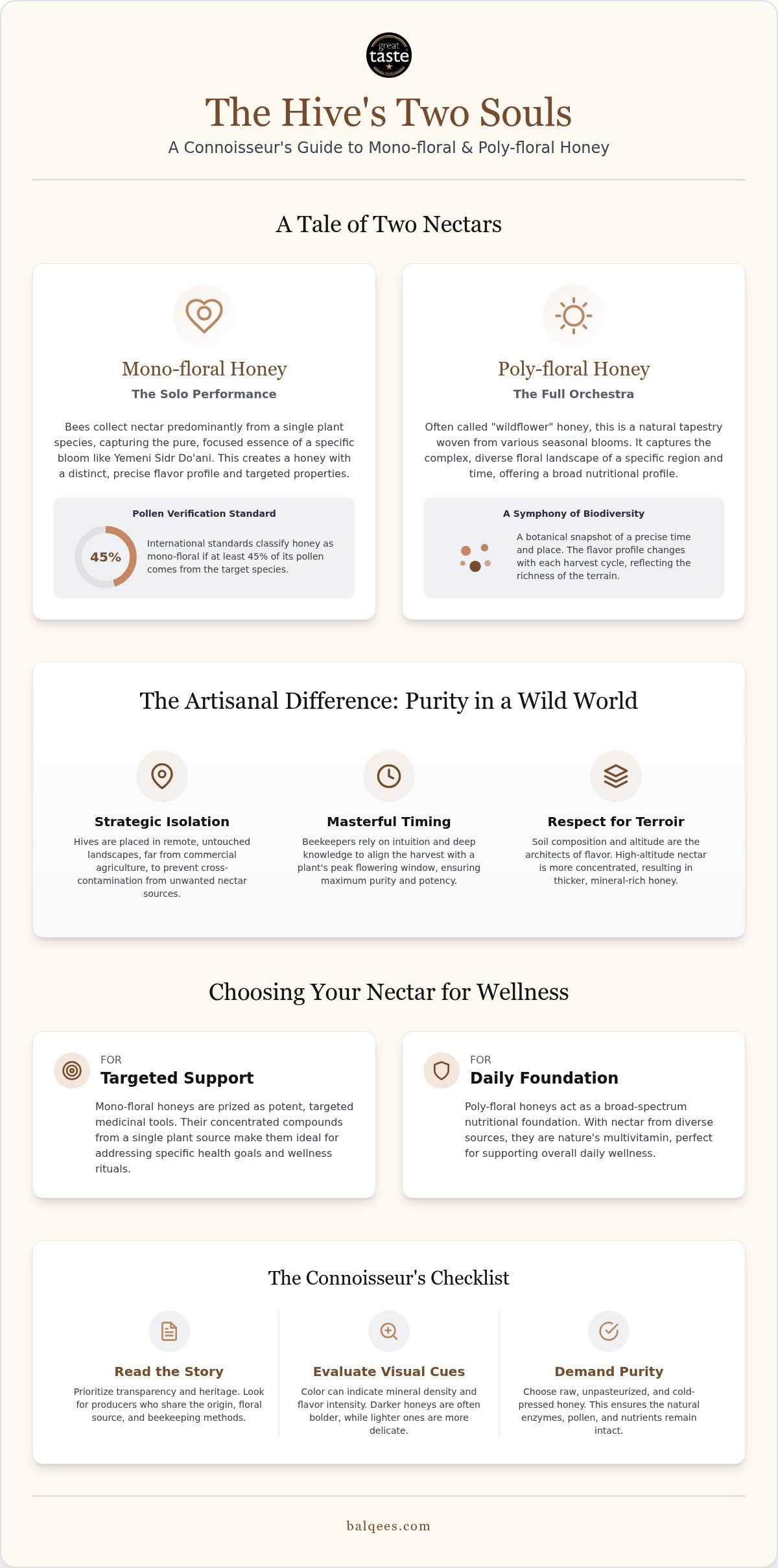
At its heart, the choice between mono-floral vs poly-floral honey is a choice between a solo performance and a full orchestra. Mono-floral honey occurs when bees collect nectar predominantly from a single plant species. It's a pursuit of singular purity. Conversely, poly-floral honey, often labeled as "wildflower," is a natural tapestry woven from various seasonal blooms. It captures the diverse floral landscape of a specific region in a single jar. Many consumers feel a sense of confusion over the "wildflower" labels on supermarket shelves, often dismissing them as generic. In reality, a true artisanal poly-floral blend is a sophisticated expression of a region's biodiversity.
Understanding what is monofloral honey? involves recognizing the intent behind the hive. Achieving this requires "floral fidelity." This is a discipline where master beekeepers place hives in remote, untouched areas, such as the ancient valleys of Yemen, during a specific plant's peak flowering window. By timing the harvest to the exact days a species like the Sidr tree blooms, beekeepers ensure the bees focus their energy on a single source. It's a delicate dance with nature that requires years of observation and respect for the local climate.
The Science of Pollen Verification
Melissopalynology is the forensic tool of the honey world. It's the microscopic study of pollen grains to verify botanical and geographical origin. While enthusiasts dream of 100 percent purity, it's biologically impossible. Bees are curious and opportunistic. They'll occasionally wander to a stray blossom on their way back to the hive. Because of this, international standards typically classify honey as mono-floral if at least 45 percent of its pollen comes from the target species. Floral percentage is the metric for monofloral status that separates artisanal excellence from industrial substitutes.
The Seasonal Symphony of Multi-Flower Blends
If mono-floral honey is a portrait, poly-floral honey is a landscape. These blends are a unique botanical snapshot of a precise time and place. Every harvest cycle brings a different flavor profile because the bees respond to whatever nature provides. One month might favor desert blooms; the next might lean toward high-altitude mountain herbs. This biodiversity doesn't just create complex, shifting flavors. It supports a robust hive ecosystem. By foraging across a variety of species, the bees create a broad-spectrum nutritional profile that reflects the untouched vitality of the terrain. It's nature's own multivitamin, crafted through the wisdom of the colony.
The Artisanal Challenge: Achieving Purity in a Wild World
True honey is a product of patience. While industrial production focuses on volume, the artisanal path is defined by a deep respect for the bee's natural rhythm. The master beekeeper acts as a sentinel, watching the horizon for the first signs of a bloom. In the remote, craggy valleys of Yemen, this intuition is everything. To succeed in the mono-floral vs poly-floral honey landscape, one must master the art of timing. If a hive is placed even a few days late, the bees may have already begun foraging on secondary blossoms, diluting the singular essence of the harvest.
Isolation is the beekeeper's greatest ally. Contamination isn't always about chemicals; in the world of premium honey, it's about unwanted nectar. By choosing untouched landscapes far from commercial agriculture, traditional Yemeni beekeeping preserves a lineage of purity. These methods avoid the heavy machinery and synthetic interventions common in industrial settings. Instead, they rely on hand-harvesting and a profound connection to the earth. This is a stark contrast to commercial supermarket brands. Those products often use industrial blending to mask low-quality harvests, creating a generic, uniform taste that lacks the soul of the hive.
Terroir and the Beekeepers Calendar
Soil composition and altitude are the silent architects of flavor. In high-altitude regions, the nectar becomes more concentrated, resulting in a honey that is thick, potent, and rich in minerals. The Sidr tree requires precise harvesting. Its bloom is fleeting. A master beekeeper must predict the peak concentration of nectar to ensure the honey achieves its legendary status. This is slow food in its purest form. It can't be rushed by technology or mass-produced in a factory. Each jar is a record of a single season's struggle and success.
Raw vs. Commercial: The Unfiltered Truth
The difference between a living food and a dead syrup often comes down to temperature. Commercial honey is frequently pasteurized and ultra-filtered. This process strips away the pollen, enzymes, and volatile aromatic compounds that define a honey's origin. Cold-pressing is the only way to maintain this integrity. When you explore the raw honey vs commercial honey distinction, you realize that heat destroys the very markers that prove botanical source. For those seeking the pinnacle of complexity, discovering a pure Yemeni Sidr represents a standard of excellence that industrial methods simply cannot replicate.
A Sensory Masterclass: Comparing Palates and Textures
To truly understand mono-floral vs poly-floral honey, one must look beyond the label and engage the senses. Terroir isn't exclusive to fine wine. In honey, it's the botanical signature written in nectar. Mono-floral varieties offer a focused, high-definition experience. They are precise. Poly-floral varieties, by contrast, are expansive. They represent a chorus of flavors that shift as they hit the tongue. This sensory journey is a reflection of the landscape itself.
Color serves as your first visual guide. It's an indicator of mineral density and antioxidant levels. Generally, the darker the hue, the more potent the mineral content. A deep amber honey suggests a rich presence of potassium, magnesium, and iron. Lighter honeys often possess a delicate floral elegance. This visual cue helps you predict the intensity before the jar is even opened. It's a map of the hive's journey through the season.
Tasting Notes for the Connoisseur
A mono-floral nectar like the Yemeni Sidr Do’ani is famous for its medicinal tang. It's bold. It's unapologetic. You taste the sun-drenched bark and the dry desert air in every drop. Poly-floral blends, such as our Yemeni Wild Flower Honey, offer a sequential journey. First, you might detect a bright citrus spark. Then, a mellow herbal undertone emerges. Finally, a warm, woody base grounds the experience. The finish is where the quality truly shows. Premium honey lingers. It stays with you, evolving on the palate long after the first taste. This depth is the hallmark of artisanal craftsmanship.
Visual and Textural Indicators
Texture is a matter of chemistry and climate. Consider why White Mountain Honey stays creamy while others remain liquid. High-altitude nectars often have a higher glucose-to-fructose ratio, leading to a naturally smooth, pearlescent crystallization. It feels like velvet. Compare this to the thick, slow-moving viscosity of Yemeni Sidr. It's heavy and luxurious. Raw, unfiltered varieties often appear cloudy. This isn't a flaw. It's proof of life. Those suspended particles are the very pollen and enzymes that industrial filtration removes. They provide the grit and soul of a truly artisanal product. Every jar tells a story of survival and seasons.
Targeted Wellness: Choosing Your Nectar Based on Health Goals
Selecting between mono-floral vs poly-floral honey for your health is a matter of intent. One isn't inherently superior to the other; they simply serve different functions in a refined wellness ritual. Think of mono-floral honey as a precision tool. It's a targeted medicinal supplement designed for specific needs. In contrast, premium poly-floral honey acts as a broad-spectrum nutritional foundation. It's the daily baseline for a resilient immune system. Both are essential components of a sophisticated honey pantry.
The potency of these nectars lies in their living enzymes and bioavailable minerals. In raw, cold-pressed varieties, these delicate compounds remain intact. Industrial honey often loses these markers through heat. When you choose an artisanal product, you're consuming a concentrated source of nature's wisdom. Whether you need the surgical strike of a single-source nectar or the diverse support of a wildflower blend, the quality of the beekeeping determines the therapeutic value.
Medicinal Potency in Single-Source Honey
The concentrated nectar of a single plant species creates a unique chemical signature. This allows for a significantly higher concentration of specific phytochemicals. For instance, Raw Yemeni Sidr Do’ani Honey is widely regarded as the gold standard for anti-inflammatory and antibacterial support. Its potency is derived from the Sidr tree’s resilience in arid conditions, which forces the plant to concentrate defensive compounds within its nectar. Specific pollens in mono-floral varieties can trigger targeted immune responses. The unique bioactive profile of Sidr nectar is characterized by exceptionally high levels of antioxidants and specialized enzymes that support rapid recovery and digestive health.
The Bioactive Diversity of Poly-floral Honey
A common skepticism suggests that poly-floral honey is merely a less potent, generic alternative. This is a misunderstanding of botanical diversity. While it lacks the singular focus of a medicinal variety, it offers a vastly wider range of antioxidants. Because the bees forage on dozens of different seasonal blossoms, the resulting honey contains a broad spectrum of phenolic compounds. This makes honey for daily wellness rituals particularly effective. These multi-flower blends, such as Yemeni Wild Flower Honey, provide essential prebiotic benefits that support a diverse gut microbiome. You are absorbing a botanical snapshot of an entire ecosystem’s vitality in every spoonful.
To experience the difference that traditional Yemeni beekeeping makes in your health journey, you can buy raw honey online directly from our heritage-sourced collections.
Building Your Honey Collection: The Connoisseur’s Verdict
Curating a honey pantry is an exercise in intentionality. It's about recognizing that your needs change with the hours of the day and the seasons of the year. A true connoisseur understands that the mono-floral vs poly-floral honey debate isn't about choosing a winner; it's about building a versatile toolkit for health and gastronomy. One jar offers the surgical precision of a single nectar source, while another provides the broad, seasonal complexity of a diverse landscape. Keeping both on hand ensures you're prepared for every ritual, from a morning energy boost to an evening wellness tonic.
The beauty of a collection lies in its synergy. While a single-origin nectar provides a high-definition taste of one specific botanical, a multi-flower blend captures the spirit of an entire ecosystem. This variety allows you to rotate your intake, ensuring your body benefits from a wider array of phytochemicals and antioxidants over time. It's a sophisticated approach to nutrition that mirrors the diversity of nature itself.
The Essential Collection Framework
A balanced collection typically rests on three pillars. First, every household needs a "Medicine Chest" jar. This should be a high-potency monofloral, such as our Raw Yemeni Sidr Do’ani Honey, reserved for its profound antibacterial and anti-inflammatory properties. Next, include a "Daily Ritual" jar. A vibrant, seasonal Yemeni Wild Flower honey is perfect here. It provides the bioactive diversity needed for long-term resilience. Finally, add a "Culinary" jar. A creamy, pearlescent variety like White Mountain Honey is ideal for pairings, offering a delicate sweetness that complements fine cheeses or artisanal breads without overpowering them.
Identifying Quality at a Glance
When buying raw honey online in the UAE, transparency is your most valuable currency. You should look for specific geographic origins rather than vague descriptions like "forest blend" or "mountain honey." Genuine artisanal products will always highlight their heritage and the traditional methods used by the beekeepers. Check the label for "raw and unfiltered" status. This confirms that the honey hasn't been heated or stripped of its life-giving pollen and enzymes. At Balqees, our commitment to artisanal beekeeping ensures that every jar remains an untouched record of the wild landscapes it came from.
The final verdict for any connoisseur is rooted in respect for the process. Whether it's the singular focus of a desert bloom or the layered symphony of a wildflower meadow, the value lies in the purity of the source. By choosing heritage-sourced Yemeni nectars, you aren't just purchasing a sweetener; you're becoming a guardian of an ancient tradition. You're supporting a slower, more respectful way of interacting with the natural world. Your honey collection becomes a testament to quality, integrity, and the enduring power of the hive.
Elevating Your Golden Rituals
The journey through the hive reveals that the finest nectars are never just sweeteners; they're snapshots of a landscape's soul. You now understand that mono-floral varieties provide the medicinal precision required for targeted healing, while poly-floral blends offer a vibrant, broad-spectrum vitality that supports your daily resilience. The distinction in mono-floral vs poly-floral honey isn't about choosing one over the other. It's about curating a collection that honors both the singular focus of the Sidr tree and the complex symphony of the wildflower meadow.
Purity is a promise kept through heritage and patience. By prioritizing raw, cold-pressed nectars from remote regions, you ensure that every spoonful contains the living enzymes and antioxidants nature intended. We invite you to explore our curated collection of rare Yemeni honeys. With our commitment to artisanal Yemeni heritage and raw and unfiltered purity guaranteed, we're proud to provide national delivery across the UAE. Let your pantry become a sanctuary of wellness and ancient tradition.
Frequently Asked Questions
What is the main difference between mono-floral and poly-floral honey?
The fundamental distinction lies in the nectar's origin. In the debate of mono-floral vs poly-floral honey, mono-floral refers to honey harvested from bees that forage predominantly on a single plant species, such as the Sidr tree. Poly-floral honey is a natural blend derived from various seasonal blossoms found in a specific region. While the former offers a focused medicinal profile, the latter provides a broader spectrum of antioxidants and a more complex flavor.
Is mono-floral honey always better than poly-floral?
Superiority is a matter of purpose rather than a fixed rule. Mono-floral varieties are prized for their targeted therapeutic properties and high-definition taste profiles. However, premium poly-floral honey, like our Yemeni Wild Flower Honey, is often better suited for daily nutritional support due to its diverse bioactive profile. A true connoisseur values both for their unique contributions to a balanced wellness ritual and a sophisticated palate that appreciates variety.
How can I tell if a honey is truly mono-floral?
Authentic identification requires a combination of laboratory analysis and sourcing transparency. Professional producers use melissopalynology to study pollen grains, ensuring at least 45 percent of the pollen originates from the target species. As a consumer, you should look for raw, unfiltered products with specific geographic origins. Avoid vague supermarket blends that lack traceability, as genuine mono-floral honey always carries the heritage of a precise, untouched landscape and traditional beekeeping methods.
Why is mono-floral honey usually more expensive?
The higher cost reflects the labor-intensive nature of artisanal beekeeping. To produce a single-source honey, beekeepers must strategically place hives in remote areas during a very short bloom window. This requires precise timing and significant logistical effort to prevent the bees from foraging on secondary nectars. Because these blooms are often fleeting and geographically limited, the supply is naturally restricted compared to industrial multi-flower alternatives that are easier to produce in bulk.
Can poly-floral honey help with seasonal allergies?
Many enthusiasts use poly-floral honey as a natural tool for building resilience against seasonal sensitivities. Because these blends contain a diverse range of pollens from various local blossoms, they provide a broad exposure that can help the body's immune system adapt. It acts as a gentle, natural bridge between you and your environment. For the best results, ensure the honey is raw and unfiltered to preserve the integrity of the local pollen grains.
Does the taste of mono-floral honey change every year?
Yes, the flavor of mono-floral nectars evolves with the environmental conditions of each harvest. While the dominant notes remain consistent, factors like rainfall, soil moisture, and temperature fluctuations influence the nectar's concentration and mineral profile. This variability is a hallmark of raw, artisanal honey. It proves the product is a living record of a specific season in the wild, untouched by industrial processes that prioritize uniform, artificial consistency over natural truth.
Is wildflower honey the same as poly-floral honey?
Yes, "wildflower" is the most common term used to describe poly-floral varieties. In the comparison of mono-floral vs poly-floral honey, both terms refer to honey created by bees that have foraged across a diverse array of nectar sources rather than a single dominant plant. While some commercial brands use the label generically, artisanal Yemeni Wild Flower Honey represents a sophisticated tapestry of seasonal blooms that truly reflects the biodiversity of the untouched region.
Which honey variety is best for medicinal use?
Mono-floral varieties are generally preferred for targeted medicinal applications due to their concentrated bioactive compounds. For example, Raw Yemeni Sidr Do’ani Honey is the gold standard for antibacterial and anti-inflammatory support. Its singular botanical focus allows for a higher density of specific enzymes and phytochemicals. While poly-floral honey is excellent for daily wellness, the precision of single-source nectars makes them the superior choice for addressing specific health concerns or aiding in rapid recovery.


