Not all liquid gold is minted in the same forge. In the rugged landscapes of Yemen, the specific valley of a honey's birth dictates its soul and its value. You've likely felt the confusion of standing before two jars of Yemeni nectar, wondering if the distinction of Do'ani vs Hadrami Sidr honey actually signifies a difference in quality or merely a clever marketing strategy. It's a valid concern for any connoisseur who wants to ensure their investment supports authentic heritage rather than just a premium price tag.
We've spent years walking these valleys and working alongside the beekeepers who guard these ancient traditions. We understand that the nuances of terroir can be complex. This guide will help you discover the distinct differences between the legendary Sidr varieties of Wadi Do’an and the broader Hadramaut region so you can find your perfect nectar with absolute confidence. We'll peel back the layers of the Yemeni honey hierarchy, exploring how unique micro-climates create the intense, dark richness of Do'ani and the balanced, spiced amber of its Hadrami cousins. By the end, you'll possess the knowledge to distinguish these flavor profiles and choose the highest grade available with the eye of a true connoisseur.
Key Takeaways
- Master the nuances of Do'ani vs Hadrami Sidr honey by understanding how the specific micro-climate of Wadi Do’an produces a rarer, more intense nectar than the surrounding province.
- Learn to identify the sensory hallmarks of premium Sidr, from the exceptionally thick viscosity of Do’ani to the spiced, caramel notes of broader Hadrami harvests.
- Discover why raw, cold-pressed Yemeni honey remains a pinnacle of wellness, packed with higher concentrations of antioxidants and live enzymes than standard varieties.
- Gain the confidence to spot authentic Yemeni origins by looking for the hallmarks of unfiltered purity rather than relying on inconsistent official grading.
- Understand the value of artisanal heritage and how direct sourcing from beekeeping families ensures the preservation of ancient traditions in every jar.
The Geography of Gold: Understanding Yemeni Sidr Honey Origins
The story of Yemeni honey begins with a tree that is as much a spiritual symbol as it is a botanical wonder. The Sidr tree (Ziziphus spina-christi) has stood for millennia in the arid landscapes of the Arabian Peninsula. It's a hardy survivor. Its roots reach deep into the parched earth, and its blossoms offer a nectar so potent it's been revered in sacred texts and ancient medicine alike. While this tree grows across many regions, the honey it produces is a direct reflection of the soil, the air, and the heritage of the people who harvest it.
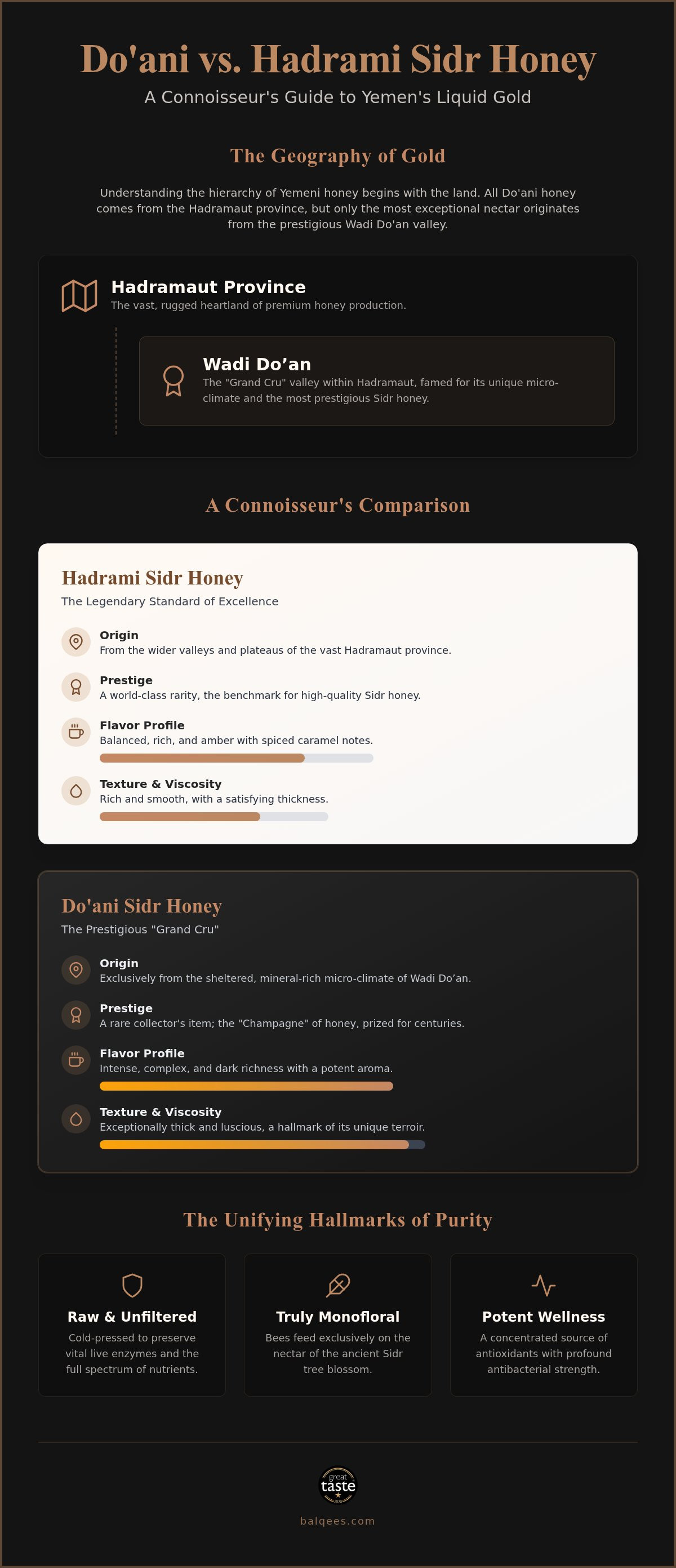
To understand the nuances of Do'ani vs Hadrami Sidr honey, one must first understand the hierarchy of the land. Hadramaut is the vast, rugged province that serves as the heartland of premium honey production. It's a place of deep canyons and high plateaus. Within this province lies Wadi Do’an, a specific valley that has become the most famous honey-producing region on the planet. Think of it this way: Hadrami honey represents the high standard of the entire region, while Do’ani is the "Grand Cru" or the "Champagne" of the terroir. All Do'ani honey is Hadrami, but only a tiny fraction of Hadrami honey can claim the prestigious Do'ani origin.
What is Hadrami Sidr Honey?
Hadramaut is a province defined by its diversity. From the coastal plains to the high mountain ranges, the landscape is a patchwork of micro-climates. Honey labeled as Hadrami typically comes from the wider valleys surrounding the main wadis. Beekeepers here follow a semi-nomadic lifestyle, moving their hives to follow the flowering cycles of the Sidr trees. This honey is the legendary standard. It's rich, amber, and possesses a medicinal profile that far exceeds almost any other honey variety in the world. It captures the wild, untouched essence of the Yemeni wilderness, offering a balanced flavor that serves as the perfect introduction to the world of Sidr.
The Prestige of Wadi Do’an
Why does Wadi Do’an hold such a singular reputation? The secret lies in the valley’s unique geography. Enclosed by towering limestone cliffs, the wadi creates a sheltered environment where the heat is concentrated and the soil is mineral-rich. This micro-climate leads to a higher density of Sidr trees than almost anywhere else. Historically, Do’an was a vital stop on the ancient spice routes, and its honey was traded as a luxury good even centuries ago. The intense aroma and exceptionally thick texture found here are the result of this specific, sheltered ecosystem. It's a rare harvest, making every jar a true collector’s item in the world of fine foods.
Hadrami Sidr Honey: The Legendary Standard of Excellence
Hadramaut is a land untouched by industrial shadow. Here, honey isn't just a sweetener; it's a legacy. While many seekers compare Do'ani vs Hadrami Sidr honey, it's essential to recognize that "standard" Hadrami honey is already a world-class rarity. Unlike mass-produced varieties found on supermarket shelves, this nectar is born from a "desert bloom" where the air is pristine and the soil is ancient. It represents a baseline of quality that most global honeys simply cannot reach.
The purity of this harvest is a result of a strictly disciplined environment. During the short winter flowering window, the bees' diet is limited exclusively to the Sidr blossom. There are no competing crops or artificial supplements. This monofloral focus ensures a density of nutrients that's truly exceptional. Every drop is a concentrated source of antioxidants, minerals, and live enzymes. It's a raw, living product that captures the untamed energy of the Yemeni wilderness.
The Medicinal Profile of Hadrami Honey
For centuries, this honey has been prized for more than its flavor. Research into the scientific properties of Sidr honey reveals why it's been called "liquid gold" by traditional healers. Its antibacterial strength often rivals high-UMF Manuka, making it a staple for those seeking digestive harmony or respiratory support. Through our traditional cold-extraction process, we preserve the vital enzymatic strength that gives raw Yemeni honey its profound restorative power. It's a gentle yet potent addition to a modern wellness ritual.
Soil and Sun: The Hadramaut Terroir
The Hadramaut plateau is a beautiful, harsh environment. Its mineral-rich soil infuses the nectar with a complex profile of trace elements that you won't find in lush, temperate climates. Extreme temperature fluctuations between the sun-drenched days and cool desert nights play a critical role in the honey’s character, encouraging a natural thickening that defines its luxurious mouthfeel. This isn't just agriculture; it's a generational craft. Beekeepers in the Southern Arabian Peninsula have spent centuries mastering the rhythms of the Sidr tree, ensuring that the honey remains as untouched and pure as the landscape itself.
If you're looking to begin your journey with these ancient traditions, exploring our range of Yemeni Sidr honey offers a sensory window into this extraordinary terroir.
Do'ani vs. Hadrami Sidr Honey: A Connoisseur’s Comparison
To the untrained eye, honey is simply a golden liquid. To the collector, it is a map of the earth. When evaluating Do'ani vs Hadrami Sidr honey, we must look beyond the surface to the sensory signatures left by the land itself. The ancient craft of Yemeni honey production has always recognized that a few miles of geography can transform the character of a harvest. While Hadrami honey from the wider province offers a beautiful, sun-kissed amber hue, the nectar from Wadi Do’an is often startlingly dark. It is deep. It is brooding. At times, it appears almost like obsidian in the jar.
Texture provides the next clue. Do'ani honey is famously viscous. It resists the spoon. It pours with a deliberate, heavy grace that speaks to its low moisture content and high mineral density. In contrast, other Hadrami varieties, while still far thicker than commercial alternatives, possess a slightly more fluid energy. The aroma follows suit. A jar from the wider Hadramaut region might greet you with warm, floral notes and a hint of caramel. Opening a jar of Do'ani is a different experience entirely. The scent is intense. It is medicinal, earthy, and commanding, signaling the potency of the Sidr trees nestled within those specific limestone cliffs.
- Visuals: Do'ani is deep, dark amber; Hadrami is rich, golden amber.
- Viscosity: Do'ani is exceptionally thick and slow-pouring; Hadrami is medium-heavy.
- Aroma: Do'ani is pungent and medicinal; Hadrami is floral and spiced.
- Price: Do'ani commands a significant premium due to the strictly limited annual yield of the valley.
The Sensory Experience of Wadi Do’an
Tasting a true Do'ani harvest is a journey of layers. It begins with a heavy sweetness reminiscent of burnt butterscotch and dried herbs. Then comes the surprise. A distinctive, slightly spicy finish lingers at the back of the throat, a hallmark of its high enzymatic activity. Because of its unique mineral composition, pure Do'ani honey is remarkably stable. It stays liquid for years, resisting the crystallization that eventually claims most other varieties. You can test this at home. A drop of authentic Do'ani on a paper towel should remain a tight, unmoving bead, refusing to soak into the fibers or spread thin.
Side-by-Side: Technical Specifications
The technical profile of these honeys reveals why they are so prized in luxury wellness. Do'ani honey consistently meets a monofloral purity standard of 90% pollen count or higher, a feat rarely matched by broader regional blends. Its pH level is slightly more acidic than standard honeys, contributing to its legendary shelf life and antibacterial potency. Unlike the thin, fleeting sweetness of generic wildflower varieties, Wadi Do'an honey possesses a heavy, velvet-like presence that coats the palate with a lingering, resinous warmth. This physical density is a direct result of the concentrated nectar found only in the valley's sheltered micro-climate.

Beyond the Label: How to Evaluate Purity and Grade
The world of luxury honey is often clouded by arbitrary labels. You might see "Grade A" or "Triple-A" stamped on a jar, but in the rugged valleys of Hadramaut, these terms carry little weight. As of August 2026, Yemen still lacks the ISO-accredited laboratory infrastructure required for international standardized grading. This means that when you compare Do'ani vs Hadrami Sidr honey, the reputation of the source is your most reliable certificate. Authentic purity isn't born in a factory; it's protected by the hands of artisanal honey hunters who understand the rhythm of the Sidr bloom.
Industrial suppliers often prioritize shelf appeal over medicinal integrity. They might heat the honey to prevent crystallization or filter it so finely that the beneficial pollen is lost. We choose a different path. For us, "Raw" and "Unfiltered" are the true hallmarks of quality. These methods ensure that the live enzymes and antioxidants remain intact. Adulteration is a growing concern, with some producers blending harvests with sugar syrups to increase volume. True Yemeni honey should never feel thin or taste like simple sugar; it should possess a complex, lingering depth that reflects the desert floor.
Identifying Real Yemeni Honey
You've likely heard of the "burn test" or the "water test" to verify purity. While these are popular in folklore, they aren't foolproof. A drop of honey catching fire or staying together in water doesn't account for the sophisticated ways modern syrups can be engineered. Instead, trust your senses. The aroma is the most difficult attribute to fake. It should be pungent and slightly herbal, especially in Do'ani varieties. If you want to dive deeper into the nuances of selection, our guide on how to identify pure honey offers more detailed insights for the discerning buyer.
Storage and Preservation
Once you've secured a jar of this liquid gold, your role as a guardian begins. Sidr honey is a living product. We always use glass jars because plastic can leach chemicals and affect the delicate flavor profile over time. Light and heat are the enemies of medicinal potency. High temperatures can degrade the sensitive enzymes that give Yemeni honey its restorative power. Keep your jar in a cool, dark cupboard to maintain that signature buttery texture. Don't worry if your honey eventually thickens; this is a natural sign of purity, though pure Do'ani is famous for its long-term stability.
Ready to experience the pinnacle of Yemeni terroir? Explore our Raw Yemeni Sidr Do'ani Honey and taste the difference that direct, artisanal sourcing makes.
The Balqees Promise: Sourcing the Finest Raw Sidr Honey
Heritage is a fragile thing. It requires a guardian. At Balqees, we don't just see ourselves as a retailer; we're a bridge between the ancient traditions of Yemen and your modern lifestyle. Our journey begins in the dust and heat of Wadi Do’an, where we've spent years building direct, personal relationships with the beekeeping families who have tended these hives for generations. This isn't a transactional arrangement. It's a partnership rooted in mutual respect for the land and the craft. When you weigh the choice of Do'ani vs Hadrami Sidr honey, you're choosing a piece of this preserved history.
Our commitment to purity is absolute. From the moment the honey leaves the hive, we maintain a strict chain of custody to protect its "living" elements. Every drop is cold-pressed. This ensures that the heat never damages the delicate medicinal profile or the complex enzymes that give Sidr honey its legendary status. The journey from the desert to our shelves in the UAE is entirely temperature-controlled, bypassing the industrial processing that strips away the soul of the nectar. We don't use additives. We don't use blends. What you receive is the untouched essence of the Sidr tree, bottled with the same reverence it was harvested with.
The Artisanal Collection
Our collection is curated with the eye of a passionate connoisseur. Exploring our Raw Yemeni Sidr Do'ani Honey allows you to experience the crown jewel of our offerings, representing the absolute pinnacle of what the Yemeni terroir can produce. Beyond this, we take pride in discovering rare honey varieties that are often unavailable on the global market. This search for excellence is balanced by our dedication to sustainable beekeeping honey. We ensure that our presence in the valley supports the local ecosystem and the livelihoods of the 100,000 beekeepers in Yemen who rely on this ancient craft for their survival.
Your Wellness Ritual
Integrating Do'ani honey into your life is an act of intentional self-care. It's a daily ritual that connects you to the earth. A single spoonful in the morning, taken raw, allows the antioxidants and minerals to work in harmony with your body. It's also the ultimate gift. Offering a jar of Do'ani is a gesture of deep respect, providing the recipient with a literal taste of health and heritage. Whether you are a seasoned collector or a newcomer, the distinction of Do'ani vs Hadrami Sidr honey is ultimately a search for the highest grade of purity. Shop our Sidr Do'ani Collection today and experience the definitive expression of Yemeni gold.
Embrace the Legacy of Yemeni Gold
Choosing between the distinct profiles of Do'ani vs Hadrami Sidr honey is more than a culinary decision; it is an invitation to participate in a storied tradition. You now understand that while the wider Hadramaut region provides a legendary standard of excellence, the sheltered cliffs of Wadi Do’an produce a nectar of unparalleled intensity and rarity. Whether you seek the spiced amber notes of the broader province or the deep, obsidian richness of the valley's finest harvest, you are investing in a living heritage that has remained untouched for centuries.
At Balqees, we remain committed to protecting this craft. Our honey is sourced directly from Wadi Do’an, ensuring every jar is 100% raw, unfiltered, and cold-pressed to preserve its vital enzymatic strength. This dedication to purity is why we are trusted by honey connoisseurs across the UAE. We invite you to bring this ancient wellness ritual into your own home and experience the profound difference of a truly artisanal harvest.
Explore the Rare Sidr Do'ani Collection at Balqees Honey and discover the perfect expression of Yemeni terroir for your wellness journey.
Frequently Asked Questions
Is Do'ani honey better than Hadrami honey?
It is a matter of rarity and personal preference rather than a simple measure of quality. Do'ani is a prestigious sub-variety of Hadrami honey, harvested from a single, sheltered valley that produces a more concentrated and intense nectar. While all Hadrami Sidr is world-class, Do'ani is often considered the "Grand Cru" of the region due to its exceptionally thick texture and deep, medicinal aroma.
Why is Yemeni Sidr honey so expensive compared to other types?
The price reflects the extreme rarity and the labor-intensive, traditional methods required for its harvest. The Sidr tree only flowers for a brief window of a few weeks each year, and the annual production of Do'ani Sidr honey is strictly limited to approximately 5 to 7 tons. Beekeepers must often lead a semi-nomadic life in remote, mountainous terrain to follow the bloom, making every jar a hard-won treasure.
Can I use Do'ani Sidr honey for medicinal purposes?
Yes, this honey has been a cornerstone of traditional healing for centuries due to its potent antibacterial and antioxidant properties. Many people integrate it into their daily wellness routines to support respiratory health, aid digestion, or boost the immune system. Its high enzymatic activity, preserved through cold-extraction, makes it a powerful raw supplement rather than just a simple culinary sweetener.
Does Sidr honey from Wadi Do’an ever crystallize?
Authentic Do'ani Sidr honey is famous for remaining in a liquid state for significantly longer than most other varieties, often staying smooth for several years. This stability is a result of its low moisture content and unique mineral composition. While most raw honeys will eventually crystallize, the high purity of the Do'ani harvest ensures it maintains its signature velvety, slow-pouring texture for the long term.
How can I tell if my Do'ani honey is authentic?
Authenticity is best identified through the sensory experience of the product and the transparency of its source. Real Do'ani honey possesses a pungent, earthy aroma and a viscosity so thick that a drop should remain a tight bead on a surface rather than spreading. When evaluating Do'ani vs Hadrami Sidr honey, look for that deep obsidian color and a complex flavor profile that finishes with a distinctive, spicy warmth.
What is the difference between Sidr honey and Manuka honey?
While both are renowned for their therapeutic benefits, they originate from different botanical sources and geographical terroirs. Manuka comes from the New Zealand tea tree, whereas Sidr is harvested from the ancient Ziziphus spina-christi tree in the Arabian Peninsula. Many find Sidr honey to be more palatable, offering a rich, butterscotch-like sweetness compared to the more clinical, herbaceous taste often associated with Manuka.
Is Balqees honey raw and unfiltered?
Every jar we offer is 100% raw, unfiltered, and cold-pressed to ensure the honey's living enzymes and natural pollens remain intact. We strictly avoid industrial heating or fine-mesh filtration, which can strip the honey of its restorative power and delicate flavor nuances. This commitment to artisanal methods ensures that you experience the honey exactly as it was intended by nature, untouched and pure.
Can I buy authentic Yemeni Sidr honey in the UAE?
Yes, you can access the finest selections of Do'ani vs Hadrami Sidr honey through our boutiques and online platform across the UAE. We manage a seamless, temperature-controlled journey from the remote valleys of Hadramaut to your doorstep, ensuring the honey's potency is never compromised. This allows connoisseurs in Dubai and beyond to enjoy the pinnacle of Yemeni heritage with absolute confidence in its origin and quality.