


Did you know that as much as 80% of the jars labeled as "Yemeni Sidr" on the global market are estimated to be counterfeit or adulterated? This startling reality makes the search for authentic healing nectars feel like a daunting quest. You want the best for your health, yet you're often met with a confusing array of MGO ratings, UMF certifications, and conflicting clinical claims. It's perfectly natural to feel uncertain when weighing Sidr honey vs Manuka honey, especially when both are hailed as the pinnacle of nature's pharmacy.
We'll help you look beyond the labels to understand the true essence of these remarkable substances. This guide offers a definitive look at the science, heritage, and unique bioactive compounds that define each variety. You'll discover why one excels in clinical wound care while the other, sourced from the ancient valleys of Yemen, offers unparalleled support for immunity. By the end, you'll have the confidence to identify genuine Yemeni Sidr and know exactly which jar to reach for when your body needs it most. We're stepping past the noise to explore the heart of these ancient traditions.
Key Takeaways
- Understand the botanical heritage of the sacred Sidr tree and the rugged Manuka shrub to see how origin shapes healing potential.
- Compare the biochemical strengths of Sidr honey vs Manuka honey to understand the difference between clinical MGO ratings and broad-spectrum antioxidant power.
- Explore the sensory profiles of these nectars, contrasting Sidr’s buttery, caramel textures with the earthy and often medicinal character of Manuka.
- Discover which variety is better suited for your health needs, from strengthening daily immunity to soothing stomach ulcers and digestive discomfort.
- Learn how to navigate a market filled with counterfeits by identifying the hallmarks of raw, unfiltered Yemeni Sidr honey.
The Botanical Origins: Sacred Desert Trees vs. Rugged Island Shrubs
To truly appreciate the nuances of Sidr honey vs Manuka honey, one must first look at the ground beneath the roots. These nectars are born from two entirely different worlds. One is a product of the sun-drenched, ancient valleys of Yemen. The other is harvested from the rugged, temperate landscapes of New Zealand. It's a story of the desert versus the island. The landscape isn't just a backdrop. It's the very soul of the honey.
The Sacred Legacy of the Sidr Tree
The Ziziphus spina-christi, or Sidr tree, holds a position of profound reverence. It's a sacred anchor in the Arabian Peninsula, appearing in religious texts as a symbol of strength and divinity. In the remote valleys of Hadramout, these trees aren't planted in neat rows. They grow wild, scattered across a landscape that hasn't changed in millennia. This wild-harvested reality is what makes the honey so potent. The bees must work quickly. The Sidr blossom is a rare treasure that only appears for a few weeks each year during the winter rains. This short window makes every drop of Raw Yemeni Sidr Do'ani Honey a concentrated miracle of nature, untouched by modern agricultural interference.
The Manuka Story: From Shrub to Global Superfood
Manuka’s journey is quite different. For years, the Leptospermum shrub was dismissed as "cattle-fodder" and cleared from pastures. Its rise to global superfood status is a modern success story, but it has changed the nature of the honey. Manuka production is now a massive commercial enterprise. While New Zealand produces exceptional honey, the scale is often industrial. There’s a clinical precision to it that contrasts sharply with the artisanal, heritage-driven methods of Yemeni beekeepers. One feels like a global commodity; the other is a legacy preserved in time. The "heritage" feel of Sidr comes from the nomadic beekeepers who still follow the ancient flowering cycles of the desert.
The terroir defines the character of each jar. Here is how the environments compare:
- Yemeni Sidr: Thrives in arid desert valleys with deep, mineral-heavy soil. This creates a thick, buttery honey that reflects the heat and resilience of the land.
- NZ Manuka: Prefers temperate, moist climates and coastal shrubs. This results in the earthy, mineral-heavy, and often medicinal notes that characterize the New Zealand profile.
- Artisanal vs. Industrial: Sidr remains a product of traditional, small-batch beekeeping, while Manuka has moved toward high-volume, standardized production.
The choice between them is often a choice between two philosophies. Do you prefer the clinical, lab-tested reliability of a global superfood, or the raw, unfiltered power of an ancient desert legacy? Both have their place, but the botanical origins tell us that they are far from the same.
The Biochemical Battle: MGO vs. Total Activity
When we look at Sidr honey vs Manuka honey under a microscope, the story shifts from ancient tradition to modern chemistry. While both are celebrated for their antibacterial properties, they achieve their potency through different biological pathways. One relies on a specific, stable compound; the other utilizes a complex, multi-layered arsenal of natural defenses. Understanding these mechanisms is essential for any connoisseur seeking true therapeutic value.
The Manuka Grading System: Deciphering UMF and MGO
Methylglyoxal, or MGO, is the clinical heart of Manuka honey. This compound provides what scientists call non-peroxide activity. It's stable, heat-resistant, and serves as the primary marker for the Unique Manuka Factor (UMF) rating. A higher UMF number indicates a more "clinical" honey, often used in hospital settings for wound care. This system is precise and laboratory-driven, offering a standardized way to measure a single chemical engine. It’s effective, but it focuses heavily on one specific molecule to define quality.
Sidr Honey’s Hidden Chemistry: Beyond the Label
Sidr honey doesn't rely on a single chemical marker to prove its worth. Instead, it offers a high concentration of antioxidants and phenolic compounds that work in harmony. This is often referred to as "Total Activity" (TA). While Manuka is famous for MGO, Sidr is packed with flavonoids and volatile oils that provide broad-spectrum support. If you want to dive deeper into the heritage behind these compounds, you can explore The Connoisseur’s Guide to Raw Yemeni Sidr Do’ani Honey to see how traditional harvesting preserves this delicate alchemy.
The differences in their biochemical makeup lead to distinct healing advantages:
- Enzymatic Power: Raw Sidr often contains higher levels of catalase and glucose oxidase, enzymes that act as the body's first line of defense.
- Bacterial Resistance: A landmark study at the University of Ottawa found that Sidr honey was remarkably effective against antibiotic-resistant bacteria like MRSA.
- Biofilm Disruption: The same research suggested that Sidr could penetrate bacterial biofilms, which are protective layers that often make infections difficult to treat.
The science suggests that while Manuka is a powerhouse for external applications, the complex phytochemical profile of Sidr makes it a superior choice for internal wellness and systemic support. It’s a choice between the clinical precision of a single compound and the holistic strength of a diverse botanical profile. If you're looking for a daily ritual to support your wellbeing, you might find our Raw Yemeni Sidr Do'ani Honey provides the balanced potency your body craves.
Sensory Profiles: A Connoisseur’s Comparison of Taste and Texture
Tasting these nectars is an exercise in mindfulness. It is a journey that begins with the eyes and ends with a lingering memory on the palate. When we look at Sidr honey vs Manuka honey through the lens of a sommelier, we see two entirely different personalities. One is a warm, golden embrace from the desert; the other is a sharp, herbal wake-up call from the coast. These differences aren't merely aesthetic. They are the direct result of the soil, the air, and the specific blossoms the bees visit.
The Sidr experience is one of pure luxury. It is exceptionally thick and viscous, possessing a buttery texture that coats the tongue. You'll find deep notes of caramel and toasted butterscotch, balanced by a delicate floral aroma that evokes the sparse, sun-drenched valleys of Yemen. It remains liquid for a remarkably long time, resisting the crystallization that affects lesser varieties. In contrast, the Manuka profile is rugged and earthy. It is often described as mineral-heavy, with a pungent, almost medicinal scent. Its texture is thixotropic, meaning it behaves like a gel until stirred, resulting in a dense, creamy consistency that feels substantial but less silky than its Yemeni counterpart.
Palate Notes for the Honey Sommelier
The finish of a honey tells you everything about its soul. Raw Yemeni Sidr Do’ani Honey is prized for its long, malty finish that stays with you, evolving into a gentle sweetness. High-MGO Manuka often presents a sharp, almost peppery aftertaste that can be slightly bitter to the uninitiated. This "medicinal" kick is a hallmark of its chemical potency, but it can be polarizing. Learning to use these sensory cues is the best way to identify high quality raw honey. If the flavor is flat or lacks these complex layers, it has likely been over-processed or diluted.
Texture and Culinary Versatility
How you use your honey depends entirely on its physical character. Sidr is the ultimate choice for the culinary artist. Its liquid gold consistency makes it the perfect partner for drizzling over aged goat cheese, warm artisanal bread, or fresh desserts. It elevates a dish without overpowering the other ingredients. Manuka is generally a "spoon-only" honey. Because of its intense, herbal profile and thick texture, it is best enjoyed straight from the jar as a daily wellness ritual. While some enjoy it in beverages, finding the Best Honey for Tea usually leads connoisseurs back to the floral elegance of Sidr, which sweetens without the bitter herbal interference of the Manuka bush.
To summarize the sensory journey:
- Sidr: Golden, buttery, caramel-forward, and elegantly floral.
- Manuka: Darker, creamy, mineral-heavy, and pungently herbal.
- Finish: Sidr is smooth and malty; Manuka is sharp and occasionally peppery.
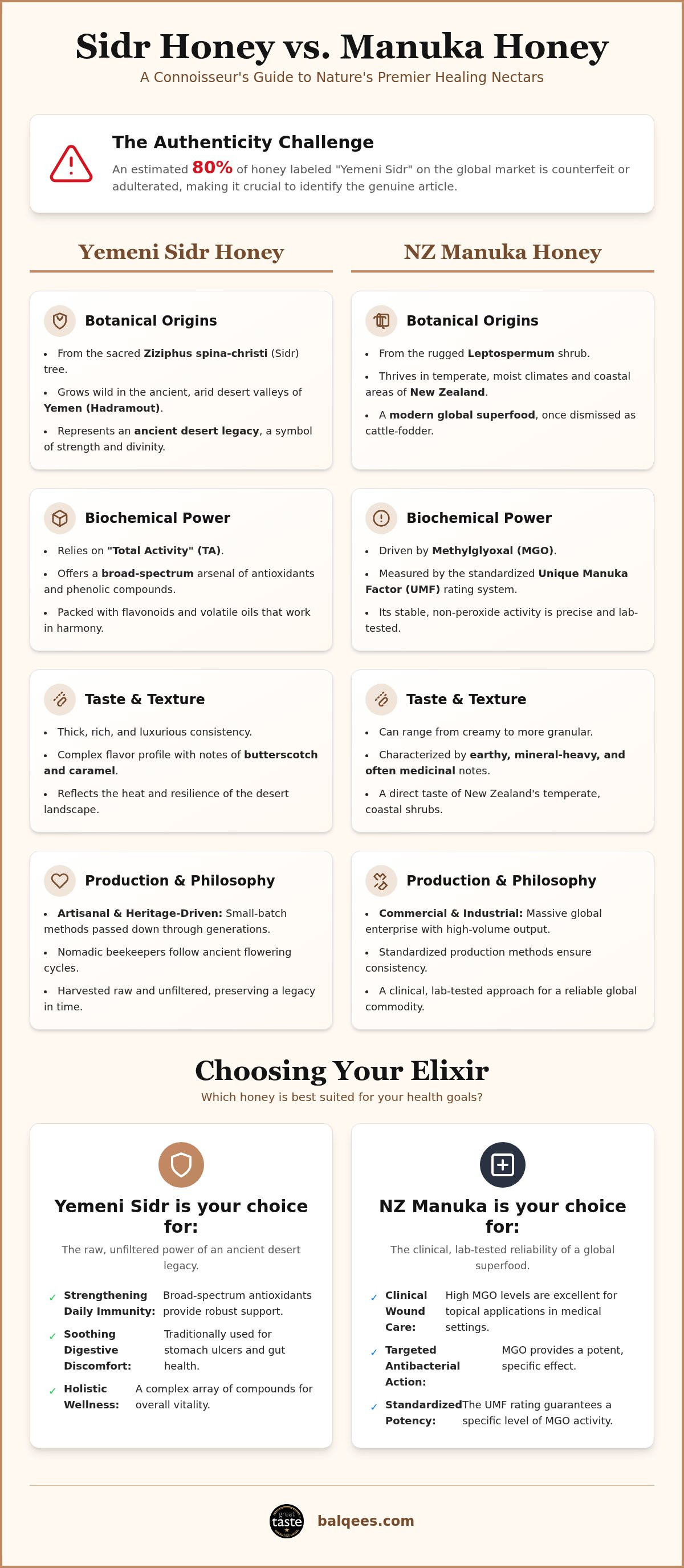
Choosing Your Elixir: Which Honey for Which Health Goal?
Choosing between these two liquid treasures isn't about finding a "winner." It's about aligning their unique strengths with your body's needs. If you're looking for a clinical bandage, Manuka is often the choice. But for those seeking a holistic, daily ritual that builds resilience from within, Sidr is incomparable. The debate of Sidr honey vs Manuka honey often comes down to the difference between a targeted treatment and a lifestyle of wellness.
The Daily Ritual: Immunity and Gut Health
Sidr honey is more than a sweetener; it's a living prebiotic. It doesn't just fight bad bacteria. It nourishes the good. Using honey for gut health is an ancient practice that modern science is finally beginning to understand. The complex sugars in Sidr act as fuel for your microbiome, making it a powerful ally against stomach ulcers and digestive discomfort. While the comparison of Sidr honey vs Manuka honey highlights different strengths, the prebiotic benefits of the Sidr tree are particularly remarkable for long-term health.
Start your morning with a spoonful of Raw Yemeni Sidr Do'ani Honey dissolved in warm, not boiling, water. For an even more potent shield, our Black Seed Fusion combines the heritage of the Sidr tree with the immune-boosting properties of Nigella sativa. It's a simple act. It transforms your morning into a moment of intentional health.
Targeted Healing: Wounds and Recovery
Manuka honey shines in the clinical world. Its standardized MGO levels make it a reliable choice for medical-grade wound dressings and skin recovery. It's a specialist. However, regarding internal vitality and respiratory support, Sidr’s ancient reputation takes the lead. It has been used for generations to soothe sore throats and clear the breath. The focus here is on holistic recovery rather than just topical application.
This nectar is also prized for its ability to restore natural vigor. It’s a source of steady, grounded energy that doesn't cause the spikes and crashes of refined sugars. Our Raw Honey & Ginseng Fusion builds on this legacy, offering a natural boost for those demanding days. Whether you're recovering from an illness or simply looking to maintain your edge, incorporating this "liquid gold" into your Honey for Daily Wellness routine provides a foundation of strength.
Experience the transformative power of the desert for yourself. Explore our collection of Raw Yemeni Sidr Do'ani Honey and find your perfect daily elixir.
The Artisanal Choice: Why Raw Yemeni Sidr Remains Supreme
In the quiet, sun-drenched valleys of Yemen, beekeeping isn't an industry. It is a sacred trust passed down through generations. While the debate of Sidr honey vs Manuka honey often centers on laboratory results, the artisanal reality of the harvest tells a deeper story. Yemeni Sidr is frequently called the "Liquid Gold" of the Middle East, not just for its color, but for its profound scarcity. Unlike the vast, commercialized Manuka plantations of New Zealand, Sidr trees grow wild in remote, arid landscapes where the harvest depends entirely on the whims of the winter rains.
This scarcity creates a significant challenge for the modern connoisseur. It is estimated that as much as 80% of the jars labeled as "Yemeni Sidr" on the global market are counterfeit or adulterated. This is where the choice becomes about more than just taste; it becomes about integrity. At Balqees, we act as guardians of this heritage, ensuring that every jar of Raw Yemeni Sidr Do'ani Honey is traceable to the specific valley where it was born. We go beyond the single nectar by offering functional honey blends that pair this ancient power with other potent botanicals like black seed and ginseng.
The Balqees Commitment to Purity
The soul of our honey lies in its raw, untouched state. Many commercial honeys, including high-volume Manuka, undergo heat treatment or fine filtration to ensure a uniform look on supermarket shelves. This process kills the very thing that makes honey a living food. We keep our honey raw, unfiltered, and unheated to preserve the delicate enzymes and volatile compounds that define its character. When you experience sustainable beekeeping honey, you're tasting the desert exactly as the bees intended. It’s a commitment to quality that prioritizes the health of the hive and the purity of the product over industrial efficiency.
Why Rare Honey is a Worthwhile Investment
Investing in a jar of rare Do’ani honey is an investment in your own wellbeing and the preservation of a dying craft. The limited harvest window, which lasts only a few weeks, ensures that the nectar is exceptionally concentrated. There is an emotional weight to consuming something that has been harvested the same way for over a thousand years. While Manuka represents a triumph of modern branding and clinical standardization, Sidr represents an unbroken link to the earth’s ancient traditions. It is the choice of the true connoisseur who values heritage as much as health.
Are you ready to experience the pinnacle of nature's pharmacy? Explore our collection of Raw Yemeni Sidr Honey and discover the difference that artisanal integrity makes to your daily ritual.
Embracing the Gold of the Desert
Choosing between these two nectars is a personal journey into the heart of nature’s pharmacy. While the debate of Sidr honey vs Manuka honey often rests on clinical markers, the true value lies in the story behind the jar. You now understand that while Manuka offers standardized clinical precision, Yemeni Sidr provides a complex, broad-spectrum heritage that supports your body from the inside out. Authenticity remains the most vital ingredient in your quest for wellness.
We invite you to trust in a legacy that spans centuries. Our honey is artisanally sourced from the remote valleys of Yemen, kept entirely unfiltered and raw to preserve every living enzyme. Trusted by connoisseurs across the UAE, Balqees remains a dedicated guardian of these ancient traditions. It's time to elevate your daily ritual with a nectar that is as pure as the desert itself. Your path to vitality is just a spoonful away.
Experience the Purity of Raw Yemeni Sidr Honey
Frequently Asked Questions
Is Sidr honey more effective than Manuka honey?
Effectiveness depends on your specific health objective. Manuka is often favored in clinical settings for topical wound management due to its stable MGO levels. However, when comparing Sidr honey vs Manuka honey for internal wellness, Sidr’s broad-spectrum antioxidant profile and high phenolic content make it a superior choice for systemic support. It offers a more holistic approach to health rather than a single chemical focus.
Why is Yemeni Sidr honey so expensive compared to other types?
The price reflects the extreme scarcity and the perilous nature of the harvest. Sidr trees in the remote valleys of Yemen blossom for only a few weeks each year, requiring nomadic beekeepers to move hives into difficult terrain. The yield is small and the traditional, artisanal methods used to extract the honey are labor-intensive. You aren't just buying honey; you're investing in a rare, wild-harvested legacy that cannot be mass-produced.
Can I use Sidr honey for wound healing like Manuka?
You can certainly use Sidr for topical applications. Research, such as the University of Ottawa study, has highlighted its ability to disrupt bacterial biofilms and combat resistant strains like MRSA. While Manuka is the global standard for medical-grade dressings, Sidr’s enzymatic power and non-peroxide activity provide potent antimicrobial benefits. It remains a staple in traditional medicine for treating skin irritations and supporting the body's natural recovery processes.
What is the best way to consume medicinal honey for maximum benefit?
To get the most from these potent nectars, you should always consume them raw. Take one teaspoon on an empty stomach each morning to allow the bioactive compounds to absorb directly. If you prefer a drink, dissolve it in warm water, ensuring the temperature is below 40 degrees Celsius. Heat destroys the delicate living enzymes that define high-quality honey. Use a wooden or ceramic spoon to maintain the honey's integrity.
How do I know if my Yemeni Sidr honey is authentic?
Authenticity is found in the sensory details and the reputation of the source. Genuine Yemeni Sidr has a distinct, buttery texture and a deep aroma of caramel and malt. It won't crystallize quickly like commercial blends. Because of the high rate of counterfeits, you should only purchase from providers who can guarantee the origin. We ensure every jar of our Raw Yemeni Sidr Do'ani Honey is traceable to its traditional source.
Does Sidr honey have a grading system like Manuka’s MGO?
Sidr honey does not currently have a globally standardized grading system like the UMF or MGO ratings used for Manuka. Instead, quality is determined by botanical purity, geographic origin, and the specific harvest season. The Do’ani region is considered the gold standard. While it lacks a clinical number on the label, its potency is verified through lab testing for pollen count and the presence of unique phytochemical markers.
Which honey is better for children’s immunity?
Sidr honey is an exceptional choice for supporting a child's developing immune system. Its rich antioxidant profile acts as a natural shield, and its mild, buttery flavor is usually more palatable to children than the medicinal bitterness of high-potency Manuka. It provides a gentle but effective way to boost daily resilience. Remember that honey should never be given to infants under one year of age due to the risk of botulism.
Can I cook with Sidr or Manuka honey, or should it be eaten raw?
You should avoid cooking with these premium honeys whenever possible. High temperatures neutralize the enzymes and antioxidants that provide their healing power. If you want to incorporate them into your meals, use them as a finishing touch. Drizzle your honey over warm porridge, yogurt, or fresh fruit after the heat has subsided. This ensures you enjoy the full sensory experience and the maximum nutritional benefits of the raw nectar.


