


A single jar of the world's most exceptional nectar is a masterpiece of timing where perfect climate, ancient bee species, and untouched landscapes align for only a few weeks each year. It isn't just food. It's a liquid map of a specific moment in nature. For many enthusiasts, the search for true quality is often clouded by confusion over raw labels or the fear of purchasing a counterfeit premium product. You deserve to know exactly what's in your jar and the heritage behind every drop.
We understand that finding authentic rare honey varieties requires more than just a trip to the local market. It demands an appreciation for floral origins and a respect for traditional harvesting methods. In this guide, we'll help you identify the world's most prestigious nectars, from the rugged valleys of Yemen to the high-altitude peaks of Kyrgyzstan. You'll learn how to source authentic raw products and discover the sensory profiles that define a true connoisseur's collection. Let's begin this journey into the heart of the hive.
Key Takeaways
- Discover how fleeting harvest windows and remote geographic isolation create the world's most elusive rare honey varieties.
- Identify the sensory signatures of global treasures, including the creamy, velvet textures of White Mountain Honey and the prestigious Sidr Do'ani.
- Master the art of sourcing by understanding why raw, unfiltered labels are non-negotiable for preserving a honey's natural potency.
- Uncover the relationship between price and purity to protect yourself from counterfeit products in the premium market.
- Connect with the ancient heritage of artisanal beekeeping and learn how these rare nectars serve as a bridge to holistic well-being.
What Defines a Rare Honey Variety?
Rarity in the world of nectar is never an accident. It is a precise intersection of geography, climate, and biological timing. While commercial honey is often a blend of various sources designed for consistency, rare honey varieties are expressions of a single, fleeting moment in a specific landscape. These honeys exist because of limited geographic availability. They are found in places where the air is thin, the soil is untouched, and the flowers bloom for only a few days each year. Without these exact environmental conditions, the unique profile of the honey simply vanishes.
A true hallmark of rarity is the total absence of industrial pollution. The most coveted nectars are harvested from regions where human interference is virtually non-existent. In these pristine valleys and mountain ranges, the bees forage on plants that have never seen a pesticide. This purity isn't just a marketing claim. It's a physical reality that you can taste in the complexity of the honey. When you remove the noise of modern agriculture, the true voice of the flower emerges.
Monofloral vs. Polyfloral Rarity
Most honey you find on a shelf is polyfloral, meaning it comes from many different types of flowers. While delicious, it lacks the focused intensity of a single source. Producing Monofloral honey is an immense challenge for any beekeeper. It requires placing hives in the heart of a specific bloom and ensuring no other nectar sources distract the bees. This level of precision is verified through melissopalynology, a scientific analysis of pollen grains. If the pollen count from the target flower isn't high enough, the batch cannot claim true monofloral status. It’s a rigorous standard that separates the common from the extraordinary.
The Role of Artisanal Beekeeping
Traditional, non-mechanized harvesting is the final pillar of rarity. Industrial honey factories use heat and high-pressure filtration to speed up production, but these methods destroy the delicate enzymes and aromas that define a premium product. Artisanal beekeepers operate on a different rhythm. They use heritage techniques passed down through generations, often harvesting by hand in remote terrain. These guardians of tradition prioritize the health of the hive, always leaving enough honey for the bees to survive naturally. This respectful, small-batch approach ensures that the honey's integrity remains untouched from the comb to the jar. It is a slow process, but for those who value authenticity, it's the only way.
The Three Pillars of Honey Scarcity
Scarcity is the silent architect of value. In the world of premium nectars, rarity isn't a marketing label; it's a physical limitation imposed by the earth itself. True scarcity is built upon three non-negotiable pillars: timing, geography, and biology. When these elements align, they create rare honey varieties that can't be replicated or scaled. If even one pillar falters, the harvest is lost for the entire year. It’s a precarious balance that demands respect from both the harvester and the connoisseur.
The most immediate challenge is the climate. A single week of heavy rain during a peak bloom can wash away the nectar or prevent bees from flying, effectively destroying a season's yield. This sensitivity makes every jar a victory over the elements. Beyond the weather, the specific bee species involved plays a vital role. Some of the most coveted honeys are produced by wild bees or regional subspecies that have adapted to survive in harsh, isolated environments. These bees don't produce honey in industrial quantities; they produce it for survival, resulting in a product that's as potent as it is limited.
Fleeting Floral Blooms
The harvest window is the most unforgiving aspect of honey production. Many of the trees responsible for the world's finest nectars, such as the Sidr tree, bloom for only a few weeks annually. It is a race against the clock. Beekeepers must possess an intimate knowledge of the land to move their hives into position at exactly the right moment. Some species only produce significant nectar every few years when the "Goldilocks" conditions of soil moisture and temperature are met. Scientific methods for honey authenticity verification help us confirm that a batch was indeed harvested during these rare, specific windows. Experience the pinnacle of these rare honey varieties through our Raw Yemeni Sidr Do'ani Honey.
Untouched Terroirs and Isolation
Geographic isolation is a natural guardian of purity. When hives are placed in high-altitude regions like the Kyrgyz mountains or remote volcanic valleys, they are shielded from the cross-contamination of commercial crops and pesticides. This physical distance ensures the honey remains raw and untouched by modern pollutants. Terroir is the unique combination of soil, air, and water that flavours the nectar. In these isolated pockets of the world, the terroir remains as it was centuries ago, allowing the bees to create a profile that is ancient, complex, and entirely unique to its coordinate on the map.
A Global Roundup of the Most Coveted Rare Honeys
Understanding the theory of scarcity is one thing, but experiencing it on the palate is quite another. Across the globe, specific pockets of wilderness produce rare honey varieties that have become the stuff of legend. These nectars aren't just sweeteners. They are historical artifacts and biological miracles. From the arid valleys of the Middle East to the frozen peaks of Central Asia, each variety tells a story of survival and artisanal dedication. Every jar is a liquid map of its origin, carrying the mineral profile of the soil and the essence of the air.
Yemeni Sidr Do'ani: The King of Rare Honey
Revered for over 7,000 years, Sidr honey from the Wadi Do'an valley is often called "Liquid Gold." This isn't hyperbole. It's one of the most expensive and potent honeys on the planet. The ancient Sidr tree holds sacred significance in the region, and its nectar is prized for its unique medicinal properties and rich, buttery taste. Unlike commercial alternatives, Raw Yemeni Sidr Do'ani Honey is harvested using traditional methods that haven't changed for millennia. It is the pinnacle of honey connoisseurship, representing a heritage that predates modern agriculture. The bees forage on trees that grow in the wild, untouched by irrigation or chemical fertilizers.
White Mountain Honey: The Alpine Treasure
High in the Kyrgyz mountains, bees forage on wild alpine flowers that thrive in thin, cold air. The result is White Mountain Honey, a nectar so distinct it looks like white velvet. Its texture is more like softened butter than liquid syrup, and it melts on the tongue with a clean, sweet finish. When performing a sensory analysis of honey, experts often point to this variety as a masterclass in delicate floral notes. It is a pure expression of the high-altitude terroir, untouched by the heat or pollution of the lowlands. The creaminess is entirely natural, a result of the unique floral sources found in these remote peaks.
Yemeni Wildflower: Nature’s Floral Symphony
While monofloral honeys offer a focused experience, pure Yemeni wildflower honey provides a complex symphony of flavors. Seasonal rains in Yemen trigger a sudden, vibrant bloom of countless desert flowers. Because the exact mix of flowers changes every year, every harvest is a unique vintage that can never be repeated. It offers a deeper, more robust profile than many other rare honey varieties, often featuring dark, mineral-rich undertones. For those who seek the untamed spirit of the desert, this variety is an essential discovery. Similarly, dark Black Honey varieties offer deep earthy undertones and potent mineral properties, providing a stark and beautiful contrast to the lighter alpine nectars.
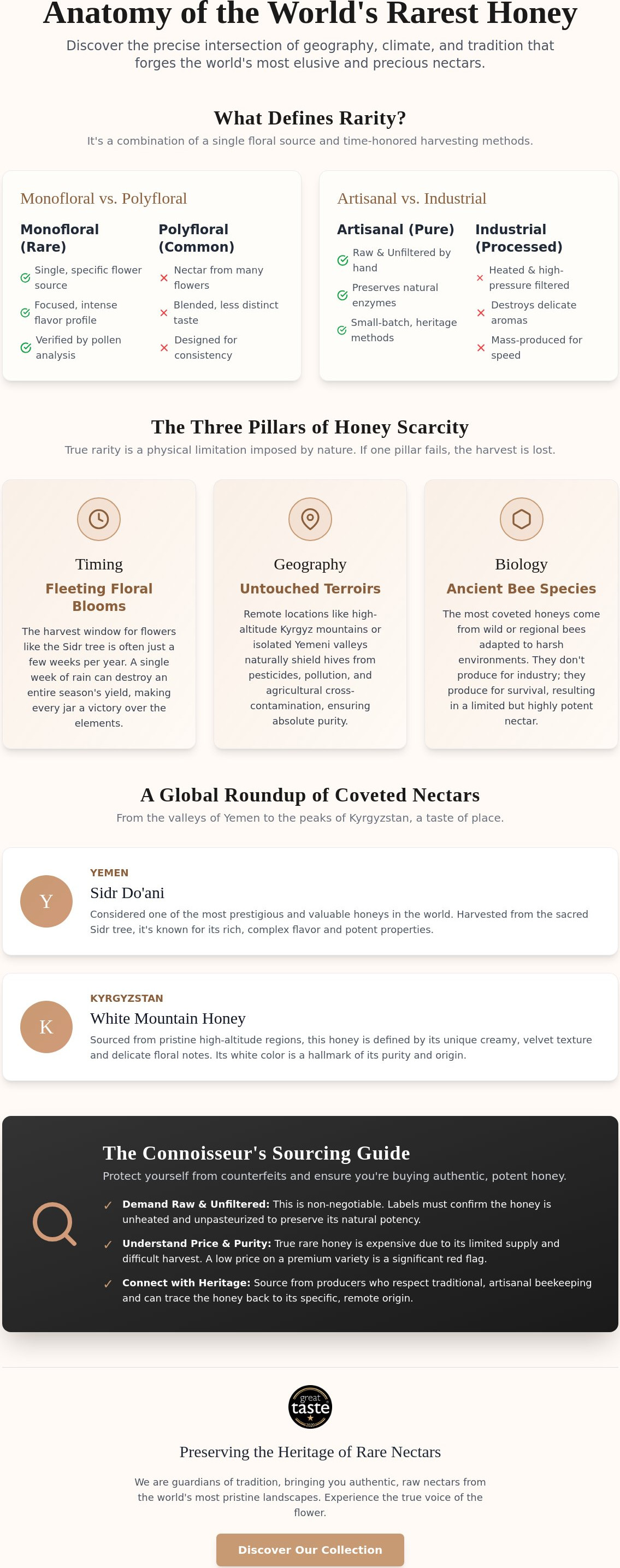
The Connoisseur’s Guide to Sourcing Authentic Honey
Authenticity is the final bridge between the hive and your health. In a market often clouded by industrial blends, finding genuine rare honey varieties requires a discerning eye and a healthy dose of skepticism. You shouldn't settle for anything less than total transparency. Price is often your first clue. Because the harvest windows are so short and the locations so remote, true rarity cannot be cheap. If a premium nectar is priced similarly to standard supermarket blends, it has likely been diluted or adulterated with syrups. Quality has a cost that reflects the labor of the bees and the dedication of the artisanal beekeeper.
Avoiding the "Supermarket Trap" is essential for any true connoisseur. Mass-produced honey is rarely truly rare. It is often ultra-filtered and pasteurized to ensure it stays liquid on the shelf for years. This process strips away the very things that make honey valuable: the pollen, the propolis, and the delicate medicinal enzymes. To source the best, look for "Raw" and "Unfiltered" on the label. These terms indicate that the honey hasn't been heated above the natural temperature of the hive, preserving its living essence. Read the label like a sommelier. You should see a specific geographic origin and a clearly defined floral source rather than a vague blend of origins.
Visual and Sensory Cues
Your senses are powerful tools for verification. Many people mistakenly believe that crystallization is a sign of spoilage. In reality, it is a hallmark of purity. Raw honey is a supersaturated solution, and over time, it will naturally return to a solid state. If your honey never crystallizes, it might be heavily processed. Texture varies wildly across rare honey varieties, from the obsidian-dark, mineral-rich Yemeni nectars to the butter-like consistency of alpine blooms. Don't forget the aroma test. A premium jar should have a complex, lingering scent that fills the room when opened. If it just smells like sugar, it probably is.
The Importance of Lab Testing
Science provides the ultimate peace of mind. For high-stakes varieties, independent lab reports are the industry gold standard. These tests verify the pollen count and ensure the absence of pesticides or added sugars. Look for "Cold Pressed" on the label as well. This means the honey was extracted using centrifugal force rather than heat, which keeps the nutrients intact. It is a slower method, but it is the only way to honor the product's integrity. It is a fundamental truth that high-quality raw honey never needs additives or heat treatment. Ready to experience the difference that true purity makes? Explore the full range of treasures available at Balqees Honey today.
Balqees: Preserving the Heritage of Rare Nectars
At Balqees, we believe that a jar of honey is a vessel of history. It's a living link to the landscapes and traditions that have remained unchanged for thousands of years. Our mission goes beyond simple retail; we act as storytellers and guardians of these ancient nectars. We've dedicated ourselves to uncovering the most exceptional rare honey varieties on the planet, ensuring that their raw, potent essence reaches your table without a single moment of interference. This is a journey of respect, transparency, and a deep-seated passion for the natural world. Every drop is a testament to our commitment to quality.
Our philosophy is rooted in the idea that honey is a bridge between ancient tradition and modern wellness. We don't see these products as mere commodities. We see them as gifts from the earth that require careful handling and profound respect. By maintaining the honey in its raw, unfiltered state, we protect the complex enzymes and aromatic compounds that define its character. We don't use high heat. We don't use pressure filtration. We simply facilitate the journey from the hive to your home, allowing the honey to speak for itself through its texture, scent, and flavour.
Our Artisanal Sourcing Process
We don't source from industrial brokers or mass-market wholesalers. Instead, we build direct, lasting relationships with remote beekeeping communities in the heart of Yemen and the high-altitude regions of Kyrgyzstan. These beekeepers aren't just suppliers; they're the true custodians of the land. Our focus remains strictly on small-batch harvests. By prioritizing quality over industrial volume, we can implement rigorous quality control measures that verify the purity of every batch. We visit these remote hives personally to ensure that the heritage techniques passed through generations are being honoured. This meticulous approach guarantees that the integrity of our White Mountain Honey and Raw Yemeni Sidr Do'ani Honey remains absolute.
Beyond Taste: Functional Rare Blends
While we celebrate the purity of single-source nectars, we also recognize the power of honey as a functional tool for health. Our approach is to enhance, never to overshadow. We've developed innovative fusions, such as our Black Seed Fusion and Raw Honey & Ginseng Fusion, which combine our premium bases with potent botanicals. These blends are designed to respect the honey's natural profile while providing targeted benefits for a contemporary lifestyle. We treat these fusions with the same artisanal reverence as our monofloral varieties, ensuring that the botanicals are integrated without high heat or chemical processing. It's a perfect balance of ancient wisdom and modern health needs. Explore our collection of rare honey varieties and find your signature nectar.
Embrace the Art of Exceptional Nectar
Finding true quality in a crowded market is about more than just taste. It’s about understanding the fleeting moments and remote landscapes that create rare honey varieties. You now know that rarity is defined by geography, the harvest window, and the integrity of the beekeeper. By looking beyond the supermarket shelf and prioritizing raw, unfiltered purity, you protect both your well-being and the ancient traditions of the hive. Every jar is a story of a specific terroir, captured at the perfect moment and delivered with reverence.
At Balqees, we are proud to act as your guide and storyteller. Our collection is sourced from 7,000-year-old Yemeni traditions and remains completely raw and unfiltered to preserve every natural enzyme. When you choose our nectars, you're directly supporting artisanal beekeeping communities who guard these wild landscapes for future generations. It’s time to elevate your palate and experience honey as nature intended. Discover the World’s Rarest Raw Honeys at Balqees and begin your own sensory journey today.
Frequently Asked Questions
What is the rarest honey in the world?
Pitcairn Island honey is often cited as the rarest due to its extreme isolation, though Yemeni Sidr Do'ani is equally coveted for its fleeting harvest. These rare honey varieties are produced in such small quantities that they never reach the mass market. The scarcity is a result of specific environmental triggers that only occur in remote, untouched corners of the globe.
Why is Yemeni Sidr honey so expensive?
The price is a direct result of the labor-intensive harvesting process in the rugged terrain of Yemen. Beekeepers move their hives deep into the mountains to reach the wild Sidr trees during their brief flowering period. This traditional approach yields a very small amount of nectar compared to industrial farming. The high demand for its legendary medicinal properties further ensures its status as a premium product.
Does rare honey expire or lose its potency over time?
Pure honey doesn't expire if it's kept in a sealed container. Archaeologists have famously discovered edible honey in ancient tombs that was thousands of years old. However, the delicate enzymes and aromatic compounds can lose their potency if the honey is exposed to direct sunlight or high heat. To keep your honey at its best, store it in a cool, dark place away from moisture.
How can I tell if my raw honey is authentic?
Authenticity is revealed through the honey's natural behavior and scent. Genuine raw honey will eventually crystallize and should possess a rich, multi-layered aroma that reflects its floral source. If a product seems too consistent or lacks a distinct smell, it may be adulterated. Trusting your source and checking for batch-specific lab results is the best way to ensure your rare honey varieties are the real deal.
What is the difference between Manuka honey and Sidr honey?
The difference lies in their botanical origins and geographic heritage. Manuka is produced from the nectar of the tea tree in New Zealand and is measured by its MGO content. Sidr honey comes from the ancient Lote tree in the Middle East and is prized for its thick, buttery texture and rich history. While both offer exceptional wellness benefits, they provide completely different sensory experiences on the palate.
Why does the colour of rare honey change between harvests?
Nature isn't a factory, so every harvest is a unique vintage. The colour of the honey is influenced by the mineral content of the soil, the amount of rainfall, and the specific mix of flowers blooming at that time. One year might produce a light golden hue, while the next yields a deep, dark amber. These natural variations are a sign that the honey is raw and unblended.
Is white honey actually made from white flowers?
Not necessarily. While White Mountain honey often comes from alpine flowers like sainfoin, the pearlescent white colour is primarily a result of the crystallization process. The honey contains tiny glucose crystals that reflect light, giving it a soft, velvet-like appearance. It isn't treated or bleached. That creamy white glow is a natural characteristic of the nectar and the cold environment where it’s harvested.
Can I use rare honey for cooking or should it be eaten raw?
You should always eat rare honey raw to protect its living enzymes. High heat destroys the delicate antioxidants and medicinal properties that make these nectars so valuable. If you want to enjoy it with warm food, wait until your tea or porridge has cooled to a drinkable temperature before stirring in the honey. This ensures you don't lose the very essence of what makes the product special.


