


For decades, the global wellness stage has been dominated by a single name from New Zealand, yet a far older, rarer treasure from the valleys of Yemen holds a potency that science is only just beginning to quantify. You've likely stood before a shelf or scrolled through an online store, caught in the debate of Sidr honey vs Manuka honey UAE, wondering if the clinical ratings of one truly outweigh the ancestral heritage of the other. It's a high-stakes choice when you're investing in your health and seeking genuine, raw purity.
We understand that the confusion over MGO levels and the fear of heat-treated counterfeits can make this decision feel overwhelming. This guide will demystify the complex world of laboratory standards and artisanal craft to help you choose the elixir that aligns with your wellness journey. We'll explore the sensory profiles, the rigorous UAE standards for purity, and the specific therapeutic scenarios where one of these prestigious honeys clearly outshines the other. From the buttery notes of Raw Yemeni Sidr Do'ani Honey to the medicinal earthiness of Manuka, you'll gain the confidence to identify true liquid gold.
Key Takeaways
- Discover how the sacred Ziziphus spina-christi tree and the rugged Manuka shrub shape the distinct therapeutic identities and ancestral heritage of these world-class honeys.
- Navigate the debate of Sidr honey vs Manuka honey UAE by understanding the difference between standardized MGO ratings and the complex, broad-spectrum bioactivity found in raw harvests.
- Learn to identify the sensory hallmarks of excellence, from the velvety, butterscotch texture of Raw Yemeni Sidr Do'ani Honey to the earthy, medicinal profile of premium Manuka.
- Gain a clear framework for choosing your elixir based on specific health goals, whether you require targeted topical recovery or a systemic boost for long-term immunity.
- Uncover the critical importance of raw, unfiltered purity and how to avoid heat-treated commercial honey that has been stripped of its life-giving enzymes.
The Botanical Origins: Sacred Sidr Trees vs. Rugged Manuka Shrubs
The story of these two honeys begins in the soil. It is a tale of two vastly different landscapes; the sun-scorched, arid mountains of Yemen and the lush, temperate hills of New Zealand. When comparing Sidr honey vs Manuka honey UAE, you aren't just comparing brands. You are comparing the botanical resilience of two distinct species. The Sidr tree, or Ziziphus spina-christi, is a sacred icon in the Middle East. It thrives where others fail. Its roots reach deep into the parched earth to find moisture, concentrating the plant's life force into a nectar that is rare and potent. This harsh desert environment is exactly what gives the honey its legendary status. The trees are survivors, and their nectar is the concentrated essence of that survival.
In contrast, the Manuka bush, Leptospermum scoparium, is a rugged shrub that blankets the New Zealand countryside. Both plants offer a very small harvest window. The flowers bloom for just a few weeks each year, typically between four to six weeks. This creates a natural scarcity that defines their prestige. If the rains are late or the winds are too high, the harvest is lost. This fleeting window is why both nectars are considered some of the rarest substances in the natural world.
The Sacred Heritage of Yemeni Sidr
In the Hadramout valley, time seems to stand still. Beekeepers here practice a nomadic craft that has remained unchanged for centuries. They move their hives by hand, following the bloom of the Sidr trees through the rugged terrain. This is the birthplace of Raw Yemeni Sidr Do'ani Honey. The term "Do'ani" refers to the Do'an valley, a region where the soil and climate conspire to produce the most concentrated, aromatic Sidr nectar on earth. It is an untouched, wild production. There are no chemicals, no managed plantations, and no artificial feeding. The bees rely entirely on the wild blossoms, making each jar a pure reflection of the desert’s ancient soul.
The Emergence of Manuka’s Global Reputation
Manuka's journey is strikingly different. For decades, New Zealand farmers considered the bush a nuisance or "scrub" plant. It was even used as cattle feed because the bees that foraged on it produced a honey that was too thick and strong for the tastes of the time. That changed when researchers discovered its unique non-peroxide activity. Today, Manuka is a clinical superstar. New Zealand has built a sophisticated industry around it, with managed plantations and strict export controls. While Sidr remains a wild, artisanal treasure, Manuka has become a standardized global benchmark. This contrast is central to the Sidr honey vs Manuka honey UAE debate. One represents the raw, unmanaged power of an ancient heritage; the other represents a triumph of modern scientific certification.
Decoding the Science: MGO Ratings vs. Bioactive Diversity
Science craves certainty. It seeks a single, measurable metric to define quality. In the comparison of Sidr honey vs Manuka honey UAE, this search often leads to the MGO rating. But focusing solely on one compound is like judging a symphony by the volume of a single violin. Nature is far more nuanced. While one honey relies on a specific chemical marker for its reputation, the other offers a complex, multi-layered defense system that has protected health for millennia.
Manuka’s Standardized Clinical Power
Manuka honey's global fame rests on Methylglyoxal, or MGO. This compound provides its unique non-peroxide activity, which remains stable even when exposed to heat or light. The Unique Manuka Factor (UMF) is a secondary grading system that verifies this potency alongside other markers like leptosperin. These ratings have made Manuka a favorite for topical applications and wound care. Medical experts often cite its antibacterial, antiviral, anti-inflammatory and antioxidant properties as the reason for its clinical success. However, high MGO levels don't always translate to better internal wellness. Chasing the highest number can sometimes lead to a "clinical" product that lacks the broader nutritional profile of a wild, raw harvest.
Sidr’s Multi-Weapon Biochemical Arsenal
Sidr honey operates with a different biological strategy. It doesn't rely on MGO for its strength. Instead, it offers a broad-spectrum diversity of bioactive compounds. Research has begun to validate what traditional healers have known for centuries. A landmark study from the University of Ottawa revealed that Sidr honey was exceptionally effective against MRSA biofilms. It destroyed these stubborn bacterial layers where other honeys struggled. This potency comes from an incredibly rich concentration of phenolic compounds and antioxidants. It's an "entourage effect" where enzymes, minerals, and nectar work in harmony. This makes the choice of Sidr honey vs Manuka honey UAE a decision between a targeted clinical tool and a diverse, systemic wellness guardian. To experience this complexity firsthand, you might explore our Raw Yemeni Sidr Do'ani Honey, which preserves these delicate compounds through meticulous cold-pressed methods.
The beauty of Sidr lies in its balance. It isn't just about one active ingredient. It's about the synergy of the desert. High levels of ascorbic acid and flavonoids provide a natural shield for the body, supporting everything from respiratory health to digestive comfort. Because it's a raw, living food, it contains the very enzymes that help your body process its nutrients. It's a masterclass in biochemical diversity that doesn't need a lab-stamped rating to prove its worth.
Sensory Profiles: A Masterclass in Taste, Texture, and Terroir
To the true connoisseur, the choice in the debate of Sidr honey vs Manuka honey UAE is ultimately settled on the tongue. It's a journey of the senses that begins long before the first taste. One is a luminous, translucent amber that catches the light like a gemstone; the other is a dense, opaque cream with the matte finish of a forest floor. These visual cues are the first indicators of the terroir that birthed them. Soil, climate, and altitude are the silent architects of flavor. The sun-drenched, mineral-rich mountains of Yemen produce a nectar that is worlds apart from the cool, damp, and rugged forests of New Zealand.
The Palate of the Desert: Sidr Honey
Raw Yemeni Sidr Do’ani Honey is often called "Liquid Gold" for good reason. Its appearance is clear and radiant. The flavor is a revelation of deep, buttery sweetness. Imagine notes of butterscotch and caramel mixed with a subtle floral aroma that lingers without being cloying. It is exceptionally dense and velvety. Unlike many other varieties, it resists crystallization for years because of its unique chemical makeup. One simple way to identify high quality raw honey by its ability to hold its shape on a spoon is to watch how it folds upon itself as it pours. This viscous texture makes it the preferred choice for culinary pairings. It elevates a fine tea or a wedge of artisanal cheese without overwhelming the other ingredients.
The Earthy Intensity of Manuka
Manuka honey offers a different kind of intensity. It is thixotropic. This means it is naturally thick and gel-like but becomes liquid when stirred or agitated. Its color ranges from dark cream to a deep, earthy brown. The taste is unmistakably herbaceous. You'll notice a slightly medicinal, bitter finish that becomes more pronounced as the MGO levels increase. For some, this edge is an acquired taste. It is less a sweetener and more a potent tonic. As the clinical ratings rise, the flavor deepens and becomes more "clinical." While Sidr is a master of culinary elegance, Manuka is a bold statement of rugged nature. Choosing between them depends on your sensory preference. Do you seek the elegant, rounded sweetness of the desert or the herbal, punchy intensity of the forest? Both are masterpieces of their respective lands.
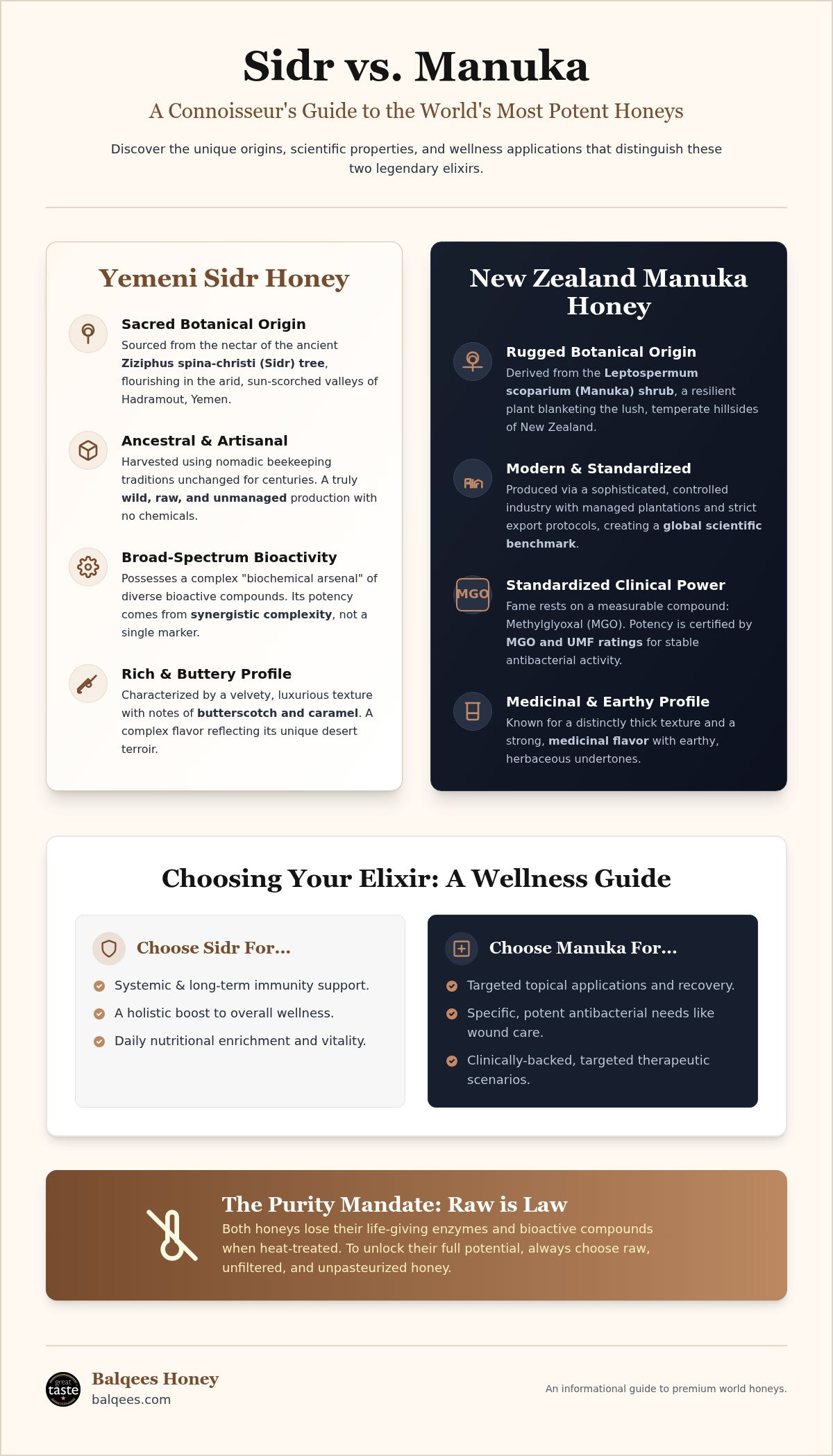
The Wellness Guide: Choosing Your Elixir Based on Health Goals
Choosing the right nectar isn't just a matter of taste; it's a commitment to your body's unique requirements. When navigating the choice of Sidr honey vs Manuka honey UAE, consider your immediate goals. Are you looking for a daily tonic to fortify your spirit, or do you need a clinical-grade intervention for a specific ailment? It helps to view these two prestigious honeys through a simple framework: systemic wellness versus targeted intervention. One is a daily companion for long-term resilience, while the other is a potent specialist for acute challenges.
When to Choose Yemeni Sidr Honey
If your goal is systemic balance and long-term vitality, Sidr is your natural ally. Many in the region turn to this liquid gold for its profound impact on digestive health. It's traditionally used to soothe stomach ulcers and support respiratory function during seasonal changes. Because of its high antioxidant levels, it's a staple in honey for daily wellness rituals. Athletes often find it's a superior natural energy booster, providing sustained vitality without the crash of processed sugars. The specific authentic Sidr honey benefits make it the perfect choice for those seeking a broad-spectrum shield for their immune system. It's a gentle yet powerful way to maintain your body's natural defenses every single day.
When to Reach for Manuka Honey
Manuka excels when the need is specific and acute. If you're battling a stubborn sore throat or seeking to improve oral health, Manuka's high MGO content provides a concentrated antibacterial effect that is hard to match. It's also a powerhouse in skincare. Many use it as a targeted treatment for acne or inflammatory skin conditions, applying it directly to the skin to harness its healing properties. When choosing Manuka, look for high UMF or MGO ratings to ensure you're getting the therapeutic potency required for these specific needs. It's less about a daily spoonful for pleasure and more about a strategic application for recovery.
Traditional Middle Eastern vitality rituals often involve a ritualistic approach to consumption. A spoonful of honey in a glass of warm water on an empty stomach is an ancient practice designed to "wake up" the digestive system and prime the body for nutrient absorption. In the context of Sidr honey vs Manuka honey UAE, this morning ritual is best served by the smooth, buttery profile of Sidr. It prepares the body for the day ahead, grounding you in a legacy of health that spans generations. Explore our Raw Yemeni Sidr Do'ani Honey to begin your own daily vitality ritual and experience the desert's most potent treasure.
Sourcing Purity in the UAE: Why the Raw Distinction Matters
A high price tag is often mistaken for a guarantee of quality. When you're weighing the merits of Sidr honey vs Manuka honey UAE, the most critical factor isn't just the botanical source or a laboratory rating. It's the state of the honey itself. Is it a living, enzymatic treasure, or has it been stripped of its soul by industrial processing? In our local market, luxury packaging can sometimes mask a product that has been pasteurized for commercial convenience. True wellness requires a return to the untouched state of the hive, where the honey remains exactly as the bees intended.
The Dangers of Processed Premium Honey
Commercial brands often use intense heat to prevent crystallization, especially in Manuka, to ensure the product looks "perfect" and remains liquid on a shelf for years. This pasteurization is the enemy of bioactivity. It destroys the delicate enzymes, heat-sensitive antioxidants, and volatile aromatic compounds that give these honeys their therapeutic power. When honey is over-filtered and heated, it becomes little more than a sophisticated syrup. Raw honey maintains its living properties because it remains in its natural, unadulterated state. Raw honey is honey that has never been heated above hive temperature, which is approximately 35°C.
Look for red flags when sourcing your next jar. If a honey is suspiciously clear, thin, or lacks the natural cloudiness of pollen, it has likely been over-processed. Nature is rarely perfectly transparent. A raw, cold-pressed harvest will often have a rich, textured appearance and a complex aroma that hits you the moment you break the seal. These are the markers of a product that hasn't been "killed" by industrial machinery.
The Balqees Commitment to Authenticity
We act as a bridge between the ancient traditions of the Hadramout valley and your modern wellness journey. Our philosophy is rooted in a deep respect for the natural world. We maintain direct, personal relationships with Yemeni beekeepers to ensure total traceability and integrity. This isn't just business; it's a guardianship of a specialized craft. Every batch of our Raw Yemeni Sidr Do'ani Honey undergoes rigorous testing to ensure it is free from additives, pesticides, and chemical residues. We don't use high-pressure filtration or heat. We let the honey speak for itself.
By choosing a cold-pressed, raw nectar, you're ensuring that every drop contains the "entourage effect" of enzymes and minerals we discussed earlier. It's the difference between a clinical supplement and a whole, living food. Experience the purity of Raw Yemeni Sidr Do’ani Honey today and discover how true, artisanal honey can transform your daily rituals. Nature doesn't compromise, and neither should you.
Elevate Your Daily Vitality with Nature’s Finest Nectars
Choosing between these two prestigious elixirs isn't about finding a winner. It's about matching the right nectar to your body's specific needs. While Manuka offers a targeted clinical edge for acute concerns, Sidr honey stands as a broad-spectrum masterpiece of bioactive diversity. In the landscape of Sidr honey vs Manuka honey UAE, the true mark of excellence is always raw, unfiltered purity. You now understand how heat treatment destroys the very enzymes and antioxidants that make these honeys legendary.
We invite you to experience this untouched power for yourself. Since 2013, we've served as a trusted guide for connoisseurs across the Emirates. Our Raw Yemeni Sidr Do'ani Honey is sourced directly from the Hadramout Valley; it is cold-pressed and raw to ensure every drop retains its living properties. Explore our collection of Raw Yemeni Sidr Honey and discover the deep, buttery heritage of the desert. Your journey toward authentic wellness starts with a single, golden spoonful.
Frequently Asked Questions
Is Sidr honey better than Manuka honey for immunity?
Sidr honey is often preferred for broad-spectrum immunity because of its high antioxidant and phenolic content. While Manuka acts as a clinical specialist for specific infections, Sidr works as a systemic shield for general wellness. Its rich vitamin and mineral profile supports the body's natural defenses in a more holistic way. This makes it a staple in traditional Middle Eastern vitality rituals for long-term health and resilience.
Why is Yemeni Sidr honey so expensive in the UAE?
The high price reflects its extreme rarity and the difficult conditions of its harvest. Sidr trees bloom for only a few weeks each year in the rugged Hadramout valley. Beekeepers must use traditional, nomadic methods to reach these wild trees, often in geopolitically challenging areas. This artisanal labor, combined with the low yield and high global demand, creates a premium value for genuine Raw Yemeni Sidr Do'ani Honey.
Can I use Sidr honey and Manuka honey together?
Yes, you can incorporate both into your wellness routine to leverage their unique strengths. You might use Sidr honey as a daily morning tonic for digestive and respiratory support while keeping Manuka for acute needs like a sore throat or topical skin care. Using them together allows you to benefit from both the broad-spectrum bioactivity of the desert and the targeted clinical power of the forest.
How do I know if my Sidr honey is authentic and raw?
Authentic raw honey should have a complex aroma and a dense, non-uniform texture. Look for "cold-pressed" or "unfiltered" labels, which indicate the honey hasn't been heated above hive temperature. In the debate of Sidr honey vs Manuka honey UAE, transparency is key. Trustworthy providers like Balqees Honey maintain direct relationships with beekeepers to ensure traceability and rigorous testing for purity without any additives or heat treatment.
Does Sidr honey have an MGO rating like Manuka?
Sidr honey does not use the MGO rating system. MGO is a specific marker for Manuka's non-peroxide activity. Sidr's potency is instead measured by its high concentration of antioxidants and enzymes. While it lacks a standardized clinical scale like UMF, its effectiveness against stubborn bacterial biofilms has been documented in independent university studies. This proves its natural strength in the Sidr honey vs Manuka honey UAE comparison without needing a lab-stamped rating.
Is it safe to eat raw Sidr honey every day?
It is generally safe and highly beneficial for most adults to consume a spoonful of raw Sidr honey daily. This practice is a cornerstone of traditional wellness in the region. It provides a natural energy boost and supports digestive health. However, honey should never be given to infants under one year old. If you have specific health conditions like diabetes, it is best to consult with a healthcare professional first.
What is the best way to store premium honey in the UAE climate?
Store your honey in its original glass jar in a cool, dark place away from direct sunlight. While the UAE climate is warm, you don't need to refrigerate raw honey. In fact, refrigeration can cause it to crystallize faster. Simply keep the lid tightly sealed to prevent moisture from entering. Raw Sidr honey is naturally stable and can maintain its flavor and bioactivity for years when stored correctly.
Can Sidr honey help with digestive issues better than Manuka?
Sidr honey is traditionally favored for digestive health, particularly for soothing stomach ulcers and improving gut comfort. Its pH balance and enzymatic profile make it a gentle but effective tonic for the digestive tract. While Manuka is excellent for oral health and specific infections, the systemic nature of Sidr makes it a preferred choice for those seeking relief from chronic digestive sensitivity or general stomach upset through natural, raw nectar.


