


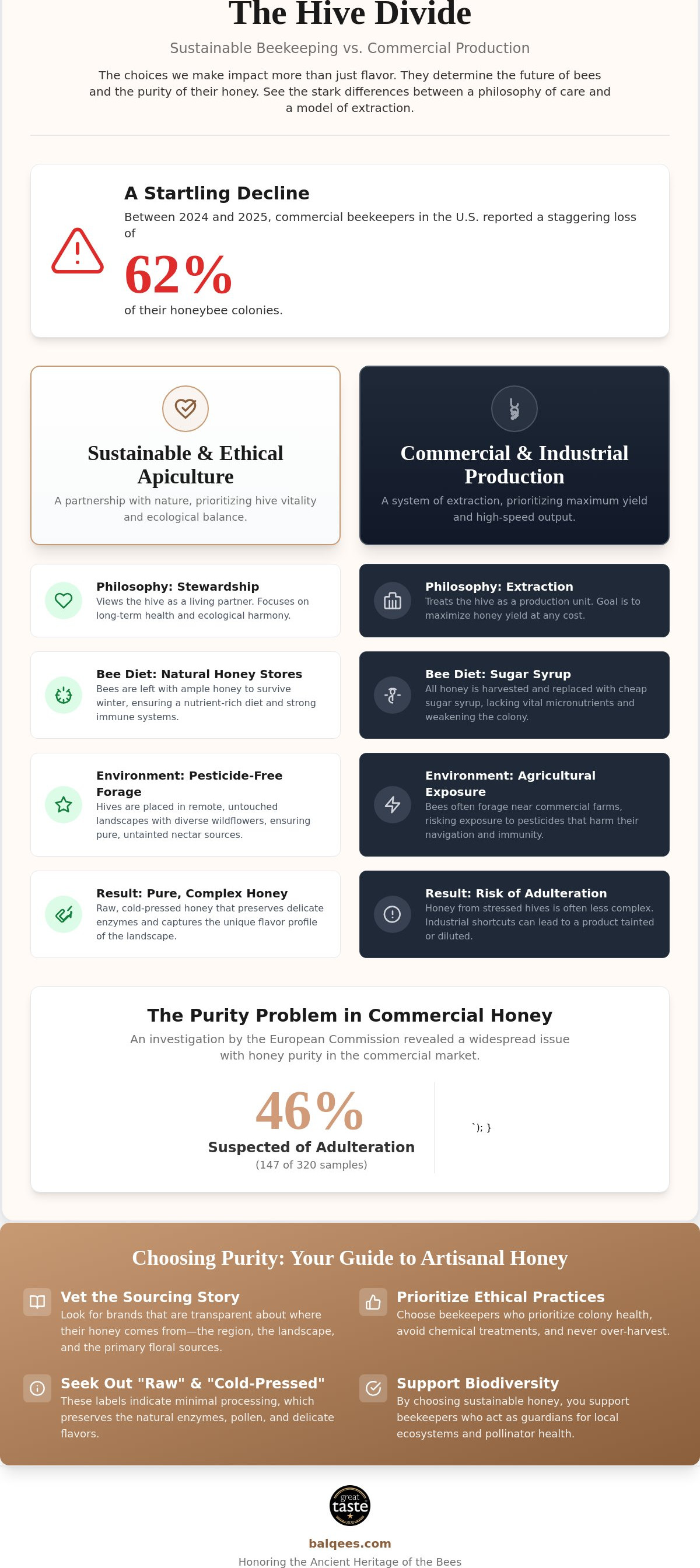
Did you know that commercial beekeepers in the U.S. lost 62% of their colonies between 2024 and 2025? This startling figure is a wake-up call for anyone who treasures the deep, complex notes of a raw, untainted harvest. For the true connoisseur, the choice of sustainable beekeeping honey is no longer just a preference; it's a commitment to the survival of a craft that dates back millennia. You deserve to know that your honey is a gift from a thriving ecosystem, not a byproduct of a stressed hive.
It's natural to feel overwhelmed by confusing labels or the fear of consuming honey tainted by industrial shortcuts. You want to trust that what you're eating is as pure as the remote, untouched landscapes where the nectar was gathered. We promise to demystify the world of ethical apiculture, showing you how sustainable practices protect the integrity of the hive and the vibrancy of the final product. We'll examine the undeniable link between bee vitality and sensory quality, teaching you how to spot the markers of a truly artisanal brand. By the end, you'll feel confident choosing honey that honors both your health and the ancient heritage of the bees.
Key Takeaways
- Learn how ecological stewardship prioritizes colony health over high-yield extraction to ensure the long-term survival of the hive.
- Discover the essential role of pesticide-free wild flowers and minimal intervention in producing authentic sustainable beekeeping honey.
- Compare the "slow honey" philosophy of traditional apiculture with the high-speed, industrial methods of commercial production.
- Identify how raw, cold-pressed techniques preserve the delicate enzymes and complex flavor profiles unique to specific landscapes.
- Master the art of vetting artisanal brands by understanding the sourcing stories and ethical practices behind every jar.
Defining Sustainable Beekeeping: More Than Just Harvesting Honey
To many, the image of beekeeping is a simple one: a wooden box, a puff of smoke, and a golden jar. But look closer. True sustainability in apiculture is less about what we take and more about what we leave behind. It represents a fundamental shift from an industrial mindset of extraction to a philosophy of ecological stewardship. At its heart, sustainable beekeeping is a profound partnership with nature that respects the bees' natural life cycles above all else. It's an acknowledgment that the hive is a living, breathing entity with its own rhythms, not a factory line for mass production.
The core difference between commercial operations and ethical ones lies in their primary objective. While industrial systems prioritize maximum yield at any cost, the producers of sustainable beekeeping honey prioritize the environment and the health of the hive. This isn't just a moral choice; it's a practical one. When we treat bees as partners rather than commodities, the result is a product that captures the true essence of the landscape. It's a slower process, certainly. It requires patience and a deep understanding of the local flora, but the integrity of the honey produced is incomparable.
Colony Health Over Industrial Production
In a sustainable apiary, the first rule of ethics is simple: the bees eat first. Leaving enough honey for the colony to overwinter is vital for their immune systems. Many commercial operations harvest every drop of honey and replace it with cheap sugar syrup. While this keeps the bees alive, it lacks the complex micronutrients found in real nectar, leaving the colony vulnerable to disease. Stress-free bees, allowed to thrive on their own stores, produce honey with a more complex chemical profile. They aren't pushed to their breaking point, and that lack of stress is reflected in the purity and vibrancy of the harvest.
Biodiversity and the Role of the Pollinator
Sustainable beekeeping looks far beyond the wooden walls of the hive. It's about supporting diverse bee species and the local flora they depend on. These apiaries act as bio-hubs for their surrounding ecosystems, fostering a ripple effect of health throughout the landscape. Better pollination leads to more resilient wild landscapes, which in turn provides better forage for the bees. This movement is even reaching our cities, where urban sustainability efforts are helping to bridge the gap between concrete jungles and the natural world. By choosing sustainable beekeeping honey, you aren't just buying a sweetener; you're supporting a system that keeps our wild spaces blooming and our ecosystems in balance.
The Core Pillars of Ethical Apiculture: Prioritising Hive Vitality
Ethical apiculture isn't a set of rigid industrial rules; it's a philosophy that treats bees as a living legacy rather than a depreciating asset. To produce authentic sustainable beekeeping honey, a keeper must act as a guardian. This requires a commitment to chemical-free management, where synthetic antibiotics and harsh miticides are strictly avoided. These substances leave lasting residues in the wax and the honey itself, compromising the very purity we seek to protect. This is a critical distinction, especially since an investigation by the European Commission found that 147 out of 320 honey samples tested in the EU were adulterated. By prioritizing the hive's internal logic, we allow the colony to regulate itself with minimal human interference, trusting in their ancient instincts.
True stewardship also involves fostering a deep connection to the land. This means ensuring colonies have access to vast, untouched landscapes where they can forage on a diverse array of wild flowers. Educational initiatives promoting balanced and sustainable apiculture highlight how prioritizing bee welfare directly correlates with local biodiversity. When the bees are healthy and the environment is flourishing, the honey becomes a liquid map of that thriving ecosystem. If you're looking to experience this harmony for yourself, you might explore our collection of artisanal harvests gathered from these very traditions.
The Importance of Pesticide-Free Forage
Modern agricultural chemicals are a silent threat to the hive. Even in small doses, pesticides can scramble a bee's navigation system and weaken its immune response. This is why sourcing from remote, high-altitude, or desert regions is so critical. Untouched landscapes are the secret behind high quality raw honey, as they ensure the nectar remains untainted by industrial runoff. Wild honey isn't just a culinary luxury; it's the most sustainable choice because it relies on the natural resilience of the earth rather than human-managed monocultures. It's honey as nature intended: wild, potent, and pure.
Breeding for Resilience, Not Just Yield
Industrial beekeeping often relies on high-production hybrids, a practice that creates a dangerous genetic monoculture. Sustainable keepers prefer hardy, native species that have adapted to their specific climates over centuries. These local varieties are better equipped to survive climate fluctuations and local pests without chemical aid. By valuing resilience over sheer volume, we ensure the honey we harvest is a surplus gifted by a strong, stable colony. It's a slower way of working, but it ensures that the sustainable beekeeping honey we enjoy today will still be available for generations to come. We don't just harvest for the season; we harvest for the future.
Traditional Wisdom vs. Modern Commercialisation
Sustainability isn't a modern invention in the world of the hive. For centuries, beekeeping was a practice of quiet observation and deep reverence. It was a "slow honey" movement long before the term existed. Traditional methods were sustainable by default because the beekeeper’s survival was tied directly to the health of the colony. Today, the contrast is stark. Modern industrial processing often views honey as a bulk commodity to be heated, blended, and moved at high speed. This mechanical approach strips away the very soul of the nectar. In contrast, the artisanal beekeeper acts as a guardian of both the bees and the landscape's history, preserving a lineage of taste that cannot be replicated in a factory.
While industrial models focus on replacing lost colonies as a business expense, traditional wisdom focuses on longevity. This philosophy is supported by modern research into Sustainable Northern Beekeeping practices, which emphasizes creating self-sustaining apiaries that mirror ancient stewardship. By choosing sustainable beekeeping honey, you're supporting a system where the harvest is a shared gift, not a forced extraction. It's a return to a sacred relationship where the human hand assists rather than dominates the natural process.
The Yemeni Sidr Tradition: A Case Study in Heritage
Nowhere is this heritage more evident than in the remote valleys of Yemen. The ancient methods used to harvest Raw Yemeni Sidr Do'ani Honey have remained largely unchanged for a thousand years. These valleys provide a naturally sustainable sanctuary, far from the reach of industrial pollutants. The Sidr tree itself is the anchor of a rare, protected ecosystem. Bees forage on its blossoms during a short, intense flowering season, creating a honey that is as much a piece of history as it is a culinary treasure. This isn't just production; it's the preservation of a wild, untouched landscape.
Artisanal Sourcing: The Human Connection
Knowing your beekeeper is the ultimate guarantee of purity. Many rare honey varieties exist only because small-scale, dedicated apiarists continue to practice their craft in the face of commercial pressure. Supporting these traditional honey-producing communities ensures economic sustainability for the families who guard these ancient secrets. When you invest in sustainable beekeeping honey, you're voting for the protection of local knowledge and the continued health of our planet’s most vital pollinators. It's a connection that spans continents and generations.
How Sustainability Shapes the Sensory Profile of Raw Honey
We often discuss apiculture in terms of ecology, but for the true connoisseur, the most immediate evidence of ethical practice is found on the tongue. The choice of sustainable beekeeping honey is, at its core, a decision to experience the untainted "terroir" of a landscape. Much like a fine vintage of wine, honey is a liquid record of the soil, the rainfall, and the specific floral blooms of a single season. When a hive is managed with a focus on stewardship, the beekeeper refuses to blend harvests or dilute the character of the nectar. This preserves a unique flavor profile that tells a story of a specific place and time, a complexity that is lost in the homogenized world of industrial production.
The sensory difference is profound. Industrial honey is often treated as a uniform commodity, heated and filtered until it is little more than a sweet syrup. In contrast, sustainable methods ensure the honey remains in its raw, living state. This is the only way to produce honey that is truly unfiltered and unheated, maintaining the delicate balance of volatile aromas that would otherwise evaporate under the stress of pasteurization. By protecting the hive's natural environment, we protect the medicinal and nutritional density that makes raw honey a functional treasure. If you are ready to experience this uncompromised purity, discover our range of raw, cold-pressed harvests and taste the difference for yourself.
Terroir and the Floral Symphony
Diverse wild forage creates a multi-layered flavor profile that commercial honey simply cannot match. While industrial blends seek a predictable, singular note, artisanal honey celebrates the "floral symphony" of the wild. A monofloral sustainable honey isn't just about one flower; it's about the dominant nectar source supported by the subtle undertones of the surrounding biodiversity. You can explore these nuances through the white mountain honey benefits, where the high-altitude flora creates a creamy, delicate texture and a flavor profile that is as rare as the landscape itself. This sensory depth is a direct result of bees foraging in a healthy, chemical-free ecosystem.
Preserving the Living Enzymes
Cold-pressing is the hallmark of the sustainable beekeeper. By avoiding heat-treatment, we preserve the living enzymes and bioactive compounds that give honey its legendary healing properties. Sustainable beekeepers refuse to pasteurize their liquid gold because they understand that heat is the enemy of quality. The texture and aroma of raw honey act as markers of its ethical origins. You might notice fine grains of pollen or a slight cloudiness; these aren't imperfections. They are proof of a minimal intervention approach that keeps the honey exactly as the bees intended. When you open a jar of sustainable beekeeping honey, the scent that meets you is the true, raw fragrance of the hive, untouched and alive.
Choosing Purity: Supporting a Sustainable Honey Future
Every spoonful of honey you enjoy is a silent endorsement of a specific way of treating the earth. Choosing sustainable beekeeping honey isn't just a culinary preference; it's an active vote for the protection of bee populations worldwide. It's a rejection of the industrial shortcuts that prioritize speed over life. We don't just source honey. We build relationships. At Balqees, we're partners with beekeepers who honor these principles, acting as a bridge between remote, traditional apiaries and your table. Transparency is the thread that connects the hive to your home. It ensures that the story you're told is the truth of the harvest. By understanding the sourcing story, you become a guardian of the craft. You ensure that the ancient wisdom of the beekeeper isn't lost to the noise of the modern market.
What to Look for in a Sustainable Honey Brand
Finding the truth requires looking beyond generic buzzwords. Authentic quality is found in designations like raw, unfiltered, and cold-pressed. These aren't just marketing terms. They're guarantees that the honey has never been subjected to the heat or fine filtration that strips away its soul. A clear geographic origin is essential. You should be able to trace your honey back to a specific valley, mountain range, or desert. This level of detail is what separates a generic product from a true artisanal treasure. When selecting premium honey gift sets, look for those that celebrate this heritage. A gift of honey should be a gift of health and a story of a landscape preserved. It's about sharing a moment of purity that respects the labor of the bees and the dedication of the keeper.
The Future of the Hive
The future of the hive rests in your hands. As more connoisseurs demand transparency, we see a global shift toward better agricultural practices. This isn't a small change. It's the beginning of a movement where beekeeping and nature exist in perfect harmony once again. Every jar you buy from an ethical source encourages another beekeeper to put the health of their colonies first. Our long-term vision is one where the ancient traditions of the hive are respected by modern society, ensuring that the liquid gold we treasure remains pure for generations. Honey is a gift from nature. It's a concentrated essence of life itself. Sustainability is simply our way of saying thank you. It's a commitment to a world that stays wild, vibrant, and sweet. Together, we can ensure that the hum of the hive never fades.
Cultivating a Legacy of Purity
We've explored how true stewardship prioritizes the vitality of the hive, ensuring that every drop remains a potent reflection of its wild origin. By honoring traditional methods and avoiding industrial shortcuts, we preserve the complex enzymes and rich terroir that define the finest harvests. Choosing sustainable beekeeping honey is more than a culinary delight; it's a commitment to a future where bees and nature thrive in harmony. It's a choice to value quality over volume and heritage over mass production.
Our collection is sourced from untouched wild landscapes using traditional Yemeni heritage methods to ensure a product that is 100% raw, cold-pressed, and unfiltered. We invite you to experience the difference that deep respect for nature makes. Discover the purity of artisanal heritage with Balqees Honey and bring the essence of the wild into your daily wellness ritual. Together, we can protect the ancient traditions of the hive while savoring the most exquisite nectars the earth has to offer. Your journey into the heart of ethical apiculture begins with a single, golden taste.
Frequently Asked Questions
Is sustainable beekeeping the same as organic beekeeping?
No, these terms aren't identical, though they often overlap in practice. Organic certification focuses primarily on the absence of synthetic chemicals and pesticides in the immediate foraging area. Sustainability is a broader philosophy that encompasses the long-term health of the bee population and the surrounding ecosystem. A hive can be organic but still managed with high-stress industrial methods. True sustainability ensures the bees aren't over-harvested or fed sugar syrup to boost human production.
Why is sustainable honey usually more expensive than commercial honey?
The price reflects the true cost of stewardship. When commercial beekeepers in the U.S. lost 62% of their colonies between 2024 and 2025, it highlighted the fragility of industrial models. Producing sustainable beekeeping honey costs more because the yield is lower; we leave enough for the bees to thrive through the winter. You're paying for the artisan's time, the remote sourcing, and the guarantee that no shortcuts were taken at the hive's expense.
Does the way honey is harvested affect its health benefits?
Harvesting methods are the primary factor in determining a honey's bioactive potency. Cold-pressing and minimal intervention preserve the delicate enzymes and antioxidants that define raw honey. Industrial heat-treatment, or pasteurization, destroys these heat-sensitive compounds to ensure a long shelf life and uniform liquid state. When honey is harvested with respect for its living nature, it retains the full spectrum of medicinal benefits found in the original nectar.
Can beekeeping actually be bad for the environment if not done sustainably?
Beekeeping can be detrimental if the land is overstocked. Placing too many hives in a single area creates intense competition for nectar, which can starve out native wild pollinators. Sustainable beekeeping respects the carrying capacity of the landscape. It's about balance rather than saturation. Ethical keepers monitor the local flora to ensure there's enough forage for every creature in the ecosystem, not just the honeybees under their care.
How can I tell if a honey brand is truly practicing sustainable beekeeping?
Transparency is your best guide. Since the 2026 EU labeling regulations, brands must list specific countries of origin and weight percentages rather than vague blends. A sustainable brand goes further by sharing the specific valley or mountain range of the harvest. Look for a narrative that prioritizes the beekeeper's relationship with the land. If a brand can't tell you the story of who gathered the nectar, it's likely not a sustainable operation.
What does 'raw and unfiltered' have to do with sustainability?
Raw and unfiltered designations are clear indicators of a minimal intervention approach. To produce sustainable beekeeping honey, the keeper must avoid heavy processing that requires massive energy consumption and strips the product of its integrity. Unfiltered honey retains traces of pollen and propolis, which are essential for the honey's nutritional profile. These markers prove that the honey was handled with artisanal care rather than industrial speed.
Are traditional beekeeping methods better for the bees than modern ones?
Traditional methods often align more naturally with bee welfare because they were developed over centuries of quiet observation. Many modern techniques prioritize speed and volume, often treating the colony as a production unit. Traditional methods, like those used in the remote valleys of Yemen, treat the hive as a living partner. These ancient practices focus on the longevity of the colony, ensuring the bees remain resilient against local pests and climate shifts without chemical aid.
How does sustainable beekeeping help with climate change?
Sustainable apiaries act as resilient bio-hubs that strengthen local plant life against climate fluctuations. By fostering biodiversity and using native bee species, these practices ensure that ecosystems remain robust. Healthy pollination cycles are the earth's natural defense against environmental stress. When beekeepers protect wild forage areas from industrial development, they help maintain vital carbon sinks and ensure the continued vibrancy of our planet's most remote landscapes.


