


How can a tree that thrives in the harshest, most unforgiving desert landscapes produce a nectar so potent that it has been revered as sacred for millennia? You already know that not all honey is created equal. Yet, the sheer volume of conflicting claims about purity and origin can make finding the truth feel like an impossible task. If you've been searching for the reality behind sidr honey benefits, you've likely encountered a landscape of skepticism and confusion.
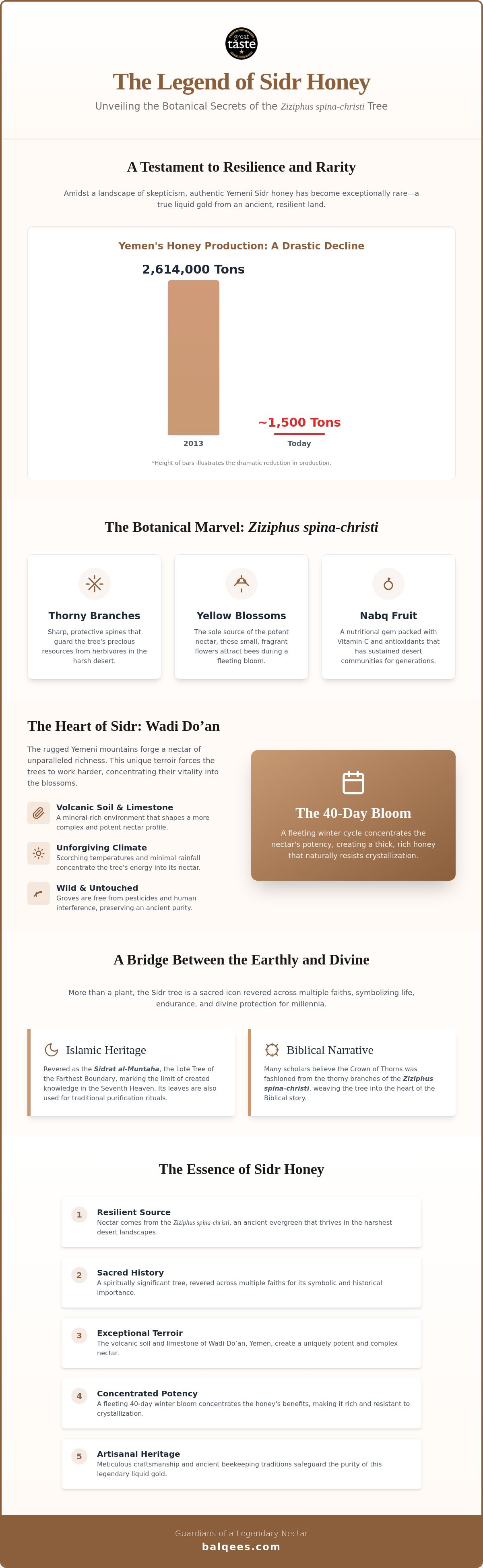
This article is your guide to the botanical secrets and ancient legacy of the Ziziphus spina-christi. We will move beyond the labels to explore the unique biology of the Sidr tree and its vital role in traditional medicine. You'll learn how Yemen's honey production has shifted from 2,614,000 tons in 2013 to approximately 1,500 tons today, making every drop of authentic honey a rare testament to resilience. We'll trace the journey from the desert blossom to the artisanal jar, revealing the heritage that defines the world's most sought-after honey.
Key Takeaways
- Identify the resilient Ziziphus spina-christi, a resilient ancient evergreen that transforms harsh desert landscapes into a source of rare botanical nectar.
- Uncover the spiritual significance of the Sidr tree, a sacred icon revered across multiple faiths for its historical and symbolic importance.
- Understand the vital role of terroir, specifically how the volcanic soil and limestone of Wadi Do’an in Yemen shape the exceptional quality of the nectar.
- Discover how the fleeting 40-day winter bloom cycle concentrates sidr honey benefits, creating a potent honey that naturally resists crystallization.
- Appreciate the meticulous craftsmanship and ancient beekeeping traditions necessary to safeguard these legendary groves and their liquid gold.
What is the Sidr Tree? Botany and Taxonomy of Ziziphus spina-christi
The Sidr tree isn't a mere plant; it's a botanical marvel. It's an ancient evergreen. It belongs to the Rhamnaceae family. Scientifically known as Ziziphus spina-christi, it carries evocative names like the Christ’s Thorn Jujube. Its physical form is a study in survival, characterized by several distinct features:
- Thorny Branches: Sharp, protective spines that guard the tree's precious resources from herbivores.
- Yellow Blossoms: Small, delicate flowers that emit a potent fragrance to attract honeybees.
- Nabq Fruit: Cherry-like fruits that transition from green to yellow, eventually ripening into a deep reddish-brown.
These blossoms are the sole source of the nectar that defines the legendary sidr honey benefits. This species thrives in the world's most unforgiving environments. It anchors itself in parched desert landscapes through a remarkably deep taproot system that seeks out subterranean water sources far below the surface.
The Resilience of the Desert Lote Tree
Scorching temperatures don't deter this tree. It flourishes in heat that would wither most vegetation, often surviving in areas with minimal rainfall for years. In these arid zones, the tree acts as a vital ecological anchor. It prevents desertification by stabilizing shifting sands and providing a canopy of shade for local wildlife. The tree's fruit is just as impressive as its endurance. Known as Nabq, this fruit is a nutritional gem. It's packed with vitamin C, iron, and essential antioxidants that have sustained desert communities for generations. This internal strength is mirrored in the nectar; the tree concentrates its vitality into its flowers, ensuring the bees collect a substance of unparalleled potency.
Geographic Distribution: From Yemen to the Mediterranean
Mapping the distribution of the Sidr tree reveals a journey across the Arabian Peninsula and parts of North Africa. Yet, not all trees are equal. The specimens growing in the rugged Yemeni mountains are unique. They are shaped by a specific terroir of volcanic soil and limestone valleys. This environment forces the tree to work harder, resulting in a nectar that is richer and more complex than its counterparts. Wild Sidr trees in Yemen remain untouched by modern agriculture. They grow exactly as they have for thousands of years, free from pesticides or human interference. This wild nature is why the sidr honey benefits from this region are so distinct from cultivated varieties found in less demanding climates. It's a heritage written in the soil and the sap.
The Sacred History and Spiritual Significance of the Sidr Tree
The Sidr tree is far more than a botanical specimen. It is a bridge between the earthly and the divine. For desert cultures, this tree has stood as a witness to history, a symbol of life, and a guardian of spiritual truth. It isn't just a source of food. It's an icon of endurance that has shaped the identity of the Arabian Peninsula for millennia. To understand the true value of the nectar it produces, one must first appreciate the weight of its legacy.
In Islamic tradition, the Sidrat al-Muntaha, or the Lote Tree of the Farthest Boundary, marks the ultimate limit of created knowledge. It stands in the Seventh Heaven, a celestial anchor mentioned in the Quran. This spiritual status elevates the tree beyond mere agriculture. It's a connection to the infinite. This reverence isn't limited to a single faith. Many scholars believe that the Crown of Thorns was fashioned from the branches of the Ziziphus spina-christi, weaving its presence into the very heart of the Biblical narrative. In every thorn and leaf, there is a story of resilience and divine protection.
The Sidr Tree in Islamic Heritage
The tree's presence in the Quran and Hadith isn't merely symbolic; it is practical. It's described as a tree of Paradise, yet its leaves are used here on earth for purification. Traditional cleansing rituals often involve Sidr leaves, ground into a fine paste to wash the skin and hair. This deep-rooted respect for the tree's purity is why we approach our Raw Yemeni Sidr Do’ani Honey with such artisanal reverence. We aren't just harvesting a product. We're acting as guardians of a legacy that has been cherished for over a thousand years.
Ancient Medicine: Beyond the Honey
To the Bedouin tribes, the Sidr was a "pharmacy in the desert." They didn't have access to modern clinics; they had the wisdom of the landscape. Every part of the tree served a purpose. The bark and roots were harvested to treat inflammation and digestive ailments. The leaves were a staple of daily hygiene. When dried and powdered, they acted as a natural shampoo and skin cleanser, prized for their ability to soothe and protect. This ancient medicinal use is the foundation upon which modern sidr honey benefits are built. The tree concentrates its defensive compounds and vitality into its nectar, creating a substance that nomadic populations have relied on for strength and healing throughout the ages. If you are looking to integrate this ancient wellness into your modern routine, exploring our collection of Raw Yemeni Sidr Do'ani Honey is a perfect place to start.
The Unique Terroir of Yemen: Why Wadi Do’an is the Heart of Sidr
Terroir is a term often reserved for the world's finest wines. Yet, it applies just as perfectly to the nectar of the Sidr tree. It describes the complete natural environment where a plant grows, including the soil, climate, and topography. In the valleys of Wadi Do’an, this terroir is incomparable. The soil is a complex blend of ancient volcanic minerals and weathered limestone. This specific geological makeup provides the Ziziphus spina-christi with a unique nutrient profile that it can't find anywhere else on earth. When the tree draws from this mineral-rich earth, it concentrates those elements into its blossoms, directly influencing the potency of sidr honey benefits.
The geography of Yemen's high-altitude plateaus adds another layer of complexity. At these elevations, the air is thin and the humidity is incredibly low. Such conditions force the tree to produce higher levels of antioxidants and secondary metabolites as a survival mechanism. It isn't just a tree growing; it's a tree thriving under pressure. This struggle results in a nectar that's exceptionally dense and chemically complex. Because these valleys are so remote, they remain a pristine, chemical-free sanctuary. There are no industrial farms nearby. There's no runoff from modern pesticides. It is nature in its most untouched state.
The Microclimate of the Hadramout Mountains
The Hadramout region is defined by its dramatic mountain ranges and hidden wadis. These valleys create isolated microclimates where the Sidr tree is the undisputed king. The isolation is a biological blessing. It prevents cross-pollination with other flowering species, ensuring the bees collect a monofloral nectar of singular purity. Seasonal weather patterns, particularly the transition into the cooler winter months, trigger the brief but intense blooming cycle. Without the specific temperature drops found in these mountains, the trees wouldn't produce the legendary "liquid gold" that connoisseurs seek. The lack of industrial pollution in these remote reaches ensures that every drop of nectar remains as pure as it was centuries ago.
Artisanal Sourcing and the Role of the Beekeeper
Harvesting this honey is an act of devotion. Yemeni beekeepers are nomadic by necessity. They follow the bloom across the rugged landscape, moving their hives to ensure the bees have access to the freshest Sidr blossoms. Time is the greatest challenge. The flowering season typically lasts only 40 days once a year. Beekeepers must act with precision and speed, harvesting the honey before the season closes. This traditional approach preserves the sidr honey benefits that mass-produced alternatives simply can't replicate. For those looking to understand the nuances of this process, our guide on Pure Sidr Honey Online offers a deeper look into authentic sourcing and the craftsmanship required to bring this honey from the wadi to your home.
The Bloom Cycle: How the Sidr Tree Produces "Liquid Gold"
The Sidr tree doesn't yield its treasures easily. It requires a precise alignment of temperature, moisture, and timing. This isn't a continuous harvest; it's a fleeting event. For most of the year, the tree stands as a silent sentinel in the desert. Then, for a brief period, it transforms. This transition is the "winter bloom," a period that typically lasts only 40 days once a year. During this window, the tree produces a nectar so chemically distinct that it creates honey unlike any other in the world. It's a dance of nature where the bees must be ready, and the environment must remain stable.
The relationship between the local bees and the Ziziphus spina-christi flowers is one of perfect synchronicity. The bees are attracted to the blossoms' potent fragrance, gathering nectar that is exceptionally rich in complex sugars. One of the most remarkable characteristics of this nectar is its resistance to crystallization. While most honeys turn solid over time, the unique chemical composition of Sidr nectar ensures the honey remains in its smooth, liquid state for years. This stability is a hallmark of its purity and a primary reason why it's referred to as "liquid gold."
The 40-Day Window of Opportunity
The biological triggers for this bloom are delicate. A specific drop in seasonal temperatures signals the tree to flower. Once it begins, the nectar production is intense but short-lived. Beekeepers live on a knife-edge during this time. They must move with absolute precision. A single heavy rainstorm or an unseasonable heatwave can wash away the nectar or dry out the blossoms, destroying a whole season's harvest in hours. This high-stakes environment is why the honey is so rare. There's no room for error, and there's no second chance until the following year. This scarcity, combined with the labor-intensive nomadic process, naturally influences the final value of the product.
Nectar Profile: Antibacterial and Antioxidant Rich
Sidr nectar contains higher levels of phenolic compounds than most other trees. These compounds are the building blocks of the honey's legendary status. This unique chemical profile is the reason why sidr honey benefits are so widely recognized in the wellness community. The nectar also possesses a high pH level, often ranging between 6 and 7, which is significantly higher than the acidic levels found in standard floral honeys. This alkalinity contributes to the honey's stability and its gentle nature on the digestive system. The tree's inherent medicinal properties, honed by its survival in the desert, are transferred directly into the nectar. The concentration of these elements during the bloom ensures the sidr honey benefits remain potent long after the harvest.
Experience the results of this extraordinary cycle for yourself by exploring our Raw Yemeni Sidr Do'ani Honey, harvested at the peak of the winter bloom.
Experiencing the Legacy: From the Sidr Tree to Your Jar
Connecting with the origin of your food is a rare luxury. When you understand the resilience of the Sidr tree, you begin to see its honey as a liquid archive of the desert. It isn't just about the taste. It's about the deep taproots, the 40-day winter bloom, and the volcanic soil of Wadi Do'an. To fully appreciate sidr honey benefits, one must respect the botanical struggle that creates it. Every jar represents a victory over the harsh elements of the Hadramout mountains.
At Balqees, we act as a bridge between this ancient landscape and your modern lifestyle. We believe that the integrity of the tree must be protected at every stage. This is why our honey remains raw and unfiltered. Industrial processing, particularly high-heat pasteurization, destroys the very enzymes and antioxidants that the Sidr tree worked so hard to concentrate. By keeping the honey in its natural state, we ensure that the tree’s essence remains untouched and potent from the wadi to your home.
The Balqees Commitment to Purity
Our work is built on trust and transparency. We maintain direct relationships with an estimated 100,000 beekeepers in Yemen whose livelihoods depend on these sacred groves. This partnership ensures that we receive only the highest grade of nectar, verified by a Certificate of Origin. To maintain our standard of excellence, we employ rigorous testing and quality control measures that exceed standard requirements. This dedication to quality is a hallmark of our brand, extending beyond Sidr to our other Rare Honey Varieties. We don't settle for blends; we provide the pure, monofloral truth of the landscape.
A Ritual of Heritage
Incorporating this honey into your life should be more than a dietary choice. It's a ritual. We suggest starting your morning with a single spoonful of honey on an empty stomach. This simple act allows you to connect with the tree’s energy and absorb the full spectrum of sidr honey benefits without interference. Notice the texture. Inhale the woody, floral aroma. It is a sensory journey through Yemeni history. For a deeper exploration of this specific terroir, our Raw Yemeni Sidr Do’ani Honey offers the ultimate expression of heritage and health. We invite you to Explore the Full Balqees Sidr Collection and discover the sacred origin for yourself.
Embracing the Spirit of the Sidr Tree
The story of the Sidr tree is one of profound endurance and sacred connection. It's more than just a source of nutrition; it is a botanical witness to thousands of years of tradition. By understanding the intricate bloom cycle and the volcanic terroir of Wadi Do'an, you can truly appreciate why sidr honey benefits are so highly prized by connoisseurs worldwide. This isn't a mass-produced commodity. It is a rare, living substance that captures the very soul of the desert.
We invite you to participate in this ancient legacy. Our honey is directly sourced from artisanal Yemeni beekeepers, ensuring that every jar supports the preservation of these historic groves. We test every harvest for 100% purity and raw enzymatic activity, guaranteeing that you receive the nectar exactly as nature intended. Through sustainable beekeeping, we work together to safeguard a heritage that has survived for millennia. Discover the Essence of the Sidr Tree with Our Raw Yemeni Honey and let the wisdom of the desert enhance your daily well-being. It is a journey of taste and tradition that begins with a single, golden spoonful.
Frequently Asked Questions
What is the scientific name of the Sidr tree?
The scientific name of the Sidr tree is Ziziphus spina-christi. It belongs to the Rhamnaceae family, an ancient botanical lineage of evergreen species that thrives in arid desert climates. While it's often referred to as the Lote Tree or Christ’s Thorn Jujube, its taxonomic classification distinguishes it from other jujube varieties found in wetter regions. This resilient tree anchors itself in the earth with a deep taproot system to survive extreme heat.
Where does the Sidr tree grow most prominently?
The Sidr tree grows most prominently across the Arabian Peninsula and parts of North Africa. However, the most legendary specimens are found in the remote mountains of Yemen, specifically in the Hadramout region. These trees flourish in a unique terroir of volcanic soil and limestone valleys. The isolation of these regions ensures the trees remain untouched by industrial pollution, allowing them to grow exactly as they have for thousands of years.
Why is the Sidr tree mentioned in religious texts?
The Sidr tree is revered as a sacred icon in multiple spiritual traditions. In Islamic heritage, it's mentioned in the Quran as the Sidrat al-Muntaha, or the Lote Tree of the Farthest Boundary, marking the limit of created knowledge. Christian history also acknowledges its significance, as many believe its thorny branches were used to fashion the Crown of Thorns. This divine association has earned the tree a status of profound respect in desert cultures.
Can you eat the fruit of the Sidr tree?
Yes, you can eat the fruit of the Sidr tree, which is known locally as Nabq. These small, cherry-like fruits are highly nutritious and rich in vitamin C, iron, and essential antioxidants. They've been a vital food source for nomadic populations for millennia, providing strength in harsh environments. The fruit's inherent nutritional density is a reflection of the concentrated sidr honey benefits that are later found in the tree's winter nectar.
How long is the blooming season for the Sidr tree?
The blooming season is remarkably brief, typically lasting only 40 days once a year during the winter months. This fleeting window is the only time beekeepers can harvest the pure, monofloral nectar. Because the season is so short, it's highly vulnerable to weather changes like rain or extreme heat. This scarcity is a primary reason why authentic Sidr honey is considered the rarest and most valuable in the world.
What makes the Yemeni Sidr tree different from others?
The Yemeni Sidr tree is distinguished by the extreme environment in which it thrives. The high altitude and low humidity of the Yemeni mountains force the tree to produce a more chemically complex nectar as a survival mechanism. This results in a honey that's more potent and stable than varieties grown in less demanding climates. This specific terroir is what maximizes the sidr honey benefits, creating a nectar that naturally resists crystallization for years.
Are Sidr leaves used for anything other than honey production?
Sidr leaves have been used for thousands of years in traditional medicine and daily hygiene. When dried and ground into a fine powder, the leaves act as a natural, soap-free shampoo and skin cleanser. Bedouin tribes also used the leaves and bark to treat inflammation and digestive ailments. The tree is often described as a "pharmacy in the desert" because every part of its biology offers some form of wellness or protection.
Is the Sidr tree endangered?
The Sidr tree isn't officially classified as an endangered species, but its habitat faces significant challenges. Climate change and regional conflicts have made it difficult for beekeepers to maintain the ancient groves and follow the traditional bloom. Protecting these trees is essential for preserving the livelihoods of an estimated 100,000 beekeepers in Yemen. Supporting sustainable, artisanal beekeeping helps ensure that this sacred botanical legacy continues to thrive for future generations.


