


Does a jar labelled “raw” prove the honey was never heated? Not necessarily. If you’re searching for “raw honey without heating UAE,” the label may not tell you how the honey was handled from harvest to jar, or whether it was gently warmed during processing or storage. “Unfiltered” describes a different aspect of handling, and the two claims aren’t interchangeable.
It’s understandable to want a clear answer, especially when warm conditions raise questions about how honey is stored and transported. Look beyond broad words such as “natural” and ask for product-specific details. In this guide, you’ll learn what raw, unfiltered and explicitly unheated mean, how to assess processing claims, and which questions to ask a seller before choosing honey in the UAE. You’ll also find practical storage guidance to help you care for your honey at home.
Key Takeaways
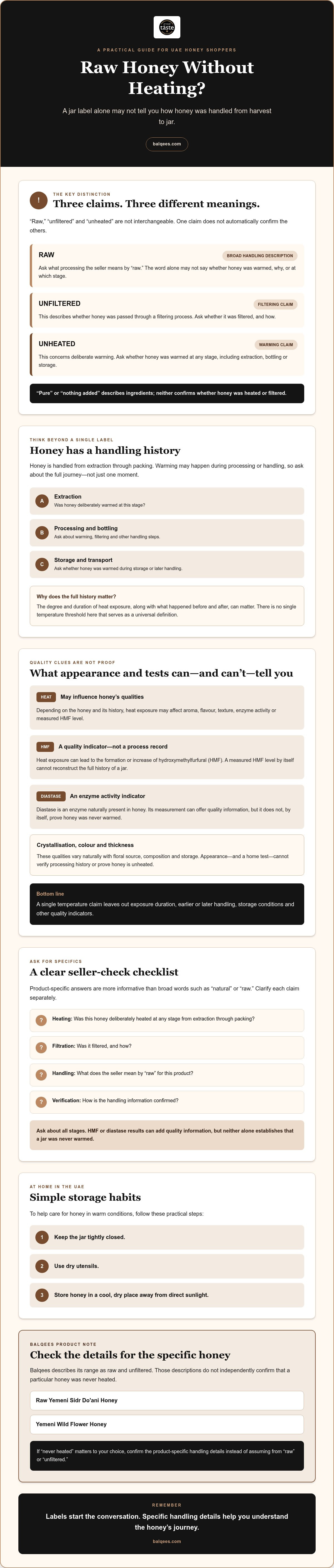
- “Raw,” “unfiltered” and “never heated” describe different things. Check the exact wording on the jar or product page.
- For a raw honey without heating UAE claim, ask the seller specifically about heating, filtration and other handling stages.
- Consider the honey’s full handling history, since both heat exposure and its duration can matter.
- Help protect honey in the UAE climate by keeping it tightly closed, using dry utensils and storing it in a cool, dry place away from direct sunlight.
- Balqees offers Raw Yemeni Sidr Do'ani Honey and Yemeni Wild Flower Honey. Check product-specific details before assuming either has never been heated.
What Does Raw Honey Without Heating Mean?
Raw honey without heating is honey whose seller confirms it hasn’t been deliberately warmed during processing. That is a specific handling claim, not something shoppers can safely infer from the word “raw” alone. Honey naturally varies in flavour, colour and texture according to its source. Those qualities don’t, by themselves, reveal how it was processed.
Honey is handled in several stages, from extraction through packing. A general overview of Honey can help explain its production and properties, but a product’s processing history requires product-specific information. The key is to distinguish the honey’s natural characteristics from claims about heating, filtering or added ingredients.
Does raw honey always mean honey was never heated?
No. “Raw” appears on product descriptions, but the word alone may not explain whether honey was warmed, why it was warmed or at which stage. Handling practices vary, and there is no single temperature threshold to apply here as a universal definition. Any proposed legal or industry definition should be checked against an authoritative source relevant to the product’s market.
A label is a starting point, not a full process record. Look for specific details and ask the seller to clarify anything the description leaves open.
Raw, unfiltered, and unheated: what is the difference?
These terms describe different aspects of honey. “Raw” is a broad description of handling, “unfiltered” refers to filtering, and “unheated” is a claim about exposure to deliberate warming. One claim doesn’t automatically establish the others. Ask about each separately rather than treating them as synonyms.
| Term | What it describes | What to clarify |
|---|---|---|
| Raw | A broad description of how honey was handled. | What processing does the seller mean by “raw”? |
| Unfiltered | Whether honey was passed through a filtering process. | Was it filtered, and how? |
| Unheated | Whether deliberate warming was used. | Was it warmed at any stage, including extraction, bottling or storage? |
Processing claims are also distinct from ingredient claims. “Pure” or “nothing added” may describe ingredients, but neither confirms whether honey was heated or filtered. Natural crystallisation or a particular texture can’t verify processing history either.
Shopper question: “Was this honey deliberately heated at any stage from extraction through packing, and how is that handling information verified?”
How Heating and Processing Can Change Honey
Heating can be one stage in honey’s journey, but practices differ. Honey may be warmed during processing or handling, and a jar’s quality can reflect more than a single moment. The degree and duration of exposure, along with what happened before and after, all matter. A seller’s description should explain the handling rather than assume every honey follows the same process.
Heat may affect honey’s delicate aroma and flavour, as well as some of its naturally occurring components. Research on the deleterious effects of heating honey discusses chemical changes, including the formation or increase of hydroxymethylfurfural (HMF) under heat exposure. Diastase, an enzyme naturally present in honey, can also be measured as an indicator of enzyme activity. These measurements can offer useful quality information, but neither one, by itself, reconstructs the full history of a jar.
A single temperature claim cannot establish a jar’s complete processing history because it leaves out exposure duration, earlier or later handling, storage conditions and other quality indicators. For shoppers seeking raw honey without heating UAE, specific answers about each stage are more informative than a standalone number or broad label.
What can heat exposure mean for honey quality?
Depending on the honey and its history, heat exposure may influence its aroma, flavour, texture, enzyme activity or measured HMF level. The effect isn’t determined by temperature alone. Duration and prior storage matter too. HMF and diastase results are indicators, not proof that honey was never warmed. A clear processing explanation should accompany any quality data.
Does crystallisation prove honey was not heated?
No. Crystallisation is a natural property of many honeys, and its timing and texture can vary with floral source, composition and storage. Some honey crystallises sooner or more visibly than other honey. Colour and thickness vary naturally as well, so appearance can’t verify that a jar is unheated or authentic. Nor can a home test establish its processing history. Ask the seller instead.
Balqees describes its range as raw and unfiltered, but those terms don’t independently confirm that a particular honey was never heated. You can review the Balqees raw and unfiltered honey range, then ask about product-specific handling if “never heated” is important to your choice.
How to Check a “Raw Honey Without Heating UAE” Claim
If you’re looking for raw honey without heating UAE, start with the exact wording on the jar or product page. Then check whether the seller explains what that wording means for the specific honey. A clear claim should distinguish heating from filtration and ingredient information, rather than leaving shoppers to fill in the gaps.
A practical checklist for assessing the claim
- 1. Record the exact wording. Note whether the label says “raw,” “unfiltered,” “unheated” or something else. These terms aren’t interchangeable.
- 2. Ask about heating directly. Was the honey deliberately warmed at any stage, including extraction, processing, bottling or storage? Ask for details about the product you’re considering.
- 3. Clarify “raw” and “unfiltered” separately. Ask what the seller means by each term for this particular honey, and whether any filtration takes place.
- 4. Ask about other handling and ingredients. Find out how the honey is handled before packing and whether anything has been added. An ingredient statement doesn’t, by itself, describe heating or filtration.
- 5. Request relevant documents if available. Batch records or laboratory results may add context. Check which product or batch they cover, what was measured and whether the document addresses heating history at all.
Which labels and tests are useful, and what are their limits?
Read label statements as separate pieces of information: origin tells you where the honey is said to come from; an ingredient list addresses what is included; “unfiltered” concerns filtration; and “unheated” concerns temperature handling. One statement doesn’t verify another. If a seller shares laboratory results, ask what the test measures and whether it applies to the batch in your jar. A result can speak only to its stated scope. It shouldn’t be treated as proof of every step in the honey’s history.
Appearance and home experiments have limits, too. Taste, thickness, colour, crystallisation and water tests can’t independently confirm that honey was never heated. They may reflect natural variation or storage, not a complete processing record. For sourcing context, explore this guide to how sustainable beekeeping is practised. Sourcing information can add context about honey’s origins, but product-specific answers are still needed to assess a heating claim.
A straightforward seller response should address the exact product and the handling stages you ask about. If the answer remains broad, treat “raw” as a general description rather than confirmation that the honey was never heated.
Buying and Storing Raw Honey in the UAE
For shoppers across the UAE, choosing raw honey involves more than reading the front label. Before ordering, check the product’s stated origin, ingredient description and handling details, then ask about anything unclear. If you’re seeking raw honey without heating UAE, sellers should be able to clarify what their particular product claims mean instead of relying on a general description alone.
What should UAE shoppers check before ordering honey?
Look for distinct information about where the honey comes from, what it contains, whether it’s filtered and how it has been handled. These details answer different questions. You can also ask how the seller protects product quality during storage and dispatch, without assuming a particular delivery method or temperature practice. For more guidance on evaluating online purchases, read this guide to buying raw honey online in the UAE.
A seller’s reply is most useful when it addresses the exact product and explains what is known about its handling. Compare the response with the original label or product page:
| Useful answer | Vague or unverifiable answer |
|---|---|
| Explains whether the specific honey was warmed during processing or packing. | Repeats “natural” or “raw” without describing handling. |
| Clarifies filtration separately from heating. | Uses “unfiltered” as if it automatically means “never heated.” |
| Shares relevant batch or test documents when available and explains what they cover. | Offers a document without identifying the product, batch or test scope. |
How should raw honey be stored at home?
Once your honey arrives, keep it in a tightly closed container in a cool, dry place away from direct sunlight and sources of heat. Use a clean, dry utensil each time; introducing moisture or food particles can affect what’s in the jar. In a warm UAE home, a shaded, dry cupboard is a practical choice, provided it follows the product’s own storage guidance.
Crystallisation is a natural change in many honeys and doesn’t automatically mean the honey has spoiled. It also doesn’t prove that the honey was never heated. Avoid treating texture as a quality test, and don’t assume refrigeration or reheating is necessary. Follow the product-specific instructions, and contact the seller if storage advice or handling claims aren’t clear.
To compare a brand’s stated sourcing and product descriptions, explore Balqees raw and unfiltered honey. Check the details for the specific honey you’re considering, and ask the seller directly if you need confirmation about its heating history.
Choosing Raw Honey Without Heating: What Balqees Shoppers Can Confirm
A careful choice begins with the jar, not an assumption. Identify the exact product, read the wording used to describe it, then ask about handling details that aren’t stated. This evidence-first approach helps distinguish a broad “raw and unfiltered” description from a specific claim that honey was never heated.
What Balqees product information is confirmed?
Balqees describes its honey range as raw and unfiltered and highlights artisanal beekeeping and Yemeni heritage. Confirmed offerings include Raw Yemeni Sidr Do'ani Honey and Yemeni Wild Flower Honey. These details provide context about the brand and its range, but they don’t establish the heating history of either named product.
That distinction matters if “raw honey without heating UAE” is the specific claim you’re trying to verify. A product name, origin or general range description can’t take the place of product-specific information about processing and handling. Don’t infer that a particular jar was never heated unless the seller confirms this for that product.
What should you confirm before choosing a jar?
Before buying, match your questions to the exact product page or jar. Check the terms used, then ask Balqees directly whether that particular honey was deliberately warmed at any stage, including during extraction, processing or bottling. Ask separately what “raw” and “unfiltered” mean for the product. If supporting information is available, clarify which product or batch it covers and what it verifies.
A thoughtful answer should address the question asked. If the response only repeats “raw” or “unfiltered,” it may clarify the brand’s description but doesn’t confirm a never-heated history. Keep the claims distinct, and make your choice based on what’s stated and what the seller can confirm, rather than appearance or assumptions about origin.
For more background on the heritage and qualities associated with this variety, read the guide to raw Yemeni Sidr Do'ani honey. Then review the details for the specific honey you’re considering and confirm any unanswered handling questions before choosing. Explore Balqees honey and review product details.
Make Your Honey Choice with Confidence
To choose raw honey without heating UAE shoppers can feel confident about, start with clear, product-specific information. Remember that “raw,” “unfiltered” and “never heated” describe different things. Check the exact wording, then ask the seller about heating and handling at each stage. A label or a jar’s appearance alone can’t establish its full history.
Once you’ve chosen, follow the product’s storage guidance. A tightly closed jar, dry utensils and a cool, dry place away from direct sunlight help you care for honey thoughtfully in the UAE climate.
Balqees describes its honey as raw and unfiltered, with confirmed offerings including Raw Yemeni Sidr Do'ani Honey and Yemeni Wild Flower Honey. Its story is rooted in artisanal beekeeping and Yemeni heritage, but those broad descriptions don’t confirm that a specific product has never been heated. Review the details and ask about the handling of the exact honey you’re considering.
Explore Balqees honey and review product details. With careful questions and clear information, you can choose a jar with greater confidence and savour its character with appreciation.
Frequently Asked Questions
Is raw honey always unheated?
No. “Raw” alone doesn’t tell you every step in a honey’s handling history. Sellers may use the term differently, and a product description may not say whether the honey was warmed during extraction, processing or bottling. Check the wording on the jar or product page, then ask the seller what “raw” means for that specific product. Treat “never heated” as a separate claim that needs a direct, product-specific answer.
Can raw honey be heated and still be called raw?
That depends on how the seller uses the term, so don’t assume there’s one universal meaning based on a label alone. Some descriptions use “raw” broadly without explaining whether any warming occurred. Ask whether the honey was deliberately heated at any stage and how the seller defines “raw” for that jar. If you need assurance that it was never heated, look for an explicit answer rather than relying on the word “raw.”
How can I tell if honey has been heated?
You usually can’t determine a jar’s heating history from appearance, taste or a home test. Colour, thickness and flavour vary naturally, and crystallisation isn’t a reliable heating test. Ask the seller about handling during extraction, processing and bottling. If laboratory results or batch documents are offered, check what they measure and which product or batch they cover. Such records may add context, but don’t necessarily prove every stage of the honey’s history.
Does crystallised honey mean it has not been heated?
No. Crystallisation is a natural change in many honeys, but it can’t verify that a jar was never heated. How quickly honey crystallises and what its texture looks like can vary with its floral source, composition and storage. Liquid honey isn’t proof of heating either. Treat crystallisation as a change in texture, not a test of authenticity or processing, and ask the seller about handling if that history matters to you.
Does UAE heat affect raw honey?
Warm conditions make thoughtful storage important, but the temperature around a jar at home doesn’t reveal how it was processed before purchase. Prolonged heat exposure can affect honey’s qualities, while the result depends on its exposure and history. Keep the jar closed and away from direct sunlight and heat. If you’re concerned about storage during handling or dispatch, ask the seller how the specific product is stored and what guidance applies after it arrives.
What should I ask before buying raw honey without heating in the UAE?
Start with the exact product and wording on its label or page. Ask: “Was this honey deliberately heated at any stage, including extraction, processing or bottling?” Then ask separately what “raw” and “unfiltered” mean for that product. You can request batch records or test documents if available, but check their scope. These questions help you assess raw honey without heating UAE claims without treating broad labels as proof of a complete handling history.
How should I store raw honey at home?
Keep honey in a tightly closed container in a cool, dry place away from direct sunlight and heat. Use a clean, dry utensil each time, since moisture or food particles can affect the contents. Crystallisation doesn’t automatically mean the honey has spoiled. Follow the storage instructions for your specific product, and don’t assume refrigeration or reheating is needed. If the label doesn’t make storage clear, ask the seller for product-specific guidance.


