


What if the purest, most potent nectar on earth doesn't come from lush, rain-soaked meadows, but from a sun-scorched canyon carved into arid rock? For centuries, Wadi Doan valley honey has been cherished as liquid gold, legendary for its dense amber hue, warm caramel notes, and remarkable enzymatic richness. If you have ever felt hesitant about investing in a jar, you aren't alone. Discerning authentic harvest origins from heated, adulterated syrups that crowd the market is genuinely difficult.
You shouldn't have to wonder whether your honey retains its living vitality or if it's merely flavored sugar. You deserve to experience the untouched purity and ancient heritage that genuine Sidr nectar promises. In this guide, you'll discover what makes Wadi Doan valley honey the most revered raw nectar in the world.
Together, we will explore this remote desert valley terroir, uncover how to identify authentic sensory profiles, and help you confidently source pure Raw Yemeni Sidr Do’ani Honey.
Key Takeaways
- Understand how the arid desert canyon climate and mineral-rich limestone soil make genuine Wadi Doan valley honey distinctly potent and sought-after.
- Learn about the ancient nomadic apiculture traditions that protect honeybee vitality without synthetic chemicals or artificial feeding.
- Discover what separates canyon-harvested Sidr from other world nectars through its rich viscosity, warm butterscotch aromatics, and unique resistance to crystallization.
- Master physical sensory tests to identify authentic raw Do'ani nectar and protect yourself against heated, adulterated syrups.
- Integrate unheated Sidr into your daily wellness rituals to safeguard its beneficial living enzymes and delicate floral notes.
What Is Wadi Doan Valley Honey and Why Is It Legendary?
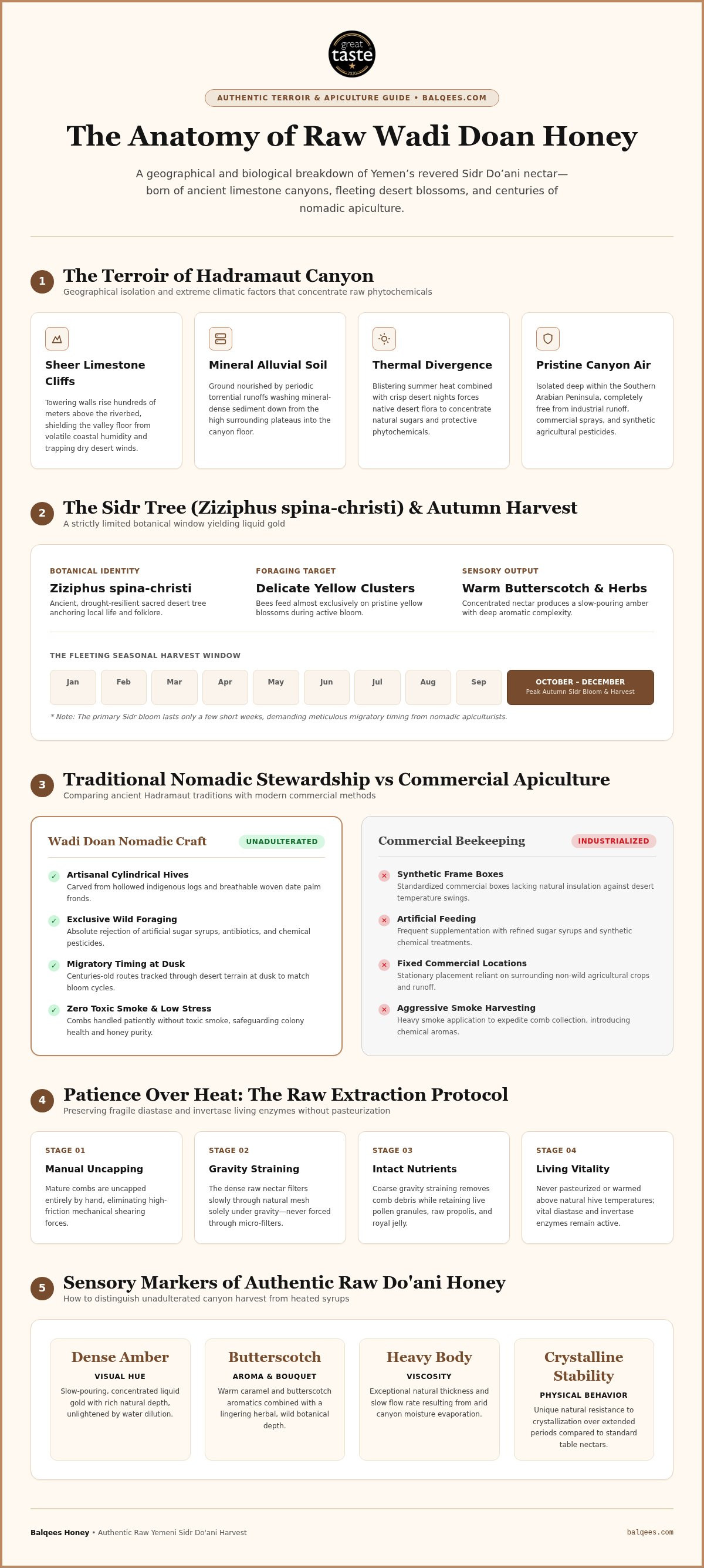
Carved deep into the Southern Arabian Peninsula, the Wadi Doan valley in Yemen's Hadramaut governorate forms a landscape unlike any other on earth. It is a dramatic desert canyon framed by sheer rock faces, shielded from coastal humidity, and rooted in ancient alluvial soil. Here, centuries of geographical isolation have preserved an untouched ecosystem where wild trees flourish without human interference. What emerges from this stark environment is extraordinary. Wadi Doan valley honey is a dense, slow-pouring amber elixir prized for its complex depth, natural enzymatic vitality, and rich apicultural heritage. It isn't just sweet syrup. It is centuries of botanical memory concentrated into liquid gold.
The Unique Terroir of Hadramaut Canyon
Terroir dictates character. In Wadi Doan, towering limestone cliffs rise hundreds of meters above the riverbed, trapping dry desert winds while sheltering the valley floor from volatile weather patterns. The ground beneath is mineral-dense, fed by periodic torrential runoffs that wash mineral rich sediments down from the surrounding plateau. Under blistering summer heat and crisp winter nights, native desert plants concentrate their sugars and protective phytochemicals to survive. In this pristine canyon air, bees gather nectar entirely free from synthetic pesticides, commercial sprays, or industrial runoff.
The Sacred Sidr Tree (Ziziphus Spina-Christi)
At the heart of this remote canyon ecosystem stands the wild Sidr tree, known botanically as Ziziphus spina-christi. Revered across regional wellness traditions for thousands of years, this resilient tree anchors local life and folklore. It blooms briefly during seasonal transitions, creating an intense, limited window for nectar gathering:
- Fleeting Bloom Cycles: The primary Sidr bloom lasts only a few short weeks, demanding meticulous timing from apiculturists.
- Pure Foraging: During the peak autumn harvest between October and December, bees feed almost exclusively on the delicate yellow blossom clusters.
- Potent Botanical Profile: Sidr blossoms yield a rich nectar that gives unheated Do'ani honey its warm butterscotch aroma, lingering herbal depth, and thick consistency.
Nomadic Apiculture: How Wadi Doan Honey Is Harvested
True honey is born of human patience and instinctive harmony with the natural world. Across the canyon floors, nomadic beekeepers maintain migratory routes that have remained virtually unchanged across centuries. They track desert flowering cycles across rugged terrain, moving their colonies at dusk to follow the fleeting Sidr blooms. This careful migration sustains the fragile honey value chain in Yemen, where apiculture is not an aggressive commercial industry, but a sacred generational craft. Through thoughtful stewardship, these keepers protect colony vitality and keep the harvest uncorrupted.
Centuries of Traditional Hive Craft
Commercial frame boxes have little place in this rugged landscape. Instead, artisanal beekeepers craft cylindrical hives from hollowed indigenous logs and woven date palm fronds. These breathable structures shield desert bees from daytime heat while insulating them against brisk canyon nights. Beekeepers reject artificial sugar syrups, antibiotics, and chemical pesticides entirely. The bees forage solely on wild blossoms. During harvest, apiculturists work patiently without toxic smoke, handling each comb gently to reduce colony stress and maintain the pristine quality of Wadi Doan valley honey.
Raw Cold-Extraction and Minimal Filtration
Commercial processors often rely on intense heat and micro-filtration to speed up bottling, but these methods strip away the honey's living essence. In the canyon, extraction is governed by patience and minimal intervention:
- Gravity Straining: Mature combs are uncapped by hand, allowing the dense nectar to filter slowly through natural mesh solely under gravity.
- Intact Botanical Compounds: Coarse straining removes bits of comb while preserving live pollen granules, natural propolis, and traces of royal jelly.
- Living Enzymatic Activity: Because the nectar is never pasteurized or warmed above natural hive temperatures, vital diastase and invertase enzymes remain active and biologically intact.
This ancient, unheated approach ensures that every jar of unadulterated Raw Yemeni Sidr Do'ani Honey arrives on your table exactly as nature intended, full of living vitality and deep terroir.
Wadi Doan Sidr vs Other Nectars: A Comparative Analysis
Every honey tells the story of its ground. When you sample monofloral varieties from across the globe, you taste the direct influence of geology, rainfall, and botany. While standard commercial options originate from monocultural farmland, true desert nectar reflects an unforgiving climate. In this extreme setting, plants produce defensive secondary metabolites to survive. This makes authentic Wadi Doan valley honey exceptionally dense in antioxidants, phenolic compounds, and bioflavonoids, setting it apart from common table honeys.
Viscosity provides an immediate sensory clue. Because desert air holds minimal ambient humidity, bees naturally reduce moisture levels below 16% without human intervention. The result is a heavy, slow-pouring texture that coats the palate with an unctuous finish rarely found in high-rainfall climates.
Wadi Doan Sidr vs New Zealand Manuka
Global connoisseurs often compare Yemeni Sidr with New Zealand Manuka, yet their biochemical signatures and sensory profiles diverge significantly:
- Bioactive Drivers: Manuka’s potency is primarily measured through methylglyoxal (MGO) content, whereas Sidr’s strength stems from high bioflavonoid density, exceptional enzymatic stability, and potent mineral content.
- Aromatic Profile: Manuka presents a pungent, medicinal bite with earthy, damp undertones. Sidr unfolds with luscious warm butterscotch, smoky resin, and subtle notes of dried date.
- Culinary Pleasure: While Manuka is often taken strictly as a therapeutic supplement, raw Do'ani nectar effortlessly bridges medicinal use and refined gastronomic enjoyment.
Doan Valley Nectar vs Wild Flower and White Honey
A broader exploration of rare honey varieties reveals just how distinct canyon Sidr truly is. Pale alpine varieties, like high-altitude white mountain harvests, offer a silky, whipped texture and delicate vanilla-floral whispers. They are light, rapid to crystallize, and refreshing on the palate.
Multi-floral wild flower blends, gathered from scattered desert blossoms, provide gentle daily sweetness with mild acidity. In contrast, Wadi Doan valley honey presents a rich, dark amber profile built on singular botanical intensity. It lingers on the palate long after tasting, offering an earthy complexity that lighter mountain and meadow honeys simply cannot duplicate.
How to Identify Authentic Raw Wadi Doan Valley Honey
Because genuine harvest yields are inherently limited, counterfeit syrups frequently crowd the market. Industry estimates suggest that between 70% and 80% of products sold globally under the Yemeni Sidr label are adulterated or heated imitations. Protecting your pantry requires a keen eye and sensory awareness. Genuine Wadi Doan valley honey possesses distinctive physical characteristics that industrial syrups and diluted blends simply cannot replicate.
Sensory Markers: Aroma, Color, and Consistency
Engage your senses before consuming. True Do'ani honey displays a rich, warm amber hue that slowly deepens over time without losing clarity. Its texture is remarkably thick and dense. When poured from a wooden spoon, it flows in a continuous, heavy ribbon rather than splashing in thin droplets.
- Aroma: An authentic jar opens with notes of sun-baked earth, cedar, dried dates, and subtle resin. If it smells like plain caramel or neutral sugar syrup, it has likely been adulterated.
- The Water Test: Drop a spoonful into a glass of cool water. Pure unheated Sidr settles at the base in a dense globule, requiring vigorous stirring to dissolve.
- Crystallization Habits: Due to its high natural fructose-to-glucose ratio, authentic raw Doan Sidr remains liquid for years, resisting the rapid, granular crystallization common in cold-climate honeys.
Provenance and Laboratory Testing Standards
Sensory observation is your first line of defense, but verifiable documentation provides total peace of mind. We outline the full testing protocols in our guide on how to identify pure honey. Reputable purveyors rely on professional laboratory analysis to verify genuine botanical origins:
- Melissopalynology: Microscopic pollen analysis confirms a dominant concentration of wild Ziziphus spina-christi pollen grains.
- Enzymatic Integrity: Testing confirms intact diastase and invertase levels, proving the harvest was never heated or pasteurized.
- Moisture Analysis: Arid canyon conditions naturally keep moisture levels exceptionally low, preventing fermentation and preserving stability.
Demand total transparency from hive to bottle. Order certified Raw Yemeni Sidr Do'ani Honey directly from Balqees to experience the true, unadulterated essence of the Hadramaut canyon.
Integrating Authentic Do’ani Honey into Daily Wellness
Bringing unheated canyon honey into your modern routine is an invitation to slow down. For generations across Southern Arabia, pure raw nectar has served as an essential restorative element rather than a casual sweetener. Savoring authentic Wadi Doan valley honey honors both your physical well-being and the ancient apicultural traditions that produced it. Protecting its delicate living components requires mindful handling.
Never add raw honey to boiling liquids or bake it at high oven temperatures. Intense heat swiftly denatures vital diastase and invertase enzymes, neutralizing the natural therapeutic profile you sought in the first place. Instead, treat unheated nectar gently. Let warm beverages cool to drinking temperature before stirring, or enjoy it directly from a wooden spoon to preserve its full vitality.
Morning and Evening Wellness Rituals
Mindful habits build vibrant health over time. Starting your morning with raw nectar creates a grounding digestive practice that sets a steady tone for the hours ahead:
- Morning Hydration: Dissolve one teaspoon of raw nectar into a glass of lukewarm or room-temperature water each morning on an empty stomach to awaken digestion gently.
- Daily Vitality: Explore foundational routines in our complete guide to honey for daily wellness.
- Evening Rest: Enjoy a small spoonful an hour before bed. The balanced natural fructose helps steady nocturnal liver glycogen stores, encouraging restorative relaxation throughout the night.
- Artisanal Pairings: Drizzle pure nectar over aged goat cheese, fresh labneh, or raw walnuts for a rich sensory contrast of salt, fat, and floral sweetness.
Sourcing Ethical Honey Nationally
Every conscious purchase directly sustains the traditional nomadic beekeepers who navigate steep desert passes to steward these wild Sidr groves. Transparent sourcing ensures these multi-generational apicultural communities thrive despite regional challenges. If you want to experience genuine artisanal nectar at home, learn how to buy raw honey online in the UAE with complete confidence.
Since 2013, Balqees Honey has worked directly with traditional Yemeni beekeeping lineages to bring pure, unheated, and unfiltered harvests straight to discerning pantries. Savoring authentic Wadi Doan valley honey connects you to a timeless lineage of pure apiculture, uncompromised craftsmanship, and nature's finest liquid gold.
Embrace the Living Legacy of Hadramaut
The dramatic desert canyons of Hadramaut yield something truly peerless. When you taste authentic Wadi Doan valley honey, you aren't just enjoying rich butterscotch notes and thick amber density. You are partaking in the uncompromised resilience of wild Sidr trees, safeguarded by generations of nomadic beekeepers who refuse heat treatment and industrial shortcuts.
Honoring this sacred craft is at the heart of our philosophy. Founded in 2013 by honey artisan Riath Hamed, Balqees Honey collaborates directly with traditional beekeepers to deliver pure, raw, and unfiltered nectar directly to discerning pantries. Arriving safely in protective glass jars with fast nationwide delivery, each harvest preserves its living enzymatic vitality from the remote canyon floor to your spoon.
Elevate your daily rituals with nectar shaped by centuries of sun, rock, and patient craftsmanship. Experience the rare luxury of Raw Yemeni Sidr Do’ani Honey at Balqees Honey and discover nature's most reverent liquid treasure.
Frequently Asked Questions
Why is Wadi Doan valley honey considered more valuable than other honeys?
Wadi Doan valley honey commands exceptional value due to its scarce harvest yields, remote canyon microclimate, and labour-intensive nomadic apiculture. The wild Sidr trees flower only for brief weeks each year in rugged, inaccessible terrain. Because traditional beekeepers avoid commercial sugar feeding, pasteurization, and chemical pesticides, every jar yields an extraordinarily concentrated, biologically active nectar that simply cannot be mass-produced.
What floral source is responsible for authentic Wadi Doan honey?
Authentic Do'ani honey comes from the blossoms of the wild Sidr tree, botanically known as Ziziphus spina-christi. This resilient desert tree thrives across Hadramaut's arid canyons, tapping into deep subterranean mineral deposits. During the autumn flowering cycle, native bees forage exclusively on these small, fragrant blossom clusters, creating a monofloral nectar renowned for its warm butterscotch notes, rich amber color, and high bioflavonoid density.
Does raw Wadi Doan Sidr honey ever crystallize over time?
Genuine raw Doan Sidr resists crystallization far longer than most floral honeys, often remaining smoothly liquid for several years. This stability happens naturally because of its exceptionally high fructose-to-glucose ratio and low moisture content. While cool temperatures may eventually cause slight granulation over an extended period, rapid, chalky solidifying typically indicates high glucose levels, floral dilution, or the addition of commercial sugar syrups.
Can I heat or cook with raw Yemeni Sidr Do’ani honey?
You shouldn't heat or cook with pure Raw Yemeni Sidr Do’ani Honey. Exposing raw nectar to temperatures above 40°C rapidly destroys its delicate invertase and diastase enzymes, alongside its heat-sensitive antioxidants. To protect its active wellness properties, always enjoy it raw. Drizzle it over warm dishes immediately before serving, or let infusions cool to a comfortable drinking temperature before stirring it in.
How should I store pure raw honey to protect its active enzymes?
Store your honey in an airtight glass jar at stable room temperature, away from direct sunlight and heat sources. Natural desert nectar has a remarkably low moisture profile, so refrigeration isn't necessary and can actually encourage unwanted moisture condensation. Keep the lid sealed tightly to prevent humidity absorption from the surrounding air, and always use a clean, dry wooden or ceramic spoon when dipping.
What is the best time of day to consume raw Sidr honey?
The ideal time to consume raw Sidr nectar is first thing in the morning on an empty stomach. Taking a single spoonful alone or dissolved into room-temperature water allows your digestive system to absorb its live enzymes and natural sugars smoothly. Alternatively, taking a spoonful an hour before sleep supports overnight liver glycogen balance, fostering calm and restful evening restoration.


