


What makes a jar of Yemeni Sidr honey worth seeking out, and how can you tell whether it’s authentic? For anyone searching for Yemeni Sidr honey in the UAE, the answer reaches beyond its rich, floral character. Its value is rooted in the Sidr tree, Yemen’s beekeeping heritage and the care taken to preserve honey in its raw, unfiltered form.
It’s natural to be cautious: premium honey can be difficult to assess, labels may leave questions unanswered, and different grades can blur together. Balqees Honey, founded by Riath Hamed in 2013, works with artisanal beekeepers in Yemen and offers a friendly guide to understanding what’s in the jar, where it comes from and how to enjoy it.
In this guide, you’ll discover why Yemeni Sidr is so prized, what to look for when assessing its origin and purity, and how its traditional wellness reputation fits into a thoughtful daily ritual. We’ll also explore the qualities that distinguish Sidr honey from other varieties, including Yemeni wildflower and White Mountain honey, so you can make a more informed choice when buying raw honey online in the UAE.
Key Takeaways
- Understand why Yemeni Sidr honey is prized, from its brief seasonal harvest to the heritage of Yemen’s Do’an Valley.
- Discover what to look for when assessing Yemeni Sidr honey Dubai, including clear origin details and trustworthy sourcing.
- Learn why simple at-home tests can’t reliably confirm purity and which questions can help you evaluate a honey seller.
- Explore Sidr honey’s traditional wellness uses and thoughtful ways to make it part of a daily routine.
- See how artisanal beekeeping and direct relationships with Yemeni beekeepers shape Balqees Honey’s approach to sourcing.
Understanding the Rarity of Yemeni Sidr Honey in the UAE
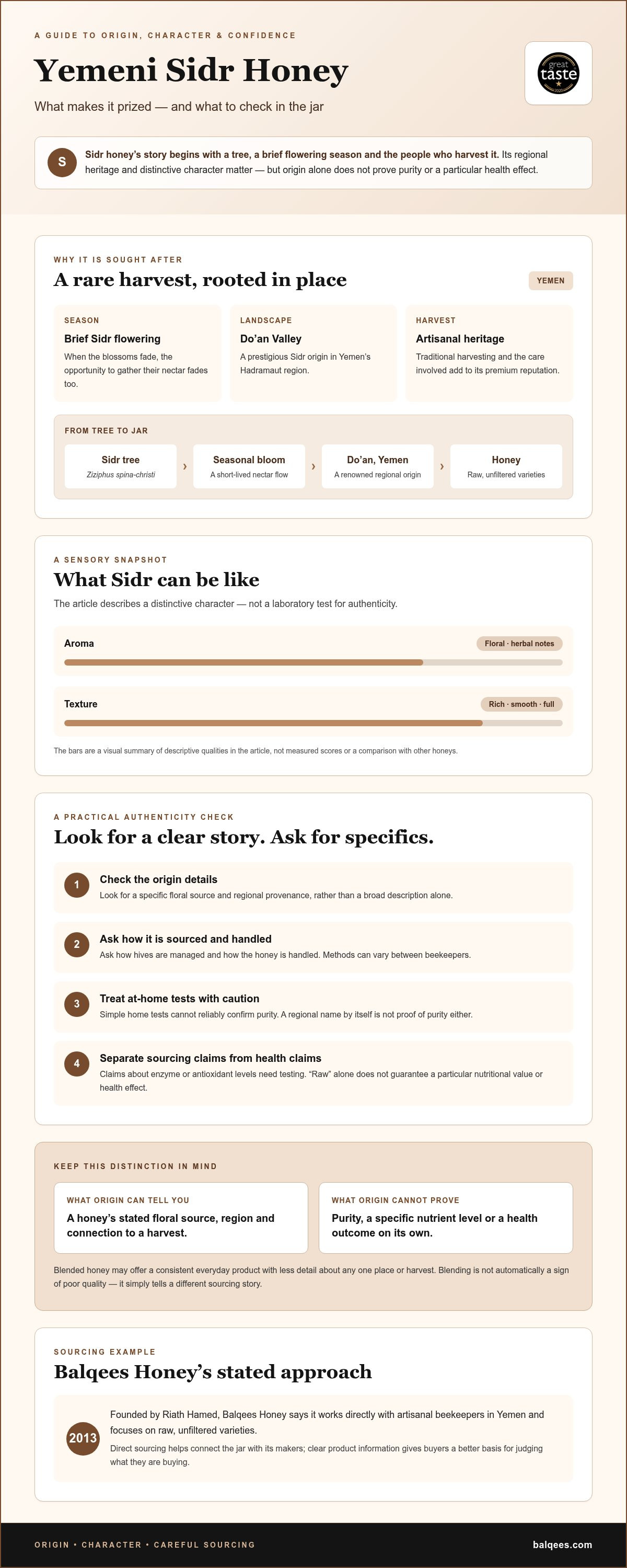
Often called the “Manuka of the Middle East,” Yemeni Sidr honey carries a heritage that reaches far beyond a modern comparison. Its character begins with the Sidr tree and a seasonal harvest that depends on a brief flowering period. When the blossoms fade, the opportunity to gather nectar from them fades too. This natural limit, alongside the care involved in traditional harvesting, helps explain why authentic Sidr honey is treated as a rare, premium food rather than an everyday sweetener.
Its “liquid gold” reputation reflects more than scarcity. Buyers are also seeking a distinctive floral, herbal aroma and a rich, smooth texture, as well as confidence in the honey’s origin. Raw Yemeni Sidr Do’ani Honey is especially prized for its association with Yemen’s Do’an region and its artisanal beekeeping heritage.
What Makes Yemeni Sidr Honey Unique?
The Sidr tree, Ziziphus spina-christi, holds cultural significance across the region and is associated with traditional uses. For botanical and historical context, see this overview of Ziziphus spina-christi. The honey’s sensory qualities offer another point of distinction: its aroma is often described as floral, with herbal notes, while its texture can feel notably full and buttery.
Raw, unfiltered honey is handled differently from honey that has been extensively processed or blended. Processing can affect its texture and natural composition, but nutrition varies between honeys; “raw” alone doesn’t establish a particular health effect or guarantee greater nutritional value. Treat it as a minimally processed food, not a medicine.
The Value of Single-Origin Honey
Origin matters because it helps you understand what the label promises. A clear floral source and regional provenance make honey easier to assess than a jar described only in broad terms. By contrast, blended supermarket honey may combine honeys from multiple sources, creating a consistent everyday product but offering less detail about any one place or harvest. Blending isn’t automatically a sign of poor quality; it simply tells a different story.
For a more informed purchase, look for specific sourcing details and ask whether the seller can explain the honey’s provenance. Balqees Honey, founded by Riath Hamed in 2013, sources from artisanal beekeepers in Yemen and focuses on raw, unfiltered varieties. That direct sourcing helps preserve a connection between the honey and its makers, while clear product information gives connoisseurs a better basis for judging what they’re buying. Distinctive character, carefully sourced.
The Sacred Origins: From the Sidr Tree to the Do'an Valley
To understand the character of Yemeni Sidr honey, follow its story back to the tree and the landscape. The Do’an Valley lies in Yemen’s Hadramaut region, a setting of rugged terrain and dry conditions. Its local climate and flowering cycle shape when bees can forage on Sidr blossoms, while the region’s remoteness and traditional harvest practices add complexity to getting honey from hive to market. The United Nations Development Programme’s report on the honey value chain in Yemen offers wider context on the challenges facing the country’s honey producers.
The Sidr tree has deep cultural and religious significance in the region. Its nectar gives the honey a distinct sense of place, but origin alone can’t prove purity or a specific level of nutrients. Soil, climate and flowering conditions can influence a honey’s character; claims about particular enzyme or antioxidant levels require evidence from testing, not just a regional name.
Artisanal Beekeeping: A Heritage of Purity
Traditional beekeeping is shaped by close attention to the bees and the seasonal landscape. In some practices, beekeepers move hives to follow Sidr blooms, giving colonies access to the short-lived nectar flow. Artisanal beekeeping is a commitment to caring for bees while respecting the heritage and natural rhythms of the land.
Methods can vary between beekeepers, so avoid assuming every producer rejects all chemicals or machinery. Ask how the hives are managed and the honey handled. Balqees Honey says it sources directly from artisanal beekeepers in Yemen and focuses on raw, unfiltered varieties, details that help connect a jar to its source.
The Do’an Valley: The Heart of Premium Honey
Do’an is widely regarded as a prestigious origin for Sidr honey, prized for its association with Yemen’s Sidr-growing landscape and traditional harvest. The valley’s geography and climate contribute to the environment in which the trees flower, but they shouldn’t be treated as proof of a particular health effect. For a closer look at the region and its honey, read The Connoisseur’s Guide to Raw Yemeni Sidr Do'ani Honey.
Extraction matters, too. Balqees Honey emphasizes raw, cold-pressed and unfiltered honey. Gentle handling and avoiding unnecessary heating can help preserve honey’s natural qualities, though no extraction description should be taken as a medical guarantee. If you’re researching Yemeni Sidr honey Dubai, look for clear origin information and ask what “cold-pressed” means in the seller’s process. You can also explore raw Yemeni Sidr Do’ani Honey as you compare sourcing details.
The Connoisseur’s Test: Identifying Authentic Yemeni Honey
A jar’s appearance can invite questions, but no single glance or kitchen trick can certify that honey is pure or truly from Yemen. Fraud and mislabelling are concerns in premium honey markets, while filtration and blending can also make a legitimate product look different from a raw, single-origin one. For anyone comparing Yemeni Sidr honey Dubai, the strongest starting point is transparent sourcing, clear labelling and a seller able to explain the honey’s origin and handling.
Raw Honey vs. Commercial Honey: The Comparison
“Commercial” describes a broad category, not a single method. Some supermarket honeys are blended or heat-treated; others may be processed differently. Raw honey is generally handled with less heat and filtration, but the label and producer’s explanation matter. Heat can reduce some naturally occurring enzymes, and filtration may remove pollen particles. Neither “raw” nor “commercial” alone proves purity, quality or a particular health benefit.
- Raw, unfiltered honey: Often retains more of its natural texture and may contain fine particles such as pollen. Colour and thickness vary by floral source and harvest.
- Processed or blended honey: May be heated, filtered or combined from different sources for a more uniform appearance and texture. Practices vary by producer.
At home, don’t rely on viral “purity tests” such as dropping honey into water, lighting it or checking whether it sticks to a spoon. These results can be affected by moisture, temperature and handling, and they can’t reliably identify added syrup. Colour and viscosity are clues to character, not proof of origin. Visible pollen or propolis may reflect less filtration, but their presence or absence doesn’t authenticate a jar.
The Connoisseur’s Purity Checklist
Use several clues together, then verify what they can’t tell you with the seller:
- Look for “raw” and “unfiltered” descriptions, plus a specific origin rather than a broad country claim alone.
- Notice the aroma. Sidr honey is often described as having a pronounced floral or herbal scent, though sensory impressions vary.
- Ask whether the seller can explain sourcing, handling and any available testing. Reputable artisanal brands should be willing to provide clear, consistent information.
Crystallisation is not a dependable authenticity test. Honey may crystallise at different rates depending on its natural sugar balance, moisture and storage conditions. Sidr honey can crystallise; it doesn’t have a rule that it will never do so or always crystallise in one distinctive way. For a more detailed guide to assessing honey, read How to Identify Pure Honey: A Connoisseur’s Checklist. Think of these checks as informed questions, not a home laboratory.
Medicinal Rituals: The Health Benefits of Yemeni Sidr Honey
Yemeni Sidr honey has a long-standing place in traditional wellness practices, and laboratory research into honey has explored antibacterial and anti-inflammatory activity. Those findings don’t establish that Sidr honey can prevent or treat illness, however. It’s best enjoyed as a food and valued for its distinctive flavour, rather than used in place of medical care. Honey is also a source of sugar, so people managing blood glucose should consider its carbohydrate content and seek advice from a healthcare professional.
For readers exploring Yemeni Sidr honey Dubai, a practical ritual can be simple: use a small spoonful to sweeten a drink or complement a meal, and pay attention to how it fits your preferences and dietary needs. There’s no established morning or evening schedule that guarantees a health benefit.
Daily Wellness Rituals with Raw Honey
- Morning: Stir honey into warm water with lemon for a comforting drink. Let the water cool slightly first, and remember that this is a flavourful ritual, not a detox or immune treatment.
- Before activity: Honey provides carbohydrates, which the body can use for energy. Raw Honey & Ginseng Fusion offers another flavour option, but don’t assume it improves athletic performance or focus.
- Evening: Add a little honey to herbal tea if you enjoy its taste. A warm drink may be soothing, but honey hasn’t been shown to guarantee better sleep.
For more ways to make honey part of everyday meals and routines, explore Honey for Daily Wellness.
Targeted Health: Functional Blends
Functional blends combine honey with botanicals, bringing their flavours together without making the blend a proven remedy. Balqees offers Black Seed Fusion and Raw Honey & Ginseng Fusion. Black seed and honey have traditional wellness associations, including respiratory and immune support, but these products shouldn’t be presented as treatments or substitutes for prescribed care. Ginseng is also used traditionally for vitality; evidence and individual responses vary, and it may not suit everyone or every medication.
Choose a blend for its ingredients and taste, read its product information, and check with a healthcare professional if you’re pregnant, managing a condition, or taking medication. Never give honey to a child under 12 months because of the risk of infant botulism. To explore Balqees’ honey and botanical blends, review the ingredients and choose a ritual that suits your needs.
Sourcing Excellence: Why Balqees is the Choice for Connoisseurs
Authenticity starts with a story a seller can explain. Balqees Honey sources directly from artisanal beekeepers in Yemen and focuses on raw, unfiltered honey, bringing traditional craft into a modern UAE pantry. Founded by Riath Hamed in 2013, the business offers a considered range that includes Raw Yemeni Sidr Do’ani Honey, Yemeni Wild Flower Honey and White Mountain Honey.
For anyone comparing Yemeni Sidr honey Dubai, direct sourcing is a useful starting point, not a substitute for asking questions. Look for clear information about the honey’s origin and handling, and check that product descriptions distinguish one variety from another. The word “unfiltered” describes handling, while a named origin helps you understand the honey’s provenance. Together, these details make it easier to choose with care.
A Commitment to Heritage and Purity
Artisanal beekeeping is closely tied to local landscapes and seasonal forage. Supporting honey sourced through these traditions can help sustain the knowledge and livelihoods behind its production, while responsible beekeeping depends on care for bee colonies and their environment. A thoughtful seller should tell you what it knows about its sourcing rather than make broad ecological promises without evidence.
Buying online can also make specialist varieties easier to explore from across the UAE. Compare descriptions, origin details and handling information before choosing. Balqees presents its raw, unfiltered approach as a link between Yemeni beekeeping heritage and everyday use; its range also includes White Mountain Honey for those curious about a different honey variety.
The Art of Giving: Premium Honey Gifting
Honey makes a considered gift because it brings together flavour, craftsmanship and a story of place. For Eid, weddings or a corporate milestone, a premium honey gift set can offer something more personal than a conventional hamper, especially for someone who enjoys discovering distinctive foods. Balqees offers honey gifting sets, with national delivery noted in its business information; check current product details and delivery information when planning a gift.
To explore ideas for presenting honey as a meaningful gift, read the guide to premium honey gift sets. Whether you’re selecting a gift or choosing a jar for your own table, let provenance, clear descriptions and careful handling guide the decision. Discover the honey range at Balqees Honey online.
Choose Sidr Honey with Confidence
Authentic Sidr honey is more than a distinctive taste. Its value lies in its connection to Yemen’s heritage, careful sourcing and the details that help you assess what’s in the jar. As you compare Yemeni Sidr honey Dubai options, prioritize clear origin information and transparent handling over appearance or at-home tests alone. And while Sidr honey has a respected place in traditional wellness, enjoy it as food rather than a substitute for medical care.
Balqees Honey brings this heritage into a modern pantry, drawing on direct relationships with artisanal Yemeni beekeepers. Founded in 2013, the brand focuses on 100% raw and unfiltered honey, including Raw Yemeni Sidr Do’ani Honey. A thoughtful choice starts with knowing the source and appreciating the craft behind each jar.
Ready to explore this distinctive honey for yourself? Experience the purity of Raw Yemeni Sidr Do'ani Honey at Balqees. Let curiosity guide your next spoonful, and enjoy discovering a tradition with a story worth savouring.
Frequently Asked Questions
Is Yemeni Sidr honey suitable for diabetics?
Yemeni Sidr honey is still a sugar-rich food, so it isn’t automatically suitable for people with diabetes. Its natural origin doesn’t remove its effect on blood glucose. If you have diabetes, ask your healthcare professional how honey may fit your meal plan, and account for its carbohydrates rather than treating it as a sugar-free sweetener. Individual needs vary, so avoid relying on honey to manage blood glucose or replace prescribed care.
What is the difference between Sidr honey and Manuka honey?
Sidr and Manuka honey come from different plants and have distinct regional and cultural histories. Sidr honey is made from nectar of the Sidr tree, while Manuka comes from the Manuka plant. Their aroma, flavour, texture and sourcing can differ by harvest and producer. Neither name alone proves purity or a particular health effect, so check the origin and handling details, and be cautious of broad claims that one is always superior.
How should I store my raw Yemeni honey to maintain its properties?
Keep raw Yemeni honey in a tightly closed container in a cool, dry place, away from direct sunlight and sources of heat. Use a clean, dry spoon to help prevent moisture or food particles from entering the jar. Refrigeration isn’t usually necessary and can make honey thicken or crystallise. Crystallisation is a natural change and doesn’t by itself mean the honey has spoiled or been adulterated.
Why is Yemeni honey more expensive than other varieties?
Yemeni honey can command a premium because some varieties are harvested during a short flowering season and gathered through artisanal practices in remote areas. Limited harvests, challenging transport and demand for distinctive, traceable origins can also contribute. The price alone doesn’t establish authenticity, though. Compare the stated floral and geographic origin, ask how the honey is sourced, and look for a seller who can explain its handling and provenance clearly.
Can I give Yemeni Sidr honey to children?
Never give honey to a child under 12 months, including raw or Sidr honey, because it can pose a risk of infant botulism. For children older than 12 months, honey may be offered as a food, in an age-appropriate amount, unless a healthcare professional has advised otherwise. Consider allergies and dietary needs, and don’t use honey as a substitute for medical advice or treatment when a child is unwell.
How can I tell if my Sidr honey is authentic and raw?
Start with the label: look for a clearly stated origin and descriptions such as “raw” and “unfiltered.” Ask the seller about beekeeper sourcing, handling and any available independent testing. A strong floral or herbal aroma and a thick texture may be characteristic, but neither proves authenticity. Water, flame and other popular home tests aren’t reliable ways to detect syrup or verify a Sidr origin.
What are the benefits of combining honey with black seed?
Honey and black seed have traditional associations with wellness, and combining them brings together their distinctive flavours. Balqees offers Black Seed Fusion, but the blend shouldn’t be treated as a proven remedy for immunity, respiratory conditions or other illnesses. Evidence for specific effects can vary, and black seed may not suit everyone or every medication. Check the ingredient information and consult a healthcare professional if you have a condition or take medicines.
Does Balqees offer national delivery across the UAE?
Balqees sells honey through its online store, with customers across the United Arab Emirates able to purchase products for direct delivery. The range includes Raw Yemeni Sidr Do'ani Honey, Black Seed Fusion, Raw Honey & Ginseng Fusion and honey gifting sets. Delivery details can vary, so check the current information on the website before ordering. If you’re searching for Yemeni Sidr honey Dubai, review the product’s origin and handling details as well as delivery information.


