


What if the amber liquid in your jar isn't just a sweetener, but a rare botanical record of a single valley's ancient ecosystem? Pure. Untouched. Meticulously handled. For the discerning palate, the various types of Yemeni honey represent the pinnacle of artisanal craft. Yet, the market is often clouded by high prices and the shadow of counterfeit labels. You've likely felt that sting of uncertainty when trying to justify the cost of a premium Sidr honey or wondered if the flavor profile truly matches your expectations.
It's understandable to seek clarity before investing in something so precious. This guide provides a clear framework to help you distinguish between the legendary harvests of the Hadramaut region with absolute confidence. We'll explore the medicinal potency of Sidr, the deep character of Sumur, and the vibrant notes of Wildflower varieties. By the end, you'll know exactly how to identify authentic jars and which honey best serves your personal wellness ritual.
Key Takeaways
- Discover how the diverse micro-climates of Yemen's mountain peaks and coastal plains create the unique terroir behind the world's most sought-after "liquid gold."
- Learn why the sacred Sidr tree and the specific geography of the Wadi Do'an valley produce a honey recognized as the global gold standard for its medicinal potency.
- Gain a clear understanding of the distinct flavor profiles and therapeutic benefits of various types of Yemeni honey, from the deep notes of Sumur to the floral highland symphony of Wildflower.
- Master a simple selection framework to verify authenticity by evaluating the dense viscosity and complex, sensory-rich aromas that define truly raw, artisanal honey.
- Identify the perfect addition to your daily wellness ritual by matching specific honey varieties to your personal palate and health goals.
The Heritage of Yemeni Honey: Why Origin Matters
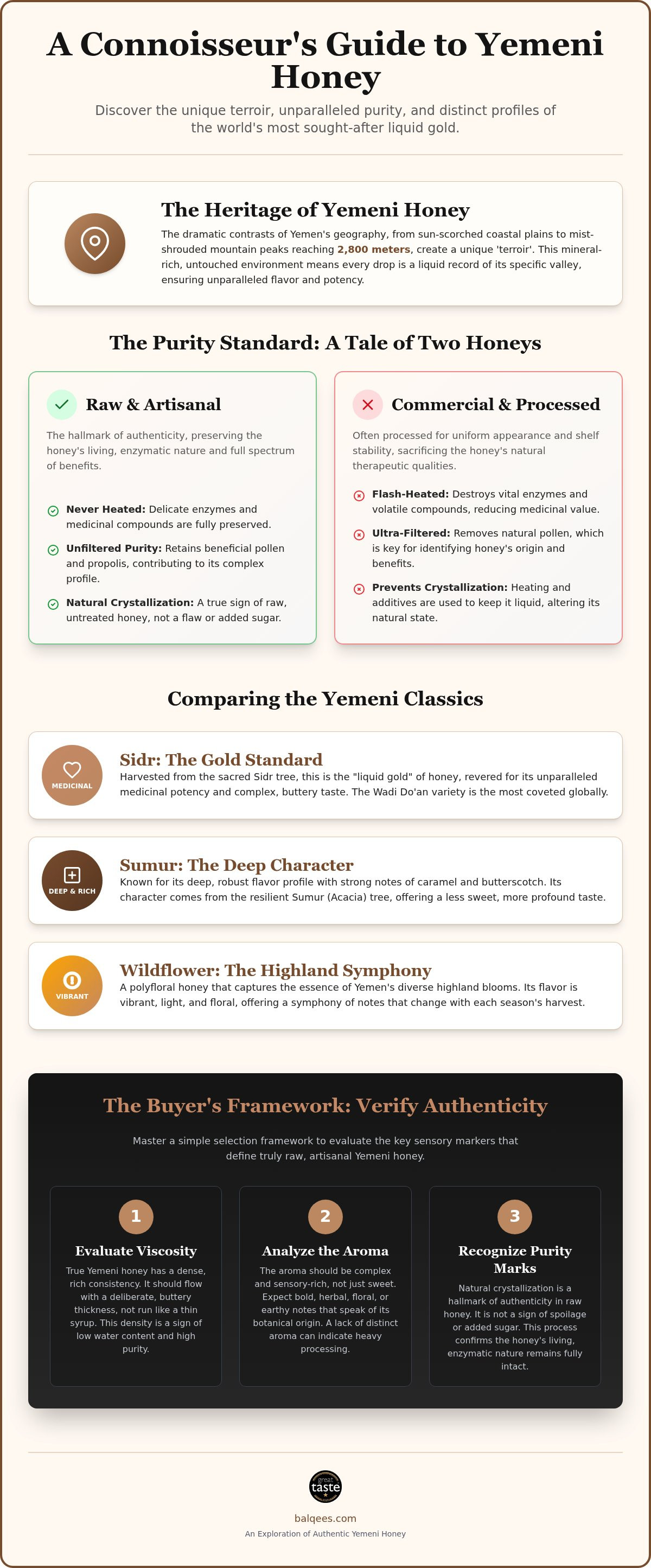
Yemen is a land of dramatic contrasts, where the geography itself dictates the soul of its nectar. From the sun-scorched coastal plains to the mist-shrouded mountain peaks reaching 2,800 meters, the landscape is a patchwork of ancient micro-climates. This environmental diversity is what gives rise to the various types of Yemeni honey, each serving as a liquid record of its specific valley or highland range. The soil here is mineral-rich and largely untouched by industrial farming, ensuring that every drop of honey carries the raw, untamed essence of the earth. This is the concept of 'terroir' in its purest form, where the unique mineral profile of the ground directly influences the flavor and medicinal potency of the final harvest.
The Ancient Art of Yemeni Beekeeping
Beekeeping in Yemen is far more than an industry; it's a sacred inheritance passed down through generations. Knowledge isn't found in modern manuals but is whispered from father to son among nomadic tribes who follow the seasonal blooms across rugged terrain. These artisans shun modern chemicals and antibiotics, relying on the natural resilience of the bees and the purity of their surroundings. The Heritage of Yemeni Honey is deeply rooted in these traditional methods that have remained unchanged for centuries, preserving a level of purity that is increasingly rare in the modern world. Yemeni honey is globally recognized as the most expensive and rare because of its labor-intensive traditional harvesting methods and the extremely limited, seasonal flowering of its unique botanical sources.
Raw vs. Commercial: The Purity Standard
For the true connoisseur, the terms 'raw' and 'unfiltered' are non-negotiable. Commercial honey is often flash-heated to prevent crystallization and simplify the bottling process, but this high-heat treatment destroys the delicate enzymes and volatile medicinal compounds that make Yemeni varieties so legendary. When you explore the differences between raw honey vs commercial honey, you'll find that temperature sensitivity is the primary guardian of quality. True Yemeni honey is never subjected to industrial heat. Natural crystallization isn't a sign of spoilage or added sugar; rather, it's a hallmark of authenticity and a sign that the honey's living, enzymatic nature remains intact. This commitment to raw purity ensures that the types of Yemeni honey you select retain their full spectrum of antioxidants and antibacterial properties.
The result of this meticulous, non-industrial approach is a product that feels less like a commodity and more like a piece of history. Each jar reflects a specific moment in time, a particular bloom, and a traditional craft that refuses to compromise with the speed of the modern world. By choosing honey with a clear provenance, you're not just selecting a sweetener; you're supporting a legacy of environmental stewardship and artisanal excellence.
Yemeni Sidr Honey: The King of Rare Nectars
The Sidr tree, known botanically as Ziziphus spina-christi, is a resilient sentinel of the Yemeni landscape. It thrives in the most arid valleys, yet it produces a nectar so potent it has been revered for millennia. Among the various types of Yemeni honey, Sidr is often called "liquid gold," not just for its color, but for its unparalleled status in the world of natural medicine. This honey is a concentrated essence of vitality, harvested from trees that are considered sacred in many cultures across the Middle East.
When you first open a jar of Raw Yemeni Sidr Do'ani, the sensory experience is immediate. It doesn't run; it flows with a deliberate, buttery thickness. The aroma is bold and unmistakably herbal, a complex scent that speaks of sun-drenched bark and wild blossoms. The taste is equally profound, offering a subtle sweetness that gives way to a long, clean finish with notes of spice and earth. This specific variety from the Wadi Do'an valley is considered the gold standard due to the region's unique climate and the purity of its ancient Sidr groves. Despite the significant challenges facing Yemeni beekeepers, they continue to harvest this rare nectar using methods that prioritize the honey's living integrity.
Sidr Do'ani vs. Other Sidr Regions
While Sidr honey is harvested in several areas, such as Baghiya or Osaymat, the Do'ani variety remains the most coveted. This preference isn't merely traditional; it's a matter of concentration. The Sidr tree has a remarkably short flowering period, often lasting only six weeks. During this fleeting window, bees work with singular focus. Understanding how authentic Sidr honey benefits the body, from its high antioxidant levels to its natural antibacterial properties, helps explain why this specific harvest is so highly prized compared to other regional varieties.
Sidr Honey Rituals for Daily Wellness
Incorporating this rare nectar into your life is an act of intentional wellness. Many connoisseurs begin their day with a simple ritual: a spoonful of Sidr honey stirred into a glass of warm water on an empty stomach. This provides an immediate immune boost and settles the digestive system. For those with active lifestyles, the honey's high mineral content makes it an exceptional post-workout recovery aid, supporting cellular repair and restoring energy. Traditionally, Sidr has also been sought after for its role in supporting men's vitality and overall strength, making it a versatile cornerstone of a holistic health routine. Whether you are looking to soothe a sore throat or simply enjoy a moment of quiet luxury, you can discover the depth of this tradition through our raw honey offerings.
Comparing the Yemeni Classics: Sumur, Wildflower, and White Mountain
While Sidr often commands the spotlight, a true connoisseur understands that the various types of Yemeni honey offer a vast spectrum of sensory delights and therapeutic applications. Beyond the legendary groves of Wadi Do'an lie other treasures, each shaped by the specific flora of Yemen's diverse topography. From the dark, mineral-heavy depths of the valleys to the light, ethereal creams of the high peaks, choosing the right variety is about matching intensity with intention. Understanding these distinctions allows you to curate a collection that serves every mood and wellness need.
Sumur Honey: The Digestive Specialist
Harvested from the thorny Acacia trees that dot the Hadramaut valleys, Sumur honey is a robust, dark nectar known for its resilience. It's often sought out as a digestive specialist. Its deep amber hue is a visual cue to its high mineral content, particularly iron, which makes it a traditional favorite for those managing anemia or looking to support blood health. The flavor is intense and sophisticated, leaving a distinct smoky, caramel-like aftertaste that lingers on the palate. It's a honey that demands attention, perfect for those who prefer a bold, earthy profile over simple sweetness.
Yemeni Wild Flower Honey: The All-Rounder
If you seek versatility, Yemeni Wild Flower honey is the quintessential all-rounder. Collected by bees that roam across the highland mountain ranges, this multi-floral symphony captures the essence of a thousand different blossoms. It offers a balanced sweetness that isn't overwhelming, making it the best honey for tea because it complements rather than masks the delicate notes of your favorite brew. It's a staple for the family kitchen, providing a gentle immune boost and a clean flavor that appeals to children and adults alike.
White Mountain Honey: The Creamy Rarity
White Mountain honey is a rare, creamy treasure sourced from the high-altitude wildflowers of Yemen’s colder mountain regions. Unlike its darker cousins, this variety has a unique white-to-light-cream color and a spreadable, almost fudge-like texture. It's mild and delicate, appealing to those who find the bold herbal notes of Sidr or Sumur too intense. You can explore the white mountain honey benefits to understand how its clean, floral profile supports daily wellness without the heavy herbal punch of lowland varieties. It represents a different side of the types of Yemeni honey, proving that purity can be found in the lightest of forms.
To help you select your perfect match, consider this simple flavor vs. function framework:
- White Mountain: Mild intensity. Best for delicate palates and spreading on warm sourdough.
- Wild Flower: Medium intensity. Best for culinary use, baking, and daily tea rituals.
- Sumur: High intensity. Best for digestive support and those who enjoy complex, smoky notes.
- Sidr Do'ani: Exceptional intensity. Best for targeted medicinal use and the ultimate sensory experience.
The Buyer’s Framework: How to Select High-Quality Yemeni Honey
Selecting the finest jar requires more than a casual glance at a label. It demands a sensory engagement with the product itself. Identifying the authentic types of Yemeni honey requires a discerning eye and a patient palate. Because of the high value of these nectars, the market is unfortunately prone to imitations. A true connoisseur knows that quality is revealed through physical characteristics and the integrity of the supply chain.
The first step is a simple visual and movement test. Authentic Yemeni honey is remarkably dense. It moves with a rhythmic, heavy grace that reflects its low moisture content. If you tilt the jar, the liquid should fold over itself slowly rather than splashing like syrup. Next, evaluate the aroma. When you break the seal, the scent should be immediate and complex. It might smell of sun-drenched earth, wild herbs, or deep floral notes. It should never smell merely like processed sugar or have a flat, one-dimensional sweetness. Finally, look for transparency in sourcing. A reputable brand maintains direct, respectful relationships with the nomadic beekeeping tribes in the wadis, ensuring that the honey is never blended with inferior harvests or adulterated for volume.
Common Mistakes to Avoid When Buying Yemeni Honey
One frequent error is purchasing honey labeled simply as 'Sidr' without a specified valley or region. Purity is tied to place, and the gold standard remains the Do'ani region. Another common confusion involves 'Marai' or general mountain honey. While Marai is a pleasant multi-floral honey, it lacks the singular medicinal potency of the Sidr tree nectar and should be priced accordingly. Most importantly, never ignore the 'Raw' designation. If a honey has been pasteurized or micro-filtered, it has lost the living enzymes and delicate pollen that define its therapeutic value. You can begin your journey with confidence by exploring our Yemeni Classic collection today.
Price vs. Value: Understanding the Investment
Authentic Yemeni honey is a result of extreme labor and natural scarcity. Beekeepers often travel deep into remote, mountainous wadis, far from any industrial activity, to reach the blooming trees. This nomadic life is physically demanding and yields a very limited amount of honey each year, which naturally justifies a premium price point. Choosing to invest in rare honey varieties is a commitment to your long-term vitality, ensuring your body receives the most potent, enzyme-rich nutrients the natural world can offer. When you see a price that feels too low for a legendary variety like Sidr, it is almost certainly a sign that the purity has been compromised.
Curating Your Collection: Standout Yemeni Classics from Balqees
Building a personal library of honey is a journey through the rugged valleys and high peaks of Arabia. Our Yemeni Classic collection serves as a curated entry point for those who seek the genuine article. It represents a selection of the most vital types of Yemeni honey, each chosen for its purity and sensory excellence. By focusing on small-batch, artisanal sourcing, we ensure that the jars reaching your table are as close to the hive as nature intended.
The undisputed pinnacle of this collection is the Raw Yemeni Sidr Do'ani. As we explored previously, its buttery texture and herbal depth make it a foundational choice for any serious enthusiast. For those seeking a more versatile, daily companion, the Yemeni Wild Flower Honey offers a lighter, multi-floral profile. It’s a vibrant harvest from the mountain ranges that brings a gentle, balanced sweetness to your morning rituals. If your palate leans toward the delicate and rare, the White Mountain Honey stands out. Its creamy, spreadable consistency and mild floral notes make it an exceptional artisanal gift for those who appreciate the subtle nuances of high-altitude flora.
Finding Your Perfect Match
The choice between these varieties often depends on where you are in your exploration. First-time buyers often find the Yemeni Wild Flower Honey to be a welcoming introduction; it’s approachable yet clearly superior to any commercial alternative. Seasoned enthusiasts, however, usually gravitate toward the complexity of Sidr Do'ani for its targeted medicinal benefits. This range is designed for versatility. Whether you’re using it as a functional wellness tool, a culinary ingredient, or a sophisticated gift, each variety offers a unique window into Yemen's rich beekeeping heritage.
Convenience and Quality: Buying Yemeni Honey Online
Sourcing these rare nectars is only half the journey; preserving their integrity during transit is equally vital. We understand that the delicate enzymes in raw honey are sensitive to environmental changes. This is why we prioritize glass packaging, which is non-reactive and essential for maintaining the honey's natural chemical balance. When you buy from us, you’re not just getting a jar; you’re receiving a meticulously handled product. We offer reliable national delivery across the UAE, ensuring that the distance between the remote wadis of Yemen and your home doesn't compromise the quality of your harvest. You can explore the full Yemeni Classic collection and bring a taste of heritage home to experience the difference that true artisanal sourcing makes.
Elevate Your Wellness Ritual with Yemeni Heritage
Choosing the right honey is more than a culinary preference; it's a sensory decision that connects you to the rugged, ancient landscapes of Arabia. You now possess the framework to distinguish between the bold medicinal strength of Sidr Do'ani and the creamy, high-altitude rarity of White Mountain. By prioritizing viscosity, aroma, and provenance, you ensure that every drop is an authentic record of its unique terroir. Understanding these diverse types of Yemeni honey allows you to move beyond simple sweetness into a world of profound therapeutic depth.
Every jar in our collection is 100% raw and unfiltered, sourced directly from artisanal Yemeni beekeepers who preserve ancient traditions. We handle every harvest with meticulous care to ensure its living integrity remains intact from the wadi to your table. Ready to experience this liquid gold for yourself? Shop the Yemeni Classic Collection and enjoy nationwide delivery across the UAE. Your perfect match is waiting to transform your daily wellness ritual into a meaningful moment of heritage and health.
Frequently Asked Questions
What is the difference between Sidr honey and regular honey?
Sidr honey is a monofloral nectar harvested from the sacred Ziziphus spina-christi tree, whereas regular honey is often a blend of various floral sources or industrially processed. This specific botanical origin results in a higher concentration of antioxidants and a unique pH level that is closer to the human body's natural state. Unlike standard supermarket varieties, Sidr maintains its medicinal integrity because it is never heat-treated or micro-filtered.
Why is Yemeni honey so expensive compared to other types?
The cost is a reflection of the extreme environmental challenges and the meticulous, non-industrial harvesting methods required in Yemen's rugged terrain. Recent 2026 government initiatives to establish specialized quality testing departments also ensure that only the purest harvests reach the international market. You are paying for a rare, seasonal product that is produced in limited quantities under conditions that larger commercial honey operations cannot replicate.
How can I tell if my Yemeni Sidr honey is authentic?
Authenticity can be verified by observing how the honey behaves; it should be exceptionally dense and move with a slow, heavy rhythm when the jar is tilted. If you dissolve a spoonful in water, authentic raw honey will remain intact for a moment rather than immediately disappearing like a sugar syrup. Furthermore, the aroma should be complex and evocative of wild herbs and sun-drenched earth, never just a simple, sweet scent.
Which type of Yemeni honey is best for a cough or sore throat?
Raw Yemeni Sidr Do'ani is widely regarded as the most effective variety for soothing respiratory discomfort due to its high enzymatic activity and natural antibacterial properties. Its thick texture provides an immediate protective coating for the throat's mucous membranes. While other varieties are beneficial, the specific nectar of the Sidr tree has been sought after for centuries for its superior ability to support the body's natural healing processes.
Does Yemeni honey expire or lose its medicinal properties?
Pure honey does not have a formal expiration date because its low moisture content and acidic pH create an environment where bacteria cannot survive. While the flavor profile of various types of Yemeni honey may evolve and deepen over several years, the medicinal compounds remain stable if the jar is kept sealed. Natural crystallization may occur over time, but this is a hallmark of raw honey and does not signal a loss of quality.
Is Yemeni Wild Flower honey as healthy as Sidr honey?
Both varieties offer significant health benefits, though they serve different roles in a wellness routine. Sidr honey is often used as a targeted medicinal tool for its high antibacterial potency, while Wild Flower honey provides a broad spectrum of nutrients from a diverse range of highland flora. It is an excellent, nutrient-dense choice for daily vitality and general immune support, offering a more balanced nutritional profile for the whole family.
How should I store my raw Yemeni honey to maintain its quality?
To preserve the delicate live enzymes, store your honey in its original glass jar in a cool, dark cupboard away from the stove or direct sunlight. It is also a best practice among connoisseurs to use a dry, non-metallic spoon when serving to avoid any potential oxidation of the honey's mineral content. Avoid refrigeration, as the cold will cause the honey to harden and lose its signature spreadable texture.
Can I give Yemeni honey to children?
Honey is a wonderful natural energy source for children, but it must never be given to infants under twelve months of age due to the risk of botulism. For older children, the different types of Yemeni honey serve as an excellent replacement for refined sugars and can help support their developing immune systems. It is a gentle, heritage-rich way to introduce wholesome, artisanal nutrition into their daily diet.


