


What if a single jar of honey held the secrets of a civilization that predates the modern world by three millennia? You've likely heard of the prestige surrounding Sidr honey and perhaps wondered if its storied reputation truly justifies the investment. It's natural to feel skeptical when confronted with premium prices in a market often clouded by imitation. We invite you to look beyond the label and discover the profound depth of Yemeni honey heritage. This journey explores the sacred landscapes where the Sidr tree thrives, the artisanal mastery passed down through generations, and the ancient traditions that ensure every drop remains a pure testament to the land's history.
You'll understand why this liquid gold is more than just a sweetener. It's a cultural identity forged over 3,000 years, maintained by beekeepers who treat their craft as a sacred trust. By the end, you'll see why the world's rarest nectar is a masterpiece of nature and human dedication. We'll demystify the traditional harvesting methods that set these varieties apart, giving you the confidence to appreciate the true value of authentic, artisanal honey.
Key Takeaways
- Trace the 3,000-year history of apiculture in the Arabian Peninsula to see how honey became a legendary royal gift and a pillar of ancient trade.
- Discover the spiritual and botanical secrets of the sacred Sidr tree, the living heart of the prestigious Yemeni honey heritage.
- Distinguish between industrial processes and the nomadic, artisanal methods that protect the raw purity and complex flavor profiles of rare nectars.
- Uncover the cultural rituals where honey serves as a cornerstone of hospitality and a vital element in celebrating life’s major milestones.
- Understand how choosing traditionally harvested honey supports the livelihoods of beekeeping families and preserves a legacy of natural craftsmanship.
The Ancient Roots of Yemeni Honey Heritage
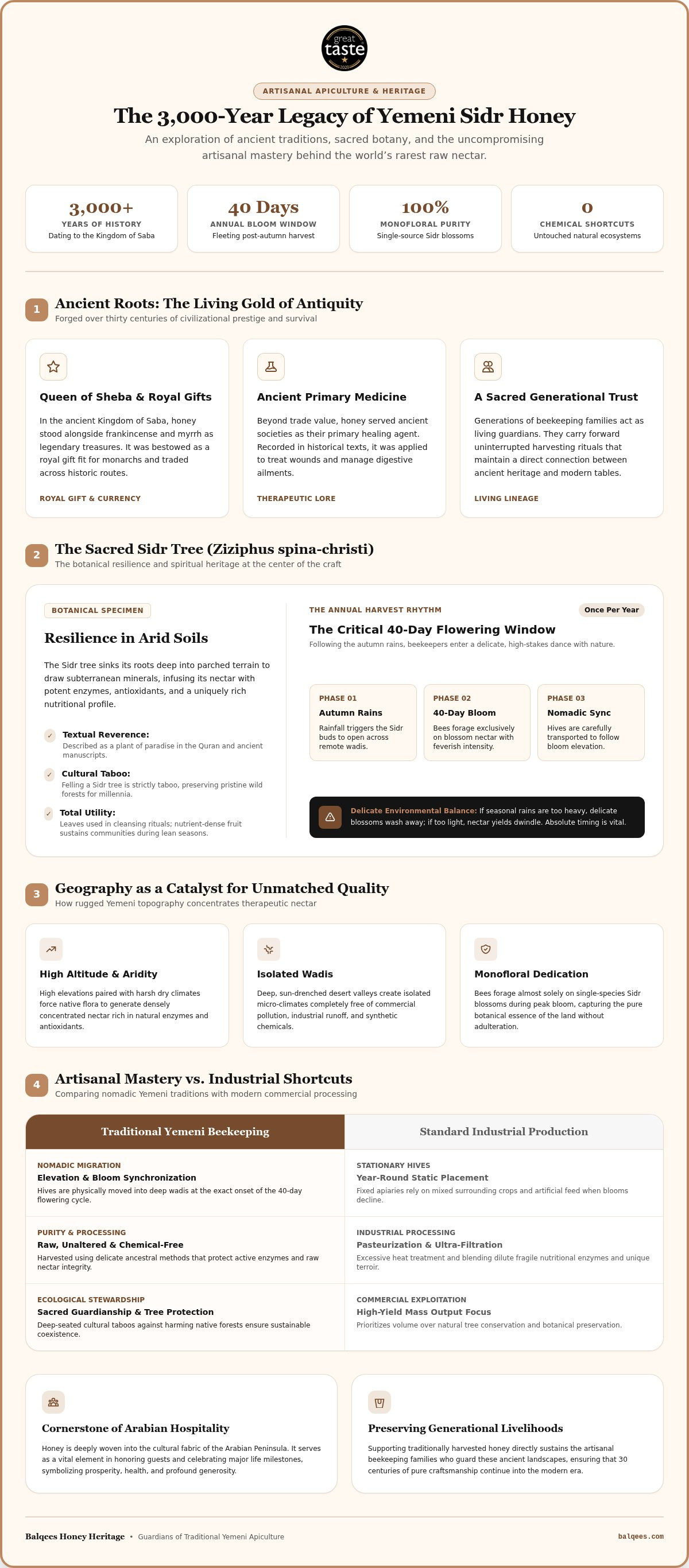
To truly grasp the weight of Yemeni honey heritage, one must travel back through three thousand years of history. This isn't merely a record of agriculture; it's a story of survival, culture, and prestige. In the context of Yemeni history, liquid gold is the shimmering, viscous essence of a landscape that has provided sustenance, wealth, and healing for over thirty centuries. It's a legacy that has survived the rise and fall of civilizations, remaining as pure today as it was in the time of the ancients.
From the Queen of Sheba to the Modern Day
The Kingdom of Saba, ruled by the legendary Queen of Sheba, built its greatness on the riches of the earth. While frankincense and myrrh are often cited as the primary treasures of the ancient trade routes, honey was equally revered. It was a royal gift fit for monarchs and a stable form of currency in bustling marketplaces. Beyond its economic value, it served as the primary medicine for ancient societies, used to treat everything from wounds to digestive ailments.
These traditions didn't fade with the fall of empires. Instead, they were passed down through the ages as a sacred trust. Today's beekeeping families are the living guardians of these methods, maintaining a lineage that connects the modern palate to an ancient world. They don't just harvest a product; they preserve a piece of human history that has remained largely unchanged for millennia.
Geography as a Catalyst for Quality
The secret to this nectar’s world-class status lies in the dramatic Yemeni landscape. It's a mosaic of jagged mountain peaks and deep, sun-drenched valleys known as wadis. This diverse topography creates a distinct terroir that influences the honey's flavor, color, and medicinal properties. High altitudes and a harsh, arid climate force the native flora to produce exceptionally concentrated nectar, rich in enzymes and antioxidants.
In these remote, unpolluted regions, bees forage almost exclusively on specific trees like the Sidr. This dedication to monofloral purity is a hallmark of the Yemeni honey heritage. By following the seasonal bloom across varied elevations, beekeepers ensure the honey remains a pure expression of the land. It's a slow, deliberate process that rejects industrial shortcuts in favor of natural integrity. The result is a nectar untouched by chemicals, capturing the raw soul of the Arabian Peninsula.
The Sacred Sidr Tree: The Heart of the Heritage
The Sidr tree, known botanically as Ziziphus spina-christi, is the silent witness to the Yemeni honey heritage. It thrives where others wither, sinking roots deep into parched earth to find hidden moisture. This resilience isn't just biological; it's a mirror of the Yemeni spirit that has cultivated this land for millennia. The tree stands as a symbol of endurance, providing shade, fruit, and the most coveted nectar in the world. Its ability to flourish in arid climates ensures that the honey produced from its blossoms is incredibly concentrated and potent.
Spiritual significance flows through every branch of the Sidr. It's a tree mentioned in the Quran and ancient manuscripts, often described as a plant of paradise. In local folklore, the Sidr is a protector. To cut one down is often considered a grave taboo, a cultural safeguard that has preserved these forests for centuries. This deep-seated respect ensures that the trees remain untouched by modern expansion, allowing the bees to forage in environments that are as pure as they were thousands of years ago.
A Tree Mentioned in Ancient Texts
Manuscripts dating back centuries highlight the Sidr's role as both food and medicine. Its leaves are used in traditional cleansing rituals, while its fruit sustains local communities during lean seasons. These deep roots don't just provide stability; they pull essential minerals from subterranean layers, infusing the nectar with a complex nutritional profile. This botanical richness is why traditional beekeeping practices in the Arab world continue to center around this specific species. The tree provides the foundation for a craft that is as much about ecology as it is about honey.
The Short, Intense Flowering Season
Nature doesn't wait. The Sidr tree blooms only once a year, typically following the autumn rains. This creates a fleeting 40-day window where the bees must work with feverish intensity. If the rains are too heavy, the blossoms are washed away; if too light, the nectar is sparse. Beekeepers must be perfectly synchronized with this rhythm, moving their hives into the wadis at the exact moment the first buds appear. It's a high-stakes dance with the elements. This delicate balance between rain, bloom, and bee is the heartbeat of the Yemeni honey heritage, producing a nectar that cannot be replicated by industrial means. Experience this rarity for yourself with our Raw Yemeni Sidr Do'ani Honey, which captures the concentrated essence of this sacred season.
Artisanal Mastery: Traditional vs. Industrial Beekeeping
Industrialization prioritizes speed and volume. Artisanal beekeeping prioritizes the bee and the land. The Yemeni honey heritage is defined by a refusal to compromise, even when the slower path is the harder one. While modern honey production often relies on stationary hives and high-heat processing, the Yemeni tradition remains nomadic and raw. This artisanal approach isn't just a method; it's a guardian of the honey's soul, ensuring that what reaches your palate is exactly what nature intended.
The Nomadic Journey of the Beekeepers
Beekeepers in Yemen don't wait for the world to come to them. They are constant travelers. They transport their hives across rugged mountain passes and deep into sun-scorched valleys to find the freshest blossoms at the peak of their nectar production. This requires an intimate knowledge of the land and a mastery of reading weather patterns. This practice is the epitome of sustainable beekeeping honey. By moving the hives, beekeepers prevent over-foraging in a single area and ensure the bees always have access to the most nutrient-dense flora.
The hives themselves are a testament to this history. Traditional 'Jubah' hives, often crafted from hollowed-out tree trunks or clay, differ significantly from the standardized Langstroth frames used in commercial operations. These ancient designs mimic the natural cavities bees seek in the wild. They provide superior insulation against the desert's extreme temperature shifts, keeping the colony healthy without the need for artificial interventions.
The Cold-Pressed Difference
Purity is the ultimate goal of the Yemeni honey heritage. In industrial settings, honey is often heated to speed up filtration and prevent crystallization. This heat is a silent killer of the delicate enzymes, pollens, and complex aromas that define high-end nectar. Traditional Yemeni methods reject this. Artisans hand-press the honey directly from the comb, a methodical process that keeps the product entirely raw and unfiltered.
When comparing raw honey vs commercial honey, the difference is immediate and sensory. Raw honey is alive with texture and a deep, multi-layered fragrance that industrial varieties simply cannot match. It's a difference you can feel as much as taste.
To understand why artisanal Yemeni honey stands alone, consider these three fundamental differences in processing:
- Nomadic vs. Stationary: Artisanal hives follow the seasonal bloom to ensure monofloral purity. Commercial hives are often fixed and may be supplemented with sugar water during lean months.
- Natural vs. Standardized Hives: 'Jubah' log hives offer natural thermal regulation. Industrial wooden boxes are thinner and often require chemical treatments to maintain hive health.
- Hand-Pressed vs. Heat-Filtered: Hand-pressing preserves every vital enzyme and antioxidant. Industrial heating destroys these compounds to ensure the honey remains a clear, consistent liquid on supermarket shelves.
The Cultural Significance and Medicinal Lore
Honey in Yemen is far more than a simple ingredient. It is a social currency, a symbol of honor, and a foundational pillar of Yemeni honey heritage. In a culture where hospitality is a sacred duty, offering a guest a bowl of pure Sidr honey is the ultimate gesture of respect. It signals that the host has spared no effort to provide the very best. This reverence extends into the most intimate family rituals, most notably the 'First Food' tradition. A tiny drop of honey is often the first substance to touch a newborn's tongue, a ritual meant to bless the child with a life of health, wisdom, and sweetness.
This ancient connection to nectar isn't just about ceremony; it's about a deep-seated belief in the earth's power to heal. For generations, Yemeni families have turned to their jars of liquid gold as a primary source of wellness. Whether it's soothing a persistent cough or dressing a minor wound, honey remains the first line of defense. Integrating honey for daily wellness is a practice that bridges the gap between the ancient wadis and the modern home, grounding us in nature's golden rituals.
Honey in the Yemeni Household
In a typical household, premium honey is treated with the same care as a vintage wine or a rare spice. It's often served simply, paired with warm, flaky bread and a touch of clarified butter, allowing the complex floral notes to shine. Sidr honey, in particular, is the crown jewel of the heritage medicine cabinet. It's rarely seen as a mere sweetener. Instead, it's a potent tonic kept for moments when the body needs restoration. The etiquette of serving it is precise; it's presented in beautiful glass or ceramic bowls, never with a metal spoon, to preserve its delicate enzymatic integrity.
The Science of Ancestral Wisdom
While the ancestors relied on intuition and observation, modern science is finally catching up to the truths of the Yemeni honey heritage. Research into the 'Do'ani' honey from the Hadramaut region reveals extraordinary levels of antioxidants and non-peroxide antibacterial activity. These properties are often compared to, and sometimes exceed, those of other world-famous medicinal honeys. It isn't just Sidr that carries this weight; varieties like white mountain honey benefits show how different altitudes and floral sources contribute to a diverse spectrum of healing. This peak of heritage honey is a testament to the land's unique chemistry, offering a natural potency that industrial products simply cannot replicate.
Discover the prestige and potency of our Raw Yemeni Sidr Do'ani Honey and bring a piece of this ancient legacy into your home.
Preserving the Legacy: Balqees and the Future of Heritage
Preserving a 3,000-year-old tradition requires more than just appreciation. It demands active guardianship. At Balqees, we view ourselves as more than retailers; we're storytellers and protectors of the Yemeni honey heritage. Our mission is to bridge the gap between the remote wadis of Yemen and the modern connoisseur, ensuring that these rare nectars don't become relics of the past. By bringing rare honey varieties to the global stage, we provide a sustainable path forward for a craft that has remained largely unchanged for millennia. Every jar we share is a testament to the endurance of the land and the people who tend it.
Ethical Sourcing as Heritage Protection
Heritage protection starts at the source. We maintain direct, personal relationships with artisanal beekeeping families, bypassing industrial middlemen who often dilute the story and the product. This direct connection allows us to guarantee the absolute purity of every harvest. We employ rigorous testing to combat honey fraud, a growing global challenge that threatens the integrity of the Yemeni name. For us, fair trade isn't just a corporate buzzword. It's the only way to ensure that traditional skills are valued, providing beekeepers with the stability they need to pass their mastery down to the next generation.
By prioritizing ethical sourcing, we protect the sacred landscapes where the Sidr tree thrives. We believe that transparency is the ultimate tool for preservation. When you know exactly where your honey comes from, you're not just a consumer; you're a witness to a specialized craft that respects the natural rhythm of the earth.
A Modern Tribute to Ancient Gold
While we look back with reverence, we also look forward with innovation. Our Raw Yemeni Sidr Do'ani Honey stands as our flagship, a pure expression of the Hadramaut region's botanical wealth. But we also believe that tradition can evolve to meet the needs of a modern lifestyle. Functional blends like our Black Seed Fusion take ancient ingredients and combine them for contemporary wellness, creating rituals that honor the past while serving the present. Every purchase is an act of preservation. When you choose artisanal quality, you aren't just buying a product. You're becoming an active participant in the Yemeni honey heritage, helping to sustain the traditions that have defined the Arabian Peninsula for centuries.
Ancient traditions are fragile. They require a dedicated community to survive. As a connoisseur, your role is vital. By seeking out authenticity and understanding the labor behind the jar, you help protect a way of life that values quality over quantity. Explore the full range of heritage nectars on the Balqees website and discover the difference that 3,000 years of mastery makes.
Embrace the Golden Legacy of Yemen
The 3,000-year journey of Yemeni honey heritage is more than a history lesson. It's a living testament to a land that refuses to compromise on quality. By understanding the nomadic rhythms of the beekeepers and the sacred nature of the Sidr tree, you move from being a consumer to a true connoisseur. You now recognize that the true value of this nectar lies in its raw, unfiltered state; it's untouched by the heat and industrial speed that often strips away nature's soul.
Founded by heritage expert Riath Hamed, Balqees Honey acts as a bridge between these ancient wadis and your modern wellness ritual. We prioritize direct sourcing from artisanal beekeepers to ensure every drop reflects its storied origin. With every batch lab-tested for 100% purity, you can feel confident in the integrity and potency of what you bring into your home. This commitment to transparency ensures that the traditions of the past remain vibrant today.
Experience the legacy: Shop the Raw Yemeni Sidr Do'ani Honey collection. Your appreciation and support keep this extraordinary craft alive for the next generation, ensuring the story of the world's rarest nectar continues to be told.
Frequently Asked Questions
What makes Yemeni honey heritage different from Manuka honey?
Yemeni honey differs from Manuka primarily in its chemical profile and historical origin. While Manuka is celebrated for its methylglyoxal content, Yemeni varieties like Sidr rely on high levels of non-peroxide activity and antioxidants. The Yemeni honey heritage is rooted in a 3,000-year-old artisanal method that rejects industrial heat. This preserves delicate enzymes that are often lost in mass-produced alternatives. It's a choice between a modern clinical standard and an ancient, living tradition of purity.
Why is Yemeni Sidr honey often called 'liquid gold'?
The term 'liquid gold' isn't just a marketing phrase; it's a historical reality. For centuries, this nectar served as a stable currency in trade and a prestigious gift for monarchs. Its thick, amber consistency and the extreme difficulty of its harvest in rugged wadis justify the name. Beyond its value, it represents the concentrated essence of a landscape that has provided healing and wealth to the Arabian Peninsula for three millennia.
How has the 3,000-year beekeeping tradition in Yemen survived?
This tradition has survived through an unbroken chain of family-led mentorship. Beekeeping in Yemen isn't a job; it's a sacred trust passed from father to son. The rugged, isolated terrain of the mountains and valleys has acted as a natural shield against industrialization. By maintaining a nomadic lifestyle, these families ensure that their bees remain healthy and connected to the wild, untouched flora that defined the region’s ancient history.
Is all Yemeni honey harvested using traditional methods?
Not all honey labeled as 'Yemeni' is created equal. While industrial methods have entered the region, authentic Yemeni honey heritage is preserved by artisans who refuse shortcuts. These beekeepers use traditional 'Jubah' hives and hand-press the honey to avoid the damage caused by centrifugal heat. At Balqees, we exclusively partner with these dedicated families. This ensures every jar we offer remains raw, unfiltered, and true to its ancestral roots.
What is the cultural significance of the Sidr tree in Yemen?
The Sidr tree is a pillar of regional identity and spiritual life. Mentioned in sacred manuscripts and ancient folklore, it's considered a plant of paradise with immense protective qualities. Cultural taboos against cutting these trees have acted as an informal conservation system for centuries. Its deep roots pull minerals from the earth, which the bees then concentrate into a nectar that is as much a medicine as it is a food.
How can I identify authentic heritage honey from Yemen?
Identifying authentic honey requires looking beyond the label for transparency and proof. Real Yemeni honey possesses a distinct, pungent aroma and a complex flavor profile that lingers on the palate. It shouldn't have the uniform clarity of supermarket syrups. We recommend choosing brands like Balqees that prioritize direct sourcing and rigorous lab testing. This ensures your honey is 100% pure and free from the additives often found in fraudulent products.
Why does the price of Yemeni honey reflect its heritage and rarity?
The price reflects the immense labor and scarcity involved in the harvest. The Sidr tree blooms for only 40 days each year, and beekeepers must transport hives across dangerous terrain to reach these blossoms. Yields are naturally low because we don't use industrial additives or sugar feeding to boost production. When you purchase this honey, you're investing in the survival of a specialized craft and the livelihoods of those who protect it.
Does Balqees support sustainable beekeeping in Yemen?
Sustainability is the foundation of our business model at Balqees. By maintaining direct relationships with beekeeping families, we ensure they receive a fair price for their mastery. This economic stability allows them to continue using traditional, bee-friendly methods rather than switching to high-yield industrial practices. We don't just sell honey; we act as a bridge that supports the ecological health of the wadis and the cultural longevity of the region.


