


Why does a single jar of honey command the same price as a fine vintage wine? If you've ever felt hesitant about the cost of premium nectar or worried about whether what you're buying is truly pure, you aren't alone. The global market is often clouded by industrial shortcuts and heat-treated imitations that strip away the very essence of the bee's work. You deserve to know exactly what goes into the bottle. Understanding the traditional Sidr honey harvesting methods is the only way to truly distinguish a generic sweetener from a legendary medicinal treasure.
We invite you to step into the rugged landscapes of Yemen, where time seems to stand still. You'll discover the ancient, meticulous techniques used to harvest the world’s most precious honey while preserving its rare medicinal properties. We explore the artisanal journey from the sacred Sidr tree to your jar, revealing how beekeepers protect the heritage of their craft. By the end, you'll see that the price isn't just for the honey; it's for a centuries-old promise of purity and the sensory experience of a world untouched.
Key Takeaways
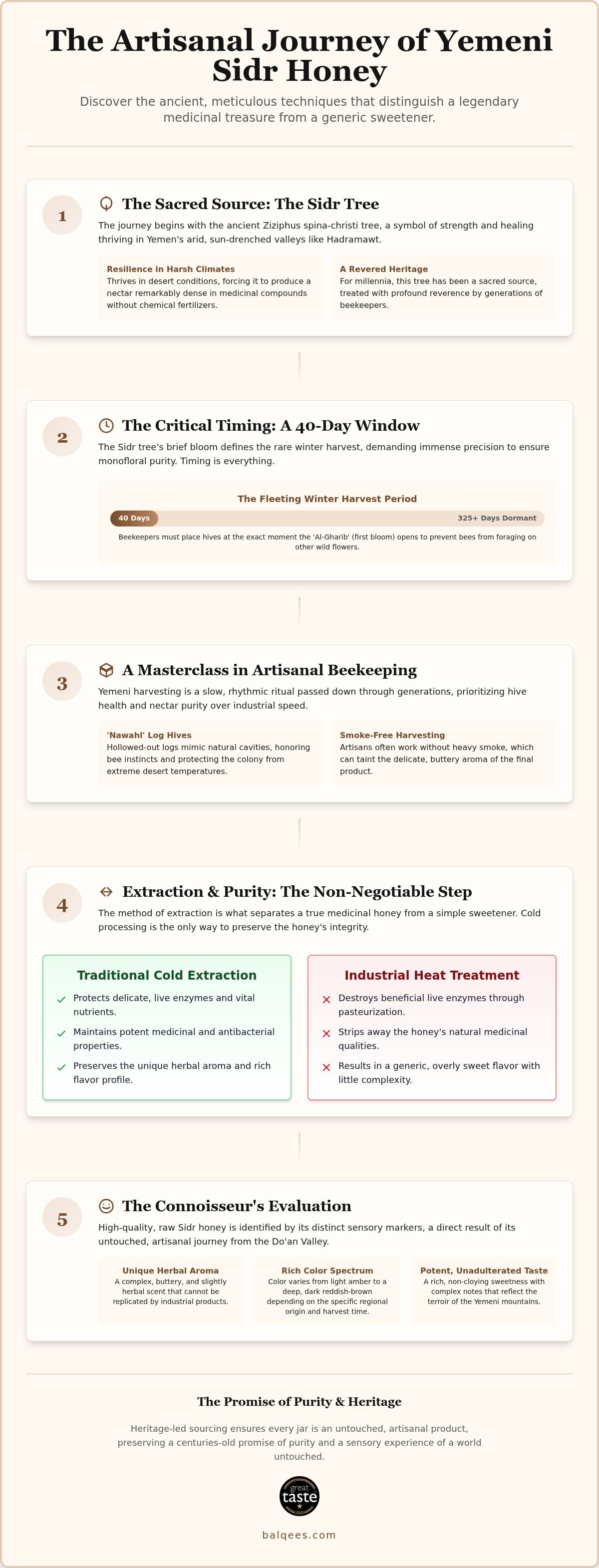
- Learn how the brief 40-day bloom of the Ziziphus spina-christi tree dictates the narrow window for the world's most precious winter harvest.
- Explore traditional Sidr honey harvesting methods like the use of hollowed 'Nawahl' log hives that maintain the purity of the nectar without disturbing the bees.
- Understand the non-negotiable role of cold extraction in protecting the honey's delicate live enzymes and potent medicinal properties from heat damage.
- Gain the expertise to identify high-quality raw honey through its unique herbal aroma and rich color spectrum; this varies by its specific regional origin.
- See how heritage-led sourcing in the Do'an valley ensures your honey remains an untouched, artisanal product rather than an industrial commodity.
The Sacred Timing: When and Where Sidr Honey Begins
The journey of honey starts long before the bee takes flight. It begins with the roots of the ancient Sidr tree, a species that has commanded respect across the Middle East for millennia. In the rugged, sun-drenched valleys of Hadramawt, these trees stand as silent guardians of a tradition that refuses to be rushed. This isn't industrial farming; it's a partnership with a landscape that demands patience. The arid, mountainous terrain of Yemen provides the perfect crucible, forcing the tree to concentrate its life force into a nectar that is remarkably dense and potent.
The Resilience of the Sidr Tree
These trees are survivors. They thrive in desert conditions where little else can endure, drawing nutrients from deep within the earth without the need for chemical fertilizers or human interference. This struggle against the elements is precisely what makes the honey so valuable. When a plant faces harsh climates, it produces higher concentrations of secondary metabolites, which translates directly into the medicinal compounds found in the nectar. For generations, the Sidr tree has been a symbol of strength and healing, a sacred source that beekeepers treat with profound reverence.
The Critical 40-Day Harvest Window
Timing is everything. The Sidr tree blooms for a fleeting period of roughly 40 days during the winter months. This narrow window defines the rare winter harvest and requires immense precision from the beekeeper. To ensure the bees forage exclusively on Sidr blossoms, maintaining the monofloral purity of the honey, the hives must be placed at the exact moment the flowers open. Traditional Sidr honey harvesting methods rely on the 'Al-Gharib', the very first bloom of the season. This initial flowering sets the standard for the entire harvest, signaling to the beekeepers that the nectar is at its peak.
Weather patterns in late autumn play a decisive role. A sudden shift in humidity or an unexpected rain can alter the honey's final moisture content, potentially changing its texture and shelf life. Beekeepers perform a silent ritual of monitoring the buds, waiting for the landscape to signal readiness. It's a high-stakes game of observation. If the hives are placed too early or too late, the bees might wander to wild flowers, diluting the unique profile of the Sidr. This level of dedication to traditional Sidr honey harvesting methods ensures that every drop of honey captured during this brief window carries the authentic, unadulterated soul of the valley.
Traditional Yemeni Harvesting: A Masterclass in Artisanal Beekeeping
In the quiet valleys of Yemen, the harvest isn't a mechanical operation; it's a slow, rhythmic ritual. While much of the world has moved toward industrial, movable frames, the most dedicated keepers of the craft still rely on the 'Nawahl'. These are hollowed-out logs that mimic the natural cavities where wild bees prefer to settle. By using these traditional structures, beekeepers honor the bee's natural instincts, creating a stable and insulated environment that protects the colony from the desert's temperature swings. It's a fundamental part of Sidr honey harvesting methods that prioritizes the health of the hive over the speed of production.
Purity is protected through silence and care. Unlike commercial operations that use heavy smoke to sedate the bees, artisanal harvesters in Yemen often work without it. They've learned that smoke can permeate the wax and taint the delicate, buttery aroma of the Sidr nectar. This dedication to traditional Yemeni honey harvesting ensures the final product remains as the bees intended, untouched by external scents or chemical residues. It's a masterclass in patience, requiring a deep understanding of bee behavior to collect the liquid gold without causing distress to the tireless workers of the hive.
The Nomadic Life of the Yemeni Beekeeper
The industry in Yemen is powered by over 100,000 beekeepers who lead a nomadic existence. They don't wait for the world to come to them; they follow the bloom. As the Sidr trees begin their 40-day flowering cycle in different regions, families pack their hives onto trucks to navigate the rugged, mountainous terrain. This isn't just logistics. It's a deep-rooted bond between the keeper and the 'tireless ambassadors' of the hive. This traditional knowledge is passed down through generations, ensuring that the migration patterns are timed perfectly with the landscape's natural clock. Experiencing the result of this labor is a sensory journey in itself, best captured in our Raw Yemeni Sidr Do'ani Honey.
Step-by-Step: The Manual Collection Process
When the time is right, the collection begins by hand. The process is meticulous:
- Gentle Removal: Beekeepers carefully remove the honeycomb from the Nawahl, using steady movements to ensure no bees are harmed.
- Manual Separation: Hand-tools are used to separate the wax from the honey. This avoids the high-speed centrifugal force used in factories, which can inadvertently heat the honey and degrade its enzymes.
- On-Site Care: Initial processing happens immediately on-site. This prevents fermentation and ensures the honey is sealed at its peak freshness, preserving the high Diastase levels that mark its quality.
By sticking to these manual Sidr honey harvesting methods, the beekeeper ensures that every jar remains a living product, filled with the antioxidants and enzymes that define true medicinal honey.
Extraction and Purity: Why Cold Processing is Non-Negotiable
The term 'raw' is frequently used as a marketing buzzword, but in the world of artisanal beekeeping, it represents a non-negotiable standard of purity. True raw honey is a living substance. It remains unheated, unfiltered, and entirely untouched by industrial machinery from the moment it leaves the hive. This commitment to minimal intervention is what separates a medicinal treasure from a generic supermarket sweetener. While the previous stages of our Sidr honey harvesting methods focus on the environment and the hive, the extraction process is where the honey’s biological integrity is either protected or destroyed.
The Science of Heat and Honey
Heat is a thief. It quietly steals the volatile aromatic compounds that give Sidr honey its legendary herbal depth, leaving behind a product that is chemically altered and biologically diminished. When honey is flash-heated during industrial pasteurization, the delicate diastase enzymes, which are responsible for many of honey's health benefits, begin to break down at temperatures above 40°C. This thermal stress doesn't just kill the enzymes; it alters the molecular structure of the sugars. HMF (Hydroxymethylfurfural) acts as a definitive chemical marker of heat damage; its presence signals that the honey’s integrity has been compromised by high temperatures or improper storage. By adhering to cold processing, we ensure these vital elements remain exactly as the bees created them.
Traditional vs. Industrial Extraction
The method of moving honey from the comb to the jar dictates its final character. Industrial operations rely on high-speed centrifugal force, which can introduce excessive oxygen and friction-based heat. In contrast, traditional Sidr honey harvesting methods favor manual pressing or gravity-fed straining. This slower pace preserves the honey’s natural viscosity and complex textures. You can see and feel the difference in every spoonful:
- Texture: Raw honey is thick, creamy, and rich, whereas heat-treated honey often feels thin and watery.
- Composition: Minimal filtration allows microscopic particles of pollen and propolis to remain. These are the "soul" of the honey, providing additional antioxidants and immune-boosting properties.
- Crystallization: Raw honey will naturally crystallize over time. While some consumers mistake this for spoilage, it's actually a hallmark of untouched purity and a sign that the honey’s natural sugars haven't been processed into a dead syrup.
Choosing cold-extracted honey means choosing a product that still breathes with the life of the Hadramawt valleys. It's a commitment to a sensory experience that hasn't been stripped of its essence for the sake of shelf-stability or industrial convenience.
The Connoisseur’s Evaluation: Sensory Markers of a Traditional Harvest
To the untrained eye, honey is simply a golden liquid. To the connoisseur, it is a map of a landscape and a record of a season. The distinct character of the final product is a direct reflection of the artisanal Sidr honey harvesting methods employed in the mountains of Yemen. When you open a jar of authentic Sidr, you aren't just smelling a sweetener. You're encountering a concentrated essence of the Ziziphus spina-christi bloom. The aroma is unmistakable; it is deeply herbal with a surprising, buttery undertone that lingers in the air. This complexity is only possible because the honey remains untouched by industrial heat, which would otherwise evaporate these volatile aromatic compounds.
The texture provides the next clue to its origin. High-quality Sidr honey is famous for its 'cloying' nature, a term used by enthusiasts to describe its incredible density and low water content. Because the Yemeni climate is so arid, the bees produce a honey that is naturally thick. It shouldn't feel watery or thin on the tongue. Instead, it should coat the palate with a rich, velvety weight. As you swallow, look for the signature finish. A slightly peppery tingle at the back of the throat is the hallmark of a potent, medicinal harvest, signaling a high concentration of the phytochemicals that make this honey world-renowned.
The Visual and Aromatic Profile
Visual inspection is your first line of defense against adulteration. Hold your jar up to a natural light source. You should see a gentle cloudiness rather than a crystal-clear transparency. This haze is a beautiful sign of life; it indicates the presence of suspended pollen grains and propolis that haven't been stripped away by fine-mesh industrial filters. For those looking for a deeper dive into these nuances, our guide on Identifying High Quality Raw Honey offers a comprehensive roadmap for the discerning buyer.
You can also perform the 'string test' at home. Dip a spoon into the jar and lift it slowly. Pure Sidr honey, harvested through traditional Sidr honey harvesting methods, should flow in a continuous, unbroken thread without snapping. If the stream breaks into individual droplets quickly, it may indicate a high moisture content or the addition of syrups. The color spectrum is equally telling. Depending on the specific region and soil composition, the hue can range from a bright golden amber to a deep, regal dark red. These variations are natural and speak to the biodiversity of the Yemeni valleys.
The Taste of Heritage
The flavor of Sidr honey is a multi-layered experience. It moves far beyond simple sweetness. The mineral-rich soil of the Do'an valley imparts a grounded, earthy quality to the nectar that you won't find in honey from other regions. To truly appreciate these nuances, we recommend a simple tasting ritual. Take a small spoonful and let it sit on your tongue for a few seconds before swallowing. Breathe in through your nose to allow the retronasal aromas to develop. You'll likely detect notes of sun-warmed wood, dried herbs, and that fleeting peppery spark. It's a taste of heritage that has remained unchanged for centuries.
Ready to experience the pinnacle of Yemeni craftsmanship? You can find this untouched purity in our signature Raw Yemeni Sidr Do'ani Honey, sourced directly from the masters of the craft.
The Balqees Promise: Protecting the Integrity of the Harvest
At Balqees, we view ourselves as more than just a purveyor of fine foods. We're guardians of a legacy. The intricate Sidr honey harvesting methods we've explored aren't just historical footnotes; they're the lifeblood of a culture that values purity above all else. Our role is to act as a bridge, connecting the ancient wisdom of the Hadramawt mountains with the needs of a modern, health-conscious lifestyle. We don't just source honey. We curate a sensory experience that respects the rhythm of the natural world.
Our commitment begins with a direct, personal partnership with artisanal beekeepers in the Do'an valley. This isn't a transactional relationship. It's a shared mission to ensure every jar of Raw Yemeni Sidr Do'ani Honey meets ancestral standards that have remained unchanged for centuries. By championing sustainable beekeeping honey, we protect the unique Yemeni bee and the fragile ecosystems it inhabits, ensuring this liquid gold survives for future generations.
From Yemen to the UAE: A Transparent Journey
Transparency is the foundation of trust. The journey from a remote Yemeni valley to our shelves in the UAE is handled with obsessive care. We perform rigorous quality checks at every stage, verifying that the honey remains exactly as it was when it left the comb. Maintaining a strict cold chain is vital. We ensure that the ambient temperature never rises to a level that would compromise the raw state of the nectar. By focusing on small-batch sourcing, we avoid the pitfalls of mass production, allowing us to maintain a level of quality that industrial suppliers simply cannot match.
Supporting the Artisans
The survival of these traditional Sidr honey harvesting methods depends entirely on the people who practice them. Paying fair, premium prices to our beekeepers isn't just a matter of ethics; it's essential for the survival of the craft. When the artisan is respected and fairly compensated, the tradition thrives. We take pride in sharing the stories of these dedicated families, bringing you closer to the source of your well-being. We invite you to explore our collection of rare honey varieties, each one a testament to the diversity of nature and the skill of the human hand.
Embrace the Legacy of the Sidr Harvest
True Sidr honey is more than a product; it's a testament to a landscape that refuses to be tamed. We've seen how the brief flowering of the Ziziphus spina-christi tree and the nomadic dedication of Yemeni beekeepers create something entirely unique. By choosing honey that honors traditional Sidr honey harvesting methods, you're protecting a biological treasure that remains unheated, unfiltered, and alive with enzymes. This isn't just about taste. It's about the integrity of a craft that has survived for millennia.
Since 2013, Balqees has been dedicated to preserving this Yemeni artisanal heritage. Every jar we offer is sourced directly from the Do'an valley, ensuring you receive 100% Raw and Unfiltered nectar that meets the highest standards of purity. It's time to bring this ancient wellness ritual into your own home and experience the difference that true craftsmanship makes. Experience the Purity of Artisanal Sidr Honey and join us in celebrating a tradition that tastes as profound as the history it carries. Your journey into the world of authentic, untouched honey is just beginning.
Frequently Asked Questions
Why is Sidr honey harvested only once or twice a year?
Sidr honey is harvested only once or twice a year because it depends entirely on the brief blooming period of the Ziziphus spina-christi tree. The primary winter harvest occurs during a narrow 40-day window in late autumn. Since the trees don't bloom year-round, beekeepers must wait for nature's specific timing. This scarcity is a hallmark of authentic Sidr honey harvesting methods, ensuring the nectar is monofloral and potent.
What is the difference between traditional and commercial honey harvesting?
Traditional harvesting relies on hollowed-out logs called 'Nawahl' and manual labor, whereas commercial harvesting uses standardized movable frames and mechanical extractors. Commercial methods often prioritize speed and volume, frequently involving flash-heating to prevent crystallization. Traditional practices in Yemen focus on preserving the honey's raw state, using gravity or light manual pressing to keep the delicate enzymes and aromatic compounds intact.
Is Sidr honey really harvested by hand in Yemen?
Yes, authentic Yemeni Sidr honey is still harvested by hand by over 100,000 artisanal beekeepers. These craftsmen navigate the rugged terrain of valleys like Do'an without the help of industrial machinery. They manually remove the combs and separate the honey using traditional tools. This labor-intensive process ensures that the bees aren't distressed and the honey remains untouched by the metallic taste or heat of factory equipment.
Does the harvesting method affect the medicinal benefits of the honey?
The harvesting method is critical to the medicinal value of the honey. Flash-heating or high-speed filtration, common in industrial settings, can destroy heat-sensitive antioxidants and live enzymes like diastase. By sticking to traditional Sidr honey harvesting methods, beekeepers ensure the honey remains 'living'. This cold extraction keeps the natural propolis and pollen grains present, which are essential for the honey's immune-boosting properties.
Why is Yemeni Sidr honey more expensive than other varieties?
The high price reflects the extreme rarity and the intense manual labor involved in its production. With a blooming window of only 40 days and a harvest that is entirely manual, the yield is significantly lower than industrial honey. Additionally, the logistical challenges of transporting hives across the mountainous Hadramawt region contribute to the cost. You're paying for a medicinal grade product that cannot be replicated by factory methods.
How can I tell if my Sidr honey was harvested using traditional methods?
You can identify traditionally harvested honey by its sensory profile. Look for a natural cloudiness, which indicates that beneficial pollen hasn't been stripped away by fine filtration. The texture should be thick and 'cloying' rather than thin or runny. Finally, the aroma should be complex and herbal; industrial honey often loses these volatile scents due to the heat used during the bottling process.
What does 'cold-pressed' or 'cold-extracted' mean for Sidr honey?
'Cold-extracted' means the honey was never heated above the natural temperature of the beehive, which is roughly 35 to 40°C. This is vital for Sidr honey because its most precious compounds are highly sensitive to thermal damage. By avoiding pasteurization, the honey retains its full spectrum of vitamins and minerals. It remains a raw, biological substance rather than a processed sugar syrup, preserving the 'soul' of the Sidr bloom.
Are the beekeeping practices used for Sidr honey sustainable?
Traditional Yemeni beekeeping is inherently sustainable because it follows the natural rhythms of the earth. Beekeepers move their hives to follow the blossoms, preventing over-foraging in a single area. They use natural log hives that provide superior insulation and don't rely on chemical fertilizers or pesticides. This ancient craft supports local biodiversity and ensures that the Yemeni bee colonies remain healthy and resilient for future generations.


